
Email remains the primary entry point for cyberattacks. Phishing, business email compromise (BEC), ransomware delivery, and data exfiltration frequently originate in the inbox.
For CISOs and IT leaders, Email Security Best Practices are no longer just technical controls. They are governance decisions that directly impact financial risk, regulatory posture, and operational continuity.
This guide outlines what works in real-world enterprise environments and how to implement it strategically.
We have also created an in-depth Email Security Guide to dive deeper into the topic of email security.
What Are Email Security Best Practices?
When executives ask, “What are email security best practices?” the answer extends far beyond deploying a spam filter or enabling default cloud protections. Email security best practices in cyber security represent a structured, risk-based strategy designed to protect business operations, sensitive data, executive communications, and customer trust.
A mature approach combines multiple layers of protection working together:
- Technical controls such as secure email gateways, advanced phishing detection, sandboxing, encryption, and data loss prevention.
- Identity protection through multi-factor authentication (MFA), conditional access policies, and protection against account takeover and impersonation.
- Employee awareness programs that reduce human risk through targeted training and phishing simulations.
- Monitoring and response capabilities integrated with SOC workflows to detect, investigate, and remediate threats quickly.
- Governance and compliance enforcement to ensure email policies align with regulatory, legal, and audit requirements.
In practical terms, email security best practices are about reducing financial exposure, preventing business disruption, and strengthening regulatory posture. The objective is not simply to block malicious messages, but to manage email as a critical business risk vector with measurable controls and continuous oversight.
Core Email Security Best Practices for Enterprises

(1) Implement a Layered Email Security Architecture
Relying on a single gateway is insufficient. A modern architecture should include:
- Secure email gateway filtering
- API-based inbox protection
- Advanced malware sandboxing
- URL rewriting and time-of-click protection
- Outbound scanning and DLP
Example:
An organization that deploys both gateway filtering and API-based protection significantly reduces the risk of delayed payload attacks that bypass traditional filters.
For deeper architectural insight, refer to our internal resource: Email Security Tools.
(2) Enforce Strong Email Authentication (SPF, DKIM, DMARC)
Email spoofing drives BEC attacks. Authentication protocols help prevent domain impersonation.
Best practices include:
- Publishing SPF records
- Enabling DKIM signing
- Enforcing DMARC policies at “quarantine” or “reject”
- Monitoring DMARC reports for abuse patterns
This reduces brand impersonation and protects external stakeholders.
(3) Prioritize Identity and Access Controls
Compromised accounts are often more damaging than external phishing attempts.
Key measures:
- Mandatory multi-factor authentication (MFA)
- Conditional access policies
- Least privilege mailbox permissions
- Monitoring login anomalies
Example:
A compromised executive mailbox can lead to wire fraud within hours. Conditional access policies reduce that exposure.
(4) Deploy Advanced Phishing and BEC Detection
Traditional spam filtering is insufficient against socially engineered attacks.
Modern controls should detect:
- Display name spoofing
- Domain lookalike attacks
- AI-generated phishing content
- Internal-to-internal impersonation
AI-driven behavioral analysis helps flag anomalies beyond static signature detection.
(5) Strengthen Outbound Email Controls
Email security is not only about inbound threats.
Outbound controls prevent:
- Data leakage
- Accidental sharing of sensitive information
- Malware propagation from infected endpoints
This includes:
- Data Loss Prevention (DLP) policies
- Encryption enforcement
- Content inspection rules
Outbound scanning protects reputation and regulatory standing.
(6) Integrate Email Security with SOC Operations
Email alerts should feed into centralized monitoring.
Best practice integration includes:
- SIEM connectivity
- SOAR automation for phishing response
- Automated mailbox remediation
- Incident trend reporting
Business Impact:
Faster containment reduces dwell time and minimizes lateral movement.
(7) Conduct Continuous Phishing Simulations and Awareness Training
Technology alone does not eliminate risk.
Security awareness programs should:
- Run controlled phishing simulations
- Track user reporting behavior
- Provide targeted micro-training
- Measure improvement over time
Metrics such as “phish reporting rate” provide measurable risk indicators for leadership dashboards.
(8) Ensure Business Continuity and Resilience
Email downtime can halt operations.
Consider:
- Continuity solutions during cloud outages
- Email backup and archiving
- Recovery planning for ransomware scenarios
Resilience planning prevents communication paralysis during incidents.
(9) Establish Clear Governance and Compliance Controls
Email is often subject to:
- GDPR
- HIPAA
- PCI-DSS
- Industry-specific mandates
Governance best practices include:
- Retention policies
- Archiving standards
- Audit logging
- eDiscovery readiness
Organizations evaluating platforms should implement trusted Email Security Solutions for alignment with regulatory requirements.
Strategic Implementation Framework
Enterprise leaders should approach email security in three stages:
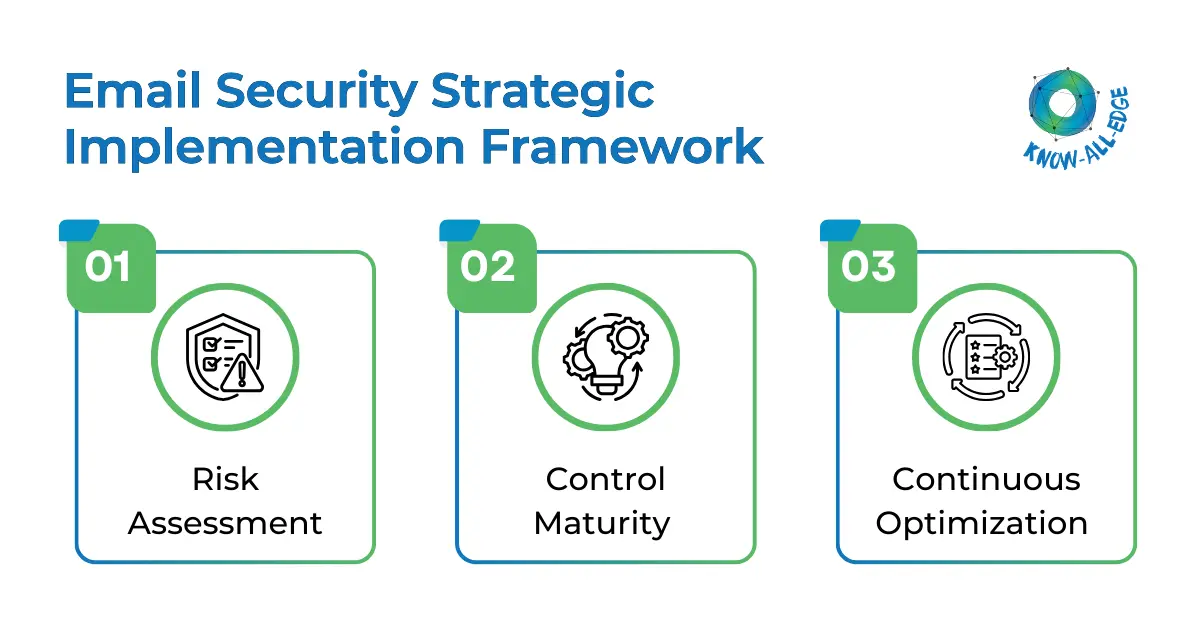
Phase 1: Risk Assessment
- Identify attack exposure
- Analyze historical phishing incidents
- Assess authentication gaps
Phase 2: Control Maturity
- Implement layered protection
- Enforce identity safeguards
- Integrate monitoring
Phase 3: Continuous Optimization
- Review incident metrics
- Update policies quarterly
- Align with evolving threat intelligence
This maturity model ensures email security evolves alongside business growth.
Common Pitfalls to Avoid
- Overreliance on default Microsoft 365 or Google Workspace protections
- Neglecting outbound scanning
- Failing to enforce DMARC policies
- Treating awareness training as a one-time exercise
- Ignoring executive impersonation risk
Each of these gaps has led to documented enterprise breaches.
How We Help
We help enterprises assess, design, and optimize email security architectures aligned to business risk and regulatory obligations. Our approach includes:
- Current-state risk assessment
- Architecture design and tool evaluation
- Implementation support
- Policy and governance alignment
- Continuous optimization reviews
Our role is vendor neutral. We focus on building sustainable protection models tailored to your infrastructure, compliance landscape, and operational maturity.
Conclusion
Email remains the most exploited communication channel in enterprise environments. Implementing structured Email Security Best Practices reduces financial exposure, protects brand reputation, and strengthens operational resilience.
Security maturity is not defined by a single product, it is defined by layered controls, disciplined governance, and continuous improvement.
If you are looking for a partner to implement email security best practices, contact us today. We provide email to help you do just that.
FAQs: Email Security Best Practices
What are email security best practices for large enterprises?
They include layered technical controls, strong authentication protocols, identity protection, SOC integration, continuous training, and governance alignment.
How often should email security controls be reviewed?
At minimum quarterly. Threat patterns evolve rapidly, and policy updates should reflect changing attack methods.
Are native cloud email protections enough?
Default protections provide baseline coverage. Most enterprises implement additional layers to address targeted phishing and BEC risks.
What metrics should CISOs track?
- Phishing click rate
- Phish reporting rate
- DMARC enforcement status
- Mean time to remediate malicious emails
- Number of compromised accounts
How do Email Security Best Practices support compliance?
They enforce data protection, retention controls, encryption standards, and audit readiness—reducing regulatory exposure.