
As organizations modernize their security architecture, two terms increasingly come up in strategic discussions: SASE and ZTNA. For many CISOs and IT leaders, the confusion isn’t whether these technologies are important. Rather it’s how they relate to each other.
Common questions include:
- Is ZTNA replacing SASE or part of it?
- Do we need both, or can one solve our access challenges?
- Where does ZTNA fit in with a broader SASE strategy?
The reality is that SASE vs ZTNA is not a direct comparison but a relationship.
ZTNA is a critical component of SASE, but SASE is a much broader architectural model that combines networking and security into a unified platform.
What is SASE?
Secure Access Service Edge (SASE) is a cloud-delivered architecture that combines networking and security services into a single platform. Instead of routing traffic through traditional data centers, SASE delivers security closer to the user, regardless of location.
A typical SASE framework includes:
- Secure Web Gateway (SWG)
- Cloud Access Security Broker (CASB)
- Firewall-as-a-Service (FWaaS)
- Zero Trust Network Access (ZTNA)
SASE is designed to provide:
- Secure internet access
- Secure application access
- Consistent policy enforcement
- Scalable, cloud-native security
In simple terms, SASE is overall architecture, not a single technology.
What is ZTNA?
Zero Trust Network Access (ZTNA) is a security model that provides identity-based access to applications without exposing the underlying network. Instead of connecting users to the network, ZTNA connects users directly to specific applications based on identity, device posture, and policy.
ZTNA focuses on:
- Application-level access
- Identity-driven authentication
- Continuous verification
- Least-privilege access
If you’re exploring how this works at a technical level, our guide on ZTNA architecture breaks down how identity, policy, and secure access brokers interact.
Key Differences Between SASE and ZTNA
When comparing SASE vs ZTNA, the most important distinction is scope.
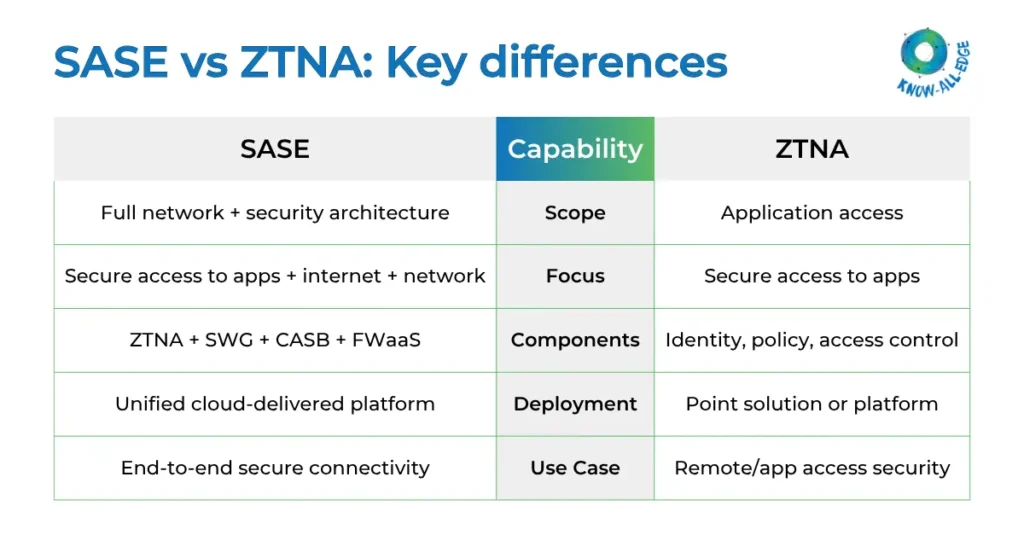
ZTNA solves a specific problem: secure application access.
SASE solves a broader problem: secure access to everything (applications, internet, and networks) from anywhere.
Role of ZTNA in SASE
To understand the role of ZTNA in SASE or how ZTNA fits inside SASE, think of ZTNA as one layer within a larger security stack.
Within SASE architecture:
- ZTNA secures access to internal applications
- SWG secures web browsing and internet traffic
- CASB protects SaaS usage
- FWaaS enforces network-level security policies
ZTNA is responsible for ensuring that users can access applications securely without exposing the network. SASE extends this by securing all other traffic types as well.
This is why organizations adopting SASE almost always include ZTNA as a core component.
SASE vs ZTNA: Who improves security in better way?
Both SASE and ZTNA improve security in different ways.
ZTNA Security Benefits
- Eliminates network-level exposure
- Reduces lateral movement risk
- Enforces identity-based access
- Provides granular application control
SASE Security Benefits
- Consolidates multiple security tools
- Applies consistent policies across environments
- Secures internet and SaaS access
- Reduces reliance on traditional network infrastructure
Organizations moving toward Zero Trust often start with ZTNA and expand into SASE for broader coverage. It’s not SASE vs ZTNA, rather its SASE and ZTNA.
Deployment Use Cases: SASE vs ZTNA
When ZTNA is the Priority
ZTNA is typically the starting point for organizations that want to:
- Replace VPN for remote access
- Secure internal applications
- Enable third-party access
- Implement Zero Trust policies
When SASE Becomes Necessary
SASE becomes relevant when organizations need to:
- Secure both application and internet traffic
- Consolidate security tools into a single platform
- Support global, distributed users
- Simplify network architecture
Combined Approach
In most real-world scenarios, organizations do not choose between SASE vs ZTNA. They implement ZTNA first and expand into SASE as part of a broader transformation.
Which One Should Organizations Choose?
The decision is not about choosing one over the other. It is about where you are on your security journey.
Choose ZTNA if:
- Your primary goal is securing application access
- You want to replace or reduce VPN usage
- You are starting your Zero Trust journey
Move toward SASE if:
- You need to secure all traffic (internet + applications)
- You want to consolidate multiple security tools
- You are building a cloud-first security architecture
For most enterprises, the roadmap looks like this: ZTNA → Zero Trust expansion → SASE adoption.
This phased approach allows organizations to modernize security without disrupting operations.
Conclusion
The conversation around SASE vs ZTNA is less about comparison and more about understanding how these models complement each other.
ZTNA is a critical building block that enables secure, identity-based access to applications. SASE builds on that foundation to provide comprehensive, cloud-delivered security architecture.
For security leaders, the focus should not be on choosing between them but on designing an architecture that aligns with business needs, user behavior, and evolving threat landscapes.
As organizations continue to adopt hybrid work models and cloud environments, both ZTNA and SASE will play a central role in securing access.
Planning a modern secure access architecture?
Know All Edge helps organizations evaluate SASE solutions and design ZTNA architectures for secure access strategies aligned with cloud and hybrid environments. Connect with our experts to explore the best approach for your organization.
Frequently Asked Questions: SASE vs ZTNA
What is the difference between SASE and ZTNA?
ZTNA focuses on securing application access using identity-based controls, while SASE is a broader architecture that combines networking and multiple security services, including ZTNA. ZTNA is a core component within SASE architecture, responsible for securing access to internal applications.
Can ZTNA replace SASE?
No. ZTNA addresses application access security, while SASE provides a complete framework for securing network, internet, and application traffic.
Do organizations need both SASE and ZTNA?
In most cases, yes. Organizations often start with ZTNA and expand into SASE for broader security coverage.
When should a company move from ZTNA to SASE?
Organizations typically move toward SASE when they need to secure internet traffic, SaaS applications, and distributed users in addition to application access.
Is SASE suitable for small and mid-sized businesses?
Yes. SASE’s cloud-delivered model can simplify security and networking for organizations of all sizes.