 Skip to content
Indian enterprises are navigating one of the most demanding regulatory moments in their history. The Digital Personal Data Protection (DPDP) Act 2023 has introduced binding obligations around how personal data is accessed and protected. SEBI has issued a comprehensive cybersecurity and cyber resilience framework for regulated entities. ISO 27001 adoption is accelerating as enterprises face pressure from customers, auditors, and boards to demonstrate security maturity.
The challenge?
Most organizations are trying to meet these requirements with network architecture that were never designed for today’s threat landscape or today’s compliance demands.
This is where Zero Trust Network Access (ZTNA) becomes more than a security upgrade. It becomes a compliance enabler.
In this post, we break down exactly how ZTNA maps to India’s three most critical compliance frameworks — DPDP, ISO 27001, and SEBI’s cybersecurity guidelines — and what it means practically for CISOs and IT heads trying to satisfy auditors while improving their security posture.
Why Compliance Is Now a Cybersecurity Imperative in India
For years, compliance and cybersecurity were treated as parallel tracks in Indian enterprises — one owned by legal and audit teams, the other by IT. That separation is no longer viable.
The DPDP Act 2023 places direct accountability on Data Fiduciaries — organizations that determine the purpose and means of processing personal data — for implementing appropriate technical and organizational safeguards. This isn’t a vague obligation. It means boards and CISOs are personally accountable when data is accessed by the wrong person, at the wrong time, for the wrong reason.
SEBI’s cybersecurity framework, updated in 2024, requires regulated entities (stockbrokers, asset managers, depositories, and more) to implement network segmentation, privileged access controls, and third-party access governance. These are not recommendations. Non-compliance carries regulatory and reputational consequences.
ISO 27001:2022, the international standard for information security management, has tightened its access control and network security requirements in its latest revision. Indian enterprises seeking certification or renewal are finding that auditors expect technical evidence, not just documented policies.
The common thread across all three? Access control. Who can access what, from where, under what conditions and how do you prove it.
That is precisely the problem ZTNA is built to solve.
What Is ZTNA and Why Regulators Care About It
ZTNA (Zero Trust Network Access) is a security architecture built on one foundational principle: no user, device, or system is trusted by default — regardless of whether they are inside or outside the network perimeter.
Access is granted based on continuous verification of identity, device health, and contextual signals and only for the specific application or resource requested. Nothing more.
The core principles of ZTNA map almost perfectly to the language regulators use:’
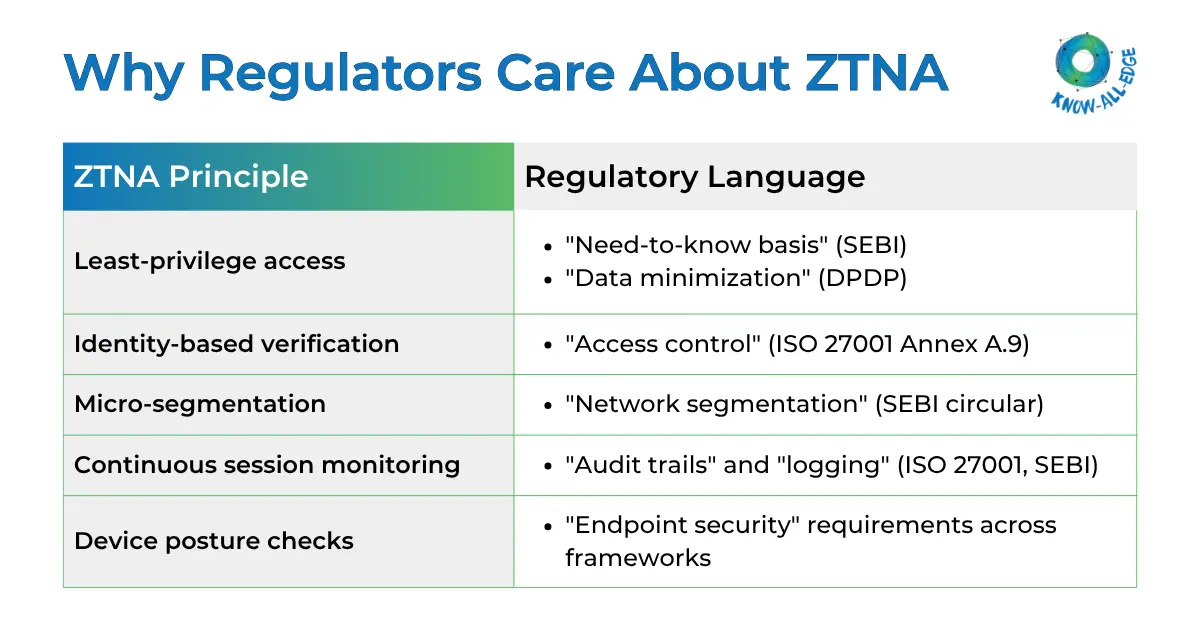
This is not a coincidence. Modern compliance frameworks are increasingly written by people who understand that perimeter-based security (the VPN and firewall model) cannot adequately protect data in a hybrid, cloud-first, remote-access world. ZTNA is the architectural response to that reality.
How ZTNA Helps Meet DPDP Act Requirements
The Digital Personal Data Protection Act 2023 is India’s most significant data privacy legislation. For enterprises, the key compliance obligations that directly intersect with network access and security architecture are:
Obligation 1: Implement appropriate security safeguards
The Act requires Data Fiduciaries to implement “reasonable security safeguards” to prevent personal data breaches. ZTNA directly contributes here by ensuring that access to systems containing personal data is granted only after identity verification, and only to the minimum scope required.
Obligation 2: Data minimization and purpose limitation
Personal data should be processed only for the specific purpose it was collected. ZTNA enforces this at the network layer — a user in the sales team simply cannot reach the HR payroll database, because ZTNA policy never grants that access. This technical enforcement is far more robust than policy documents alone.
Obligation 3: Breach notification and accountability
The DPDP Act requires timely notification of data breaches. ZTNA’s continuous session logging creates detailed audit trails — who accessed what, when, from which device — making it significantly easier to scope and report a breach accurately and quickly.
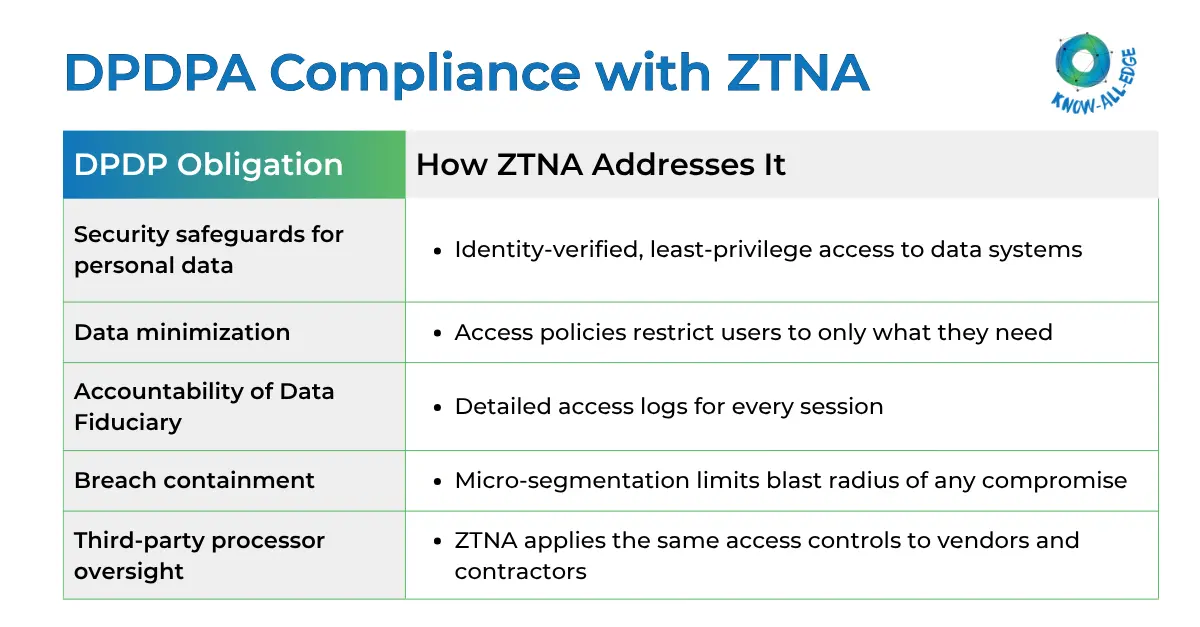
For CISOs, ZTNA doesn’t just improve your DPDP posture, it produces the documented, auditable evidence that regulators will eventually ask for.
ZTNA and ISO 27001 — A Natural Fit
ISO 27001:2022 is structured around a set of Annex A controls that organizations must implement and document. Several of these controls are directly satisfied or made significantly easier to demonstrate by ZTNA architecture.
Annex A.9 — Access Control
This is the most direct mapping. ISO 27001 requires organizations to implement formal access control policies, manage user access rights, restrict privileged access, and review access rights regularly. ZTNA enforces access control dynamically and continuously — making the ISO requirement a built-in outcome of the architecture rather than a manually managed process.
Annex A.13 — Network Security (now A.8.20-A.8.23 in 2022 revision)
The standard requires network segregation and controls on network services. ZTNA’s micro-segmentation directly satisfies this: users and devices only reach the specific network segments their role requires, and this is enforced automatically.
Annex A.12 — Operations Security (logging and monitoring)
ISO 27001 requires detailed event logging and monitoring. ZTNA generates granular access logs by design — every connection attempt, every session, every policy enforcement decision is recorded. This dramatically simplifies the evidence collection process during audits.
Practical audit benefit: ISO 27001 auditors increasingly look for technical controls, not just documented policies. A ZTNA deployment provides demonstrable, live evidence that access control policies are being enforced — which reduces audit friction and increases certification confidence.
SEBI’s Cybersecurity Framework and Zero Trust
SEBI’s Cybersecurity and Cyber Resilience Framework (CSCRF), updated in 2024, applies to a broad set of regulated entities (REs) including stockbrokers, depository participants, asset management companies, and market infrastructure institutions.
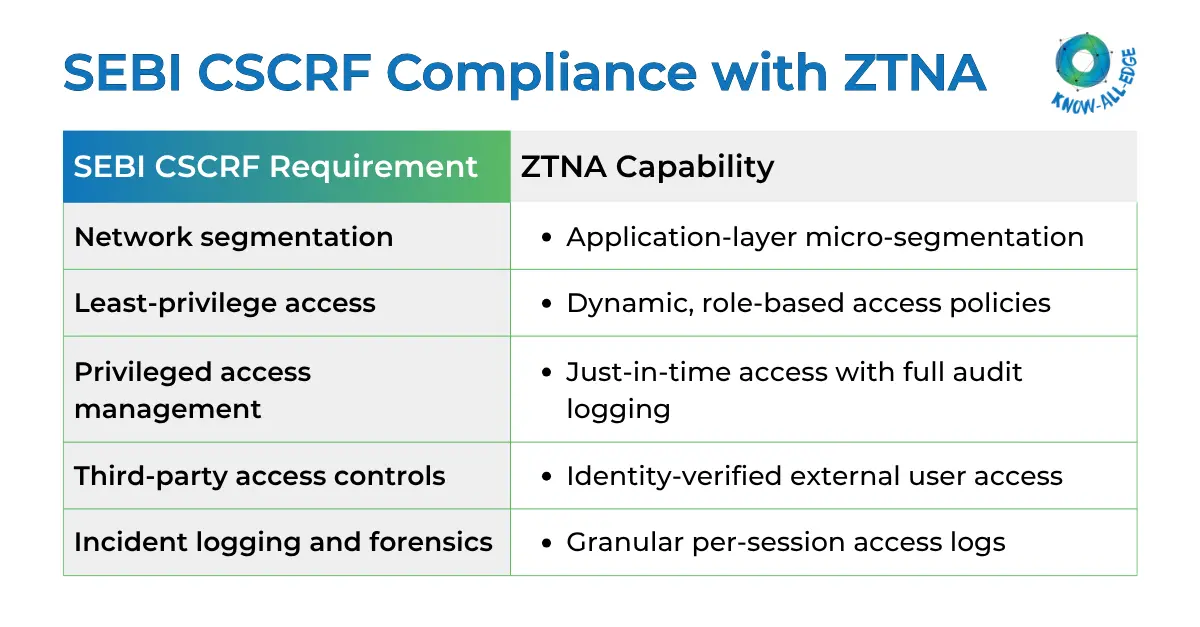
The framework is one of the most prescriptive cybersecurity mandates issued by any Indian regulator, and several of its requirements align directly with Zero Trust architecture:
Network Segmentation
SEBI explicitly requires REs to implement network segmentation to isolate critical systems. ZTNA operationalizes this at the application layer rather than relying on static network zones, access is segmented dynamically based on user identity and role.
Privileged Access Management
SEBI’s framework calls for strict controls over privileged accounts. ZTNA can enforce just-in-time privileged access, granting elevated permissions only when needed, for a specific duration, with full logging. This directly addresses SEBI’s concern about insider threats and compromised admin credentials.
Third-Party and Vendor Access
Many SEBI-regulated entities work with a wide ecosystem of technology vendors, data providers, and service partners. ZTNA applies the same identity-based access controls to external parties as to internal users, eliminating the common risk of over-permissioned vendor accounts.
Incident Response Readiness
SEBI requires REs to maintain detailed logs for forensic investigation and timely incident reporting. ZTNA’s session-level logging capability means that in the event of a security incident, security teams can quickly determine the full scope of what was accessed, which is essential for SEBI’s breach reporting timelines.
Practical Steps to Align ZTNA with Your Compliance Goals
Understanding the mapping is one thing. Getting there is another. Here is a practical starting point for Indian enterprises looking to use ZTNA as a compliance lever:
Step 1: Map your compliance obligations
Identify which frameworks apply to your organization. DPDP is universal for any entity handling personal data of Indian citizens; SEBI applies to regulated financial entities; ISO 27001 applies to those seeking or maintaining certification. For each framework, identify the specific access control and network security requirements.
Step 2: Identify access control gaps
Audit your current access model. Are users and vendors accessing systems through a flat VPN? Do you have visibility into who accessed what and when? Are privileged accounts adequately controlled? These gaps are both security risks and compliance liabilities.
Step 3: Prioritize ZTNA deployment for regulated data flows
You don’t need to replace your entire network architecture on day one. Start by deploying ZTNA for the access paths most relevant to your compliance obligations: Systems containing personal data (DPDP), critical financial infrastructure (SEBI), or in-scope assets for your ISO 27001 certification boundary.
Step 4: Document ZTNA controls as audit evidence
Work with your ZTNA vendor to ensure that access logs, policy configurations, and access review reports are exportable in formats your auditors can use. The best compliance tool is one that generates evidence automatically, not one that creates additional documentation overhead.
Step 5: Involve compliance teams early
ZTNA deployments succeed faster when legal, compliance, and security teams align on the access policies from the start. Compliance officers understand what auditors look for; security teams understand what technology can enforce. The overlap is where your compliance advantage lives.
Conclusion
For Indian enterprises, the question is no longer whether ZTNA is worth exploring, it’s whether you can afford to delay it. The DPDP Act, SEBI’s cybersecurity framework, and ISO 27001 are all moving in the same direction: away from perimeter-based trust, toward identity-verified, least-privilege access control.
ZTNA is not a compliance checkbox. It is the architectural foundation that makes meeting these obligations technically enforceable, operationally sustainable, and auditor ready.
If your organization is working toward DPDP readiness, SEBI compliance, or ISO 27001 certification and you want to understand how ZTNA fits into your specific environment our team can help you assess where to start.
Frequently Asked Questions
Is zero trust a compliance framework?
No, Zero Trust is a security model, not a compliance framework. It helps enforce access control and generates audit-ready evidence to support regulations like DPDP, ISO 27001, and SEBI.
What’s a real-world ZTNA for compliance example?
ZTNA restricts users to only the apps they need. For example, a finance user can access only financial systems, not HR data, with all activity logged for compliance.
How does ZTNA improve audit readiness for Indian compliance frameworks?
ZTNA provides real-time access logs and policy records, making it easy to show auditors who accessed what and when.
Can ZTNA help with compliance across multiple regulations at once?
Yes, ZTNA provides a unified access control model that supports DPDP, ISO 27001, and SEBI requirements simultaneously.
