 Skip to content
Key Takeaways
- Network segmentation means dividing a network into multiple network zones to control access and improve security. It keeps attacks from spreading.
- A network can be segmented using different ways, like using VLANs, microsegmentation, or application-level controls.
- Zero Trust segmentation checks every user and device before allowing access, making networks safer.
- It also helps monitor traffic, enforce access rules, meet compliance, and reduce damage if something goes wrong.
Introduction
Your network is not a single system anymore. It’s a potential highway for attackers.
You have remote employees, cloud applications, hybrid setups, third-party integrations, and distributed infrastructure. This complexity gives attackers a way to get into the network and move around without being noticed.
According to CrowdStrike, once attackers breach your network, they achieve lateral movement in just 29 minutes (65% faster than 2024). It signals more frequent and intense cyberattacks in 2026.
Network segmentation changes the equation. It breaks your big network into smaller zones, each with its own access controls. This forces attackers to slow down (or stop entirely) even after an initial breach, containing damage to a single segment instead of your entire infrastructure.
This guide explains what network segmentation is, why you need it for modern security, and how combining it with zero trust strategies can dramatically reduce your breach risk.
What is Network Segmentation?
Network segmentation, in simple terms, is the practice of dividing a larger network into smaller, isolated segments or zones. Each segment operates as its own controlled environment, with defined access rules governing how traffic moves between them.
Instead of having one flat network where everything can talk to everything else, segmentation creates boundaries. These boundaries reduce unnecessary communication and make it much harder for attackers to move freely if they gain access.
A few real-world examples of network segmentation are:
- In an enterprise setup, the HR system is isolated from the engineering environment. Finance databases are restricted to specific applications. Guest Wi-Fi is completely separated from internal corporate systems. Without segmentation, a compromised employee laptop could expose financial records and engineering secrets to attackers.
- In healthcare, patient data systems are segmented from administrative networks to meet HIPPA compliance requirements. Breaching one segment doesn’t expose protected health information (PHI). Mixing systems could result in regulatory fines and patient privacy violations.
- In manufacturing, operational technology (OT) networks are separated from IT systems to prevent disruptions in production lines.
Why is Network Segmentation in Cybersecurity Needed?
Network segmentation has evolved from a performance optimization tool to a critical containment strategy for network security.
Here’s why it matters: Most breaches don’t fail at the perimeter. They fail during the lateral movement phase, when attackers attempt to spread from their initial entry point. Without segmentation, this phase is fast and often invisible. With it, attackers hit a wall.
Segmentation slows that movement down or stops it entirely. Here’s what that means in practice:
- A compromised user device doesn’t automatically expose your servers
- A breached application can’t easily access your database
- Malware doesn’t spread unchecked across departments
This containment strategy is one of the strongest defenses against ransomware and advanced persistent threats.
Types of Network Segmentation
Not all segmentation strategies are the same. Depending on your infrastructure and security maturity, you can use different approaches.
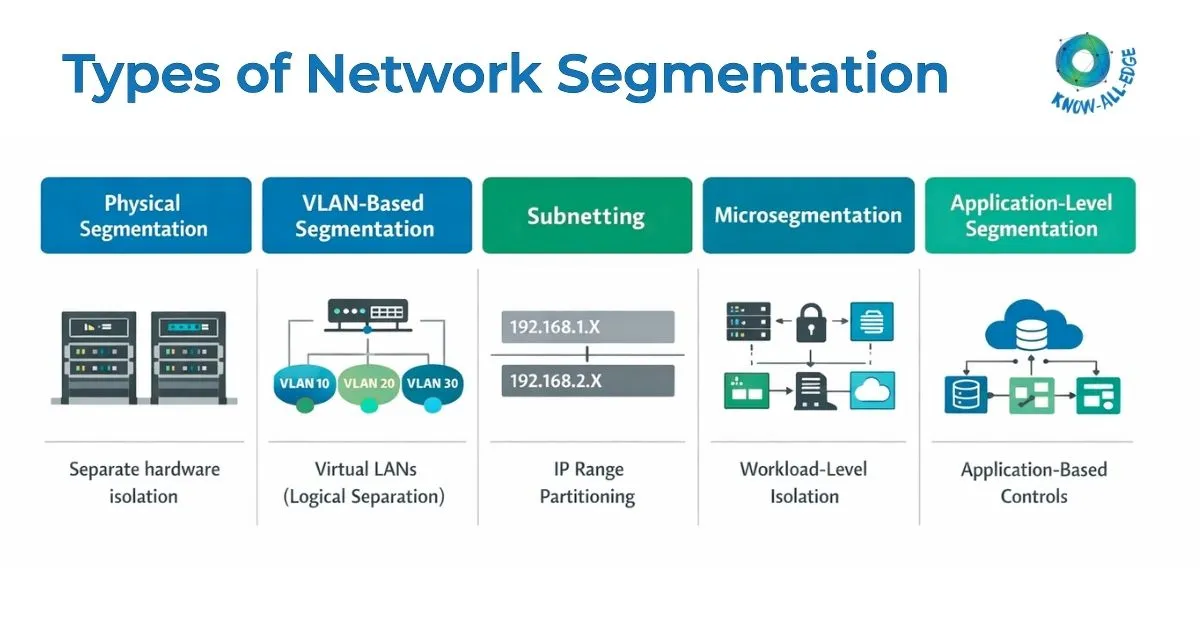
(1) Physical Segmentation
This is the most traditional form, where separate physical devices and hardware are used to isolate networks. It’s highly secure but expensive and not very flexible.
- Best for: High-security environments (government, finance) where defense-in-depth justifies the cost.
(2) VLAN-based Segmentation
Virtual LANs allow logical segmentation within the same physical network. This is widely used in enterprise environments and offers a good balance between cost and control. However, VLANs rely on network location, not identity – meaning a compromised device on the same VLAN can still access restricted resources.
- Best for: Traditional enterprise networks requiring network-level isolation.
(3) Subnetting
Breaking networks into smaller IP ranges helps manage traffic and apply access policies. While useful, it’s often not enough on its own for modern security requirements.
- Best for: Initial segmentation of large networks, often combined with other methods.
(4) Microsegmentation
This is a more advanced approach where segmentation happens at the workload or application level. Policies are highly granular, often tied to identity rather than just IP addresses.
- Best for: Cloud-native architectures and environments with dynamic infrastructure where workloads scale and move frequently.
(5) Application-level Segmentation
Controls are applied based on application behavior and dependencies, not just network location. This is increasingly relevant in cloud-native and containerized environments where workloads scale dynamically.
- Best for: SaaS, containerized environments, and microservices architectures.
Each of these plays a role depending on how deep you want your segmentation strategy to go.
Benefits of Network Segmentation
Network segmentation directly reduces risk in multiple ways. Here are a few benefits of network segmentation discussed:
- Containment: In a flat network, hackers can move freely once they get in. Segmentation blocks this, so attackers are limited to reach only certain areas.
- Visibility: When a network is divided into smaller sections, it becomes simple to see an unusual activity. It becomes much easier for security teams to spot problems in less time because traffic is organized and easier to understand.
- Least Privilege Access: With segmentation, organizations can give people and apps only the access they need. This adds tough security and supports zero-trust policies, where no one is automatically trusted.
- Data Protection and Compliance: Organizations can isolate their critical systems and important data. It further helps in meeting privacy and regulatory requirements (GDPR, HIPAA, PCI-DSS).
- Network Performance: Smaller segments reduce unnecessary traffic, improving network speed and stability.
- Reduced Incident Impact: When there are less chances of spreading attacks, it reduces downtime, data loss, and recovery costs. This is why the network segmentation market is in the boom and is predicted to go around $17.32 billion by 2030.
Challenges in Implementing Network Segmentation
- Complexity in Large Networks: Legacy systems and complex on-premises infrastructure can be difficult to segment without disrupting operations.
- Mitigation: Start with critical assets and expand incrementally.
- Visibility Challenges: Without understanding traffic flows, it’s hard to define effective segmentation policies.
- Mitigation: Use network monitoring tools to map traffic flows and dependencies before segmentation design.
- Over-Segmentation: Too many restrictions can create operational bottlenecks.
- Mitigation: Test policies in staging environments before production deployment.
- Human Factor & Misconfiguration: Poorly configured rules or inconsistent policy enforcement can weaken the entire setup.
- Mitigation: Document all policies, enable auditing, and conduct quarterly policy reviews.
Best Practices for Effective Segmentation
A successful segmentation strategy doesn’t start with technology, it starts with understanding your environment.
(1) Map Your Assets & Data Flows
Create an inventory of systems, applications, data, and users. Classify by risk level and sensitivity. Document how data flows between systems. This becomes your segmentation blueprint.
(2) Protect Critical Systems First
Start with high-risk areas. Prioritize databases holding customer data, financial systems, and authentication servers. Build outward incrementally.
(3) Apply the Principle of Least Privilege
Only allow the minimum access necessary for systems to function. This approach is the foundation of zero-trust and reduces lateral movement paths.
(4) Monitor Continuously
Segmentation is not a one-time setup. Set up automated alerts for policy violations and conduct quarterly reviews of access logs. Update policies as infrastructure changes.
(5) Align with Zero Trust & Overall Security Strategy
Segmentation is one pillar of a zero-trust architecture. Integrate with identity and access management (IAM), endpoint detection and response (EDR), and security information and event management (SIEM) for comprehensive defense.
Network Segmentation in Modern Environments
Traditional segmentation was all about physical hardware and VLANs in on-premises data centers. Modern IT environments, especially cloud and hybrid setups, require a more dynamic approach.
In the cloud, software controls network segmentation using security groups, identity-based rules, and service permissions. AWS Security Groups, Azure Network Security Groups, and Google Cloud VPC Firewall rules allow precise control over which workloads can communicate. This makes segmentation stronger and more flexible than traditional hardware approaches.
However, misconfigurations are common. Overly permissive cloud security rules are a leading cause of breaches. This is why segmentation must work closely with identity and access management (IAM), ensuring access is granted based on who you are, not just where you are on the network.
By using segmentation with zero trust in the cloud, organizations can set consistent rules, block attackers from spreading, and better protect their systems.
The Shift Toward Zero Trust Segmentation
Traditional segmentation assumes that traffic inside the network is somewhat trustworthy.
But is it really? The answer is no.
This is where zero trust segmentation comes into play. Zero Trust is based on a simple principle: never trust, always verify. Every request, whether it originates inside or outside the network, must be authenticated, authorized, and continuously validated.
Zero trust network segmentation takes this concept and applies it to how systems communicate. Instead of relying on static network boundaries, it enforces policies based on identity, context, and behavior. This approach is especially relevant in environments with remote work, cloud applications, and distributed infrastructure.
Rather than asking “where is this traffic coming from?”, zero trust asks “who is making this request, and should they be allowed to do this?”
It’s a fundamental shift from perimeter-based security to identity-based security.
Where ZTNA Fits In?
ZTNA (Zero Trust Network Access) solutions are a key component of the zero-trust model. They replace traditional VPN-based access by granting users access only to specific applications, not the entire network. ZTNA operates on identity-based policies and continuously validates trust with each request.
This is essentially helpful for remote users who usually connect from unmanaged or partially trusted devices. Even if credentials are stolen, ZTNA prevents attackers from moving freely across the network. Access is restricted to specific applications the user needs for their role.
To implement ZTNA effectively, Know All Edge partners with global solution providers like Zscaler and others to help organizations deploy ZTNA solutions faster, enforce policies consistently, and integrate segmentation with cloud security comprehensively.
Final Thoughts
Cyber attackers don’t need obvious entry points anymore. They wait for a single weakness to breach and establish themselves in your network. Once inside, they move laterally, and that’s where most breaches succeed.
It’s high time for organizations to prioritize network security seriously.
Network segmentation is one of the few controls that actually limits the damage of a breach instead of just trying to prevent it. It acknowledges a fundamental truth: breaches happen. What matters is how fast you can contain them.
As networks grow more complex and threats more advanced, segmentation must evolve too. This means going beyond basic VLANs to identity-driven, zero-trust models supported by technologies like ZTNA.
Organizations serious about security must adopt identity-based segmentation and ZTNA to stop breaches from spreading.
FAQs on Network Segmentation
Is network segmentation the same as subnetting?
No, subnetting splits IP addresses, while network segmentation separates network areas and controls access.Subnetting can be part of segmentation, but segmentation also includes policies and security controls.
How does network segmentation improve security?
Network segmentationhelps improve security in multiple ways. It stops attacks from spreading, protects important systems, controls who can access what, and makes it easier to spot unusual activity.
What is an example of a segmented network?
A segmented network separates different systems to improve security and manage access. Forexample, in a hospital, patient records are stored on a network isolated from administrative systems, while medical devices run on a separate network.
Is network segmentation the same as VLAN?
No, a VLAN (Virtual LAN) is one method of implementing network segmentation by logically grouping devices within a network. Network segmentation is a broader concept that can include VLANs, physical separation, microsegmentation, or software-defined controls. All these aims at isolating traffic and improving security.
