 Skip to content
Introduction
Data has quietly become the most critical asset in modern enterprises. It is even more important than an organization’s infrastructure and applications.
Data today moves across multi-cloud platforms, SaaS applications, third-party integrations, and internal systems. It gets copied, transformed, stored, and sometimes forgotten. In this environment, traditional security approaches struggle because they were never designed to track data at this scale.
This is where Data Security Posture Management (DSPM) works. It shifts the focus from ‘Where is my system vulnerable?’ to a more important question ‘Where is my sensitive data, and how exposed is it?’
The urgency is not theoretical. According to the latest report from IBM, the global average cost of a data breach reached $4.4 million in 2025, highlighting how expensive gaps in data security have become. Another report says, in India alone, the average breach cost has risen to INR 220 million, showing a consistent upward trend. These numbers reflect operational disruption, loss of trust, and long-term reputational damage. And in most cases, the root cause is not lack of tools, it is lack of visibility and control over data.
This is exactly what DSPM best practices aim to address.
Understanding DSPM in the Current Security Landscape
DSPM is often misunderstood as just another security tool category. In reality, it is more of an operational approach. It sits alongside cloud security (CSPM), SaaS security (SSPM), identity security, and data loss prevention, but its focus is very specific; it looks directly at the data layer.
What makes DSPM different is context. It does not just identify where data exists. It connects three important elements:
- Sensitivity
- Access
- Exposure
Without this combination, security teams often end up solving the wrong problems.
For enterprise security teams, DSPM becomes especially relevant because environments are no longer centralized. Each client or business unit may have a different cloud provider, different SaaS tools, and different access models. Without a unified view of data, security becomes fragmented.
What are Some DSPM Best Practices for Data Security?
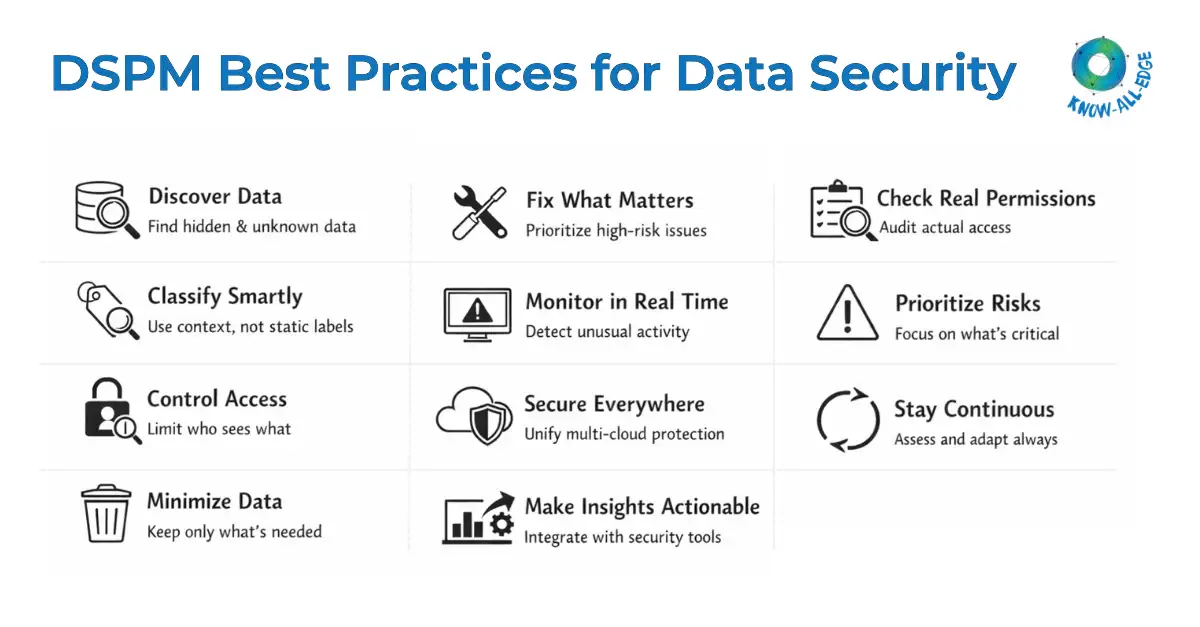
(1) Eliminating Data Blind Spots Through Continuous Discovery
One of the most common issues in enterprises is unknown data. Data that exists, but no one is actively tracking it. This includes:
- Shadow databases
- Unmanaged storage buckets
- Backups
- and even test environments
DSPM best practices start with continuous discovery, not one-time scanning. Data environments are dynamic, and discovery must be equally adaptive. Without this, organizations operate with incomplete visibility, which directly increases risk.
(2) Making Data Classification Context-Aware, Not Static
Traditional classification approaches assign labels and stop there. But the data is not static. Its sensitivity can change depending on usage, location, and access patterns.
Effective DSPM practices treat classification as a living process. For example, a dataset might not be sensitive in isolation, but when combined with another dataset, it becomes highly critical. This context-driven approach helps security teams prioritize what actually matters.
(3) Mapping Sensitive Data to Identity and Access Entitlements
Access is often the weakest link in data security. Not because controls are missing, but because they are too broad.
DSPM emphasizes understanding of who has access to what data, and whether that access is justified. Over time, permissions accumulate. Employees change roles, projects evolve, and access rarely gets revoked.
This leads to situations where sensitive data is accessible to more users than necessary. Identifying and correcting these mismatches is a core DSPM practice.
(4) Treating Data Minimization as a Security Strategy
There is a tendency to store everything. Storage is cheap, and data might be useful someday. But from a security perspective, more data means more risk.
Data minimization is not just a compliance requirement. It is a practical way to reduce the attack surface. Old, unused, or duplicated data often becomes an easy target because it is rarely monitored.
Strong DSPM practices include identifying such data and removing it where possible. This is one of the simplest yet most overlooked ways to improve security posture. However, this becomes especially important as regulations like the DPDP Act emphasize continuous visibility and control over personal data, making DPDPA and DSPM closely aligned.
(5) Analyzing Effective Permissions Instead of Assigned Roles
Security teams often rely on role-based access controls. While useful, they do not always reflect reality. What matters is effective access – the actual permissions a user ends up with after multiple roles and policies are combined. Among all the DSPM best practices, analyzing these effective permissions is another one. This allows organizations to detect privilege creep and hidden access paths that might otherwise go unnoticed.
(6) Detecting Misconfigurations in the Context of Data Sensitivity
Misconfigurations are common, especially in cloud environments. But not all misconfigurations are equally risky.
An open storage bucket with non-sensitive data is very different from one containing critical business information. DSPM brings this context into the picture. It helps teams prioritize remediation based on actual impact rather than just technical severity.
(7) Monitoring Data Activity in Real Time
Traditional audits are periodic. They provide a snapshot, but not a continuous view.
DSPM introduces real-time monitoring of data access and movement. This includes tracking unusual patterns such as:
- Bulk downloads
- Unexpected access times
- Or access from unfamiliar locations
With the rise of AI-driven attacks and automation, threats are becoming faster. According to IBM, organizations are seeing increasing incidents where lack of proper access controls leads to security events. This makes continuous monitoring not just useful, but necessary, especially as AI is increasingly being used both to launch attacks and to strengthen DSPM capabilities, which we’ve explored in detail in our DSPM for AI blog.
(8) Standardizing Data Security Across Multi-Cloud and SaaS Environments
Enterprises today rarely operate in a single environment. Data is distributed across AWS, Azure, Google Cloud, and multiple SaaS platforms. Each environment has its own security model. Without standardization, gaps are inevitable. DSPM best practices aim to create consistent data security policies across all environments. This reduces fragmentation and ensures that sensitive data is protected regardless of where it resides.
(9) Integrating DSPM Insights into Security Operations
Visibility alone is not enough. Security teams already deal with large volumes of alerts, and adding more data without context can increase complexity.
DSPM practices focus on integrating data risk insights into existing systems such as SIEM and SOAR. This ensures that alerts are not just generated, but also prioritized and actionable.
When data sensitivity is combined with threat intelligence, response becomes more effective.
(10) Automating Risk Prioritization Using Contextual Signals
Not all risks require immediate action. One of the challenges in security operations is prioritization.
DSPM helps by combining multiple signals, like data sensitivity, exposure level, and access patterns, to calculate risk more accurately. This reduces noise and allows teams to focus on what truly matters.
(11) Establishing Continuous Data Security Posture Assessment
Security is not a one-time implementation. Environments evolve, new applications are introduced, and data keeps growing.
DSPM practices require continuous assessment of data security posture. This includes:
- Regular validation of controls
- Monitoring of changes
- And adapting to new threats
Organizations that treat DSPM as an ongoing program, rather than a project, tend to achieve better outcomes over time.
From Visibility to Action: The Real Challenge
One of the interesting patterns in enterprise security is that many organizations already have visibility tools. They can identify risks, generate reports, and even highlight vulnerabilities.
But action is where things slow down.
This gap between visibility and remediation is often due to operational complexity. Fixing a data exposure issue may require coordination between multiple teams – security, cloud, DevOps, and business units.
This is where system integrators play an important role. They help bridge this gap by aligning tools, processes, and teams. DSPM, when implemented effectively, is not just about identifying risks. It is about enabling organizations to act on them in a structured way.
At Know All Edge Networks, we take a practical approach to this challenge. We work with multiple leading DSPM technology partners and integrate their capabilities into your existing environment, rather than introducing isolated tools. This allows us to create a unified view of data risk while ensuring that remediation actions are seamlessly embedded into your current security and operational workflows.
Looking to implement DSPM in your environment? We can help from DSPM strategy to execution.
Conclusion
Data security is no longer a supporting function. It is central to business resilience. As organizations continue to expand across cloud and SaaS environments, the challenge is not just protecting infrastructure but understanding and securing the data itself.
Above discussed, all the DSPM best practices provide a structured way to approach this problem. They bring visibility, context, and prioritization into data security, which are often missing in traditional approaches.
The direction is clear. Organizations that invest in understanding their data – where it exists, who can access it, and how it is exposed, will be better prepared to manage risks.
Because in the end, security is not just about preventing breaches. It is about knowing what matters most, and protecting it effectively.
FAQs on DSPM Best Practices
How is DSPM different from traditional data security tools?
DSPM focuses on data visibility, context, and risk prioritization, whereas traditional tools often focus on protecting infrastructure or enforcing predefined policies. It connects data sensitivity with access and exposure to give a clearer risk picture.
Is DSPM only relevant for large enterprises?
No. While large enterprises benefit significantly, any organization handling sensitive data in cloud or SaaS environments can gain value from DSPM. Even mid-sized companies face similar visibility challenges as they scale.
How long does it typically take to implement DSPM?
Initial visibility can be achieved in a few weeks, but full implementation is an ongoing process. It depends on the complexity of the environment, number of data sources, and integration with existing security tools.
Can DSPM help with regulatory compliance?
Yes. DSPM supports compliance by identifying where sensitive data resides and how it is handled, making it easier to align with regulations like GDPR, HIPAA, and others during audits.
