
In an age of relentless cyber-threats, evolving regulatory demands, and the complexities of hybrid and multi-cloud environments, a solid data protection strategy isn’t a luxury – it’s the bedrock of business survival. For CISOs and IT leaders, this means moving beyond simple backups to a holistic approach of cyber resilience.
This guide, brought to you by the experts at Know All Edge, is designed to be your essential resource. We will walk you through everything you need to know to design, implement, and maintain a robust & secure Backup and Disaster Recovery solution that protects your organization from any threat, from ransomware to natural disasters.
The Modern Threat Landscape: Why Traditional Backup Isn’t Enough
For today’s CISOs, the challenge is no longer about protecting against simple hardware failures or accidental deletions. The threat environment has become relentless, multi-dimensional, and business critical. Enterprises now face:
- AI-Powered Ransomware: Attackers use automation and machine learning to rapidly identify and encrypt backups, rendering traditional recovery strategies ineffective.
- Insider Threats & Credential Misuse: Malicious insiders or compromised privileged accounts can deliberately target backup repositories, leaving organizations without a safety net.
- Supply Chain & Third-Party Risks: Dependence on SaaS platforms, public cloud providers, and IT service vendors means your data resilience is only as strong as the weakest link in your ecosystem.
- Regulatory & Audit Pressure: Frameworks like SEBI, RBI, HIPAA, and GDPR are raising the bar for uptime, availability, and data retention. Non-compliance not only attracts penalties but also erodes stakeholder trust.
Backup alone is no longer sufficient – what’s needed is a cyber-resilient Backup and DR strategy. Let’s explore why this matters to your business.
Why Backup and DR Matters to You
In today’s unpredictable digital landscape, the question isn’t “if” a disaster strikes, but “when.” Data loss from ransomware, hardware failure, or natural disaster can threaten business survival.
A robust strategy is crucial for your company’s cyber resilience.
- Minimizes Downtime & Business Interruption: A well-defined RTO ensures that critical services are back online quickly, preventing revenue loss and reputational damage.
- Prevents or Limits Data Loss: By defining RPOs, you ensure that you don’t lose more data than your business can tolerate.
- Compliance and Regulatory Demands: Many industries (finance, healthcare, government) have strict regulations regarding data retention and availability.
- The Ultimate Ransomware Defense: In an age where even backups are targeted, a secure, immutable copy of your data is your last line of defense against paying a ransom.
- Stakeholder Confidence: Knowing your data is secure builds trust with customers, partners, and investors.
- Periodic Validation: A good strategy includes regular DR drills, giving you the confidence that your recovery plan works when it’s needed most.
The Business Case for Backup and Disaster Recovery
For CISOs, every investment must be justified. Backup and DR provides one of the clearest ROI stories in cybersecurity:
| Metric | Impact |
| Cost of Downtime | Large enterprises can lose $5,600 per minute during outages (Gartner). |
| Regulatory Fines | Non-compliance can trigger hefty penalties (SEBI, GDPR). |
| Insurance & Reputation | Tested recovery plans reduce cyber insurance premiums and reassure stakeholders. |
When compared with these risks, the TCO of a modern BDR solution is a fraction of potential losses, making it not just a technical safeguard, but a strategic financial shield.
Key Terms You Need Know
To build a resilient backup and DR strategy, you must first master the terminology and metrics that govern it.
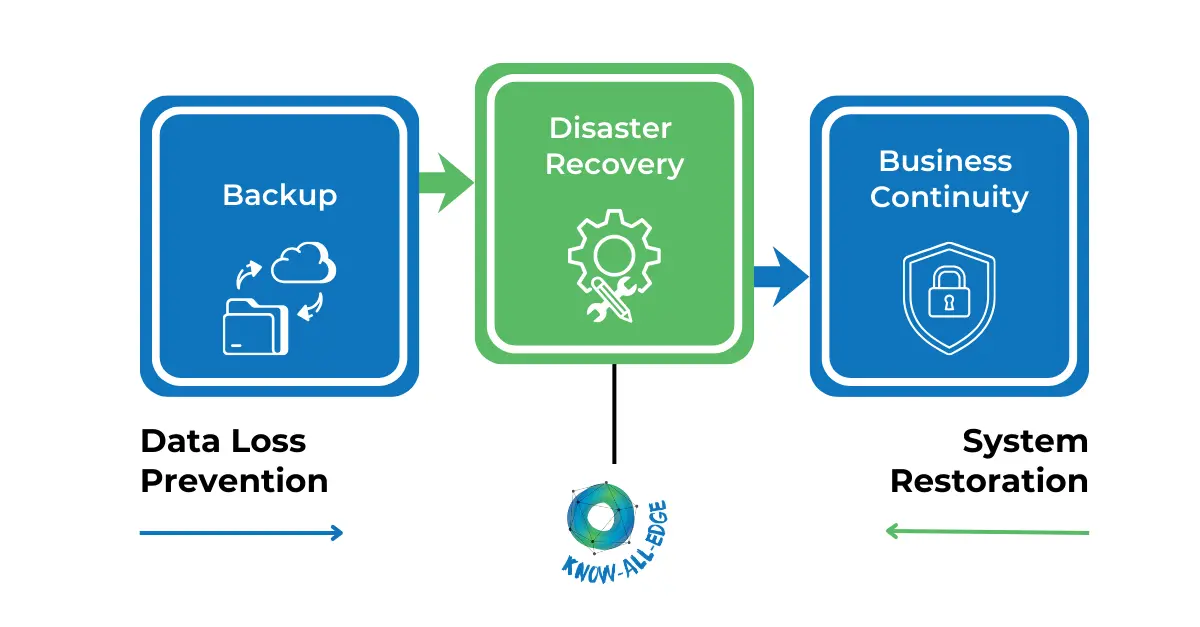
Backup: The fundamental process of copying and archiving your data so it can be restored in case of loss or corruption.
Disaster Recovery (DR): The strategic processes and tools to restore entire IT infrastructure and applications after a catastrophic event. DR is about resuming business operations, not just recovering files.
Business Continuity (BC): The broader organizational plan to ensure critical business functions continue during and after a disaster. DR is a core component of BC.
Recovery Metrics
| Term | Definition |
| Recovery Point Objective (RPO) | Maximum data your business can afford to lose (e.g., 15-min RPO = 15 min of data loss max). |
| Recovery Time Objective (RTO) | Maximum tolerable downtime (e.g., RTO 4h = system must be operational within 4h). |
| Failover / Failback | Automatic switch to standby system (failover) and return to primary (failback). |
| Replication / Snapshot | Secondary copy methods; snapshots = point-in-time, replication = continuous. |
What CISOs Should Measure: The Backup and DR Dashboard
A CISO’s role is to act as the chief architect of an organization’s cyber resilience. When designing your backup and disaster recovery (DR) strategy, you must move beyond simply purchasing a solution and instead focus on defining the core requirements and metrics that will guide its success. Your strategic decisions are the foundation upon which the entire data protection framework is built.
To move from theory to execution, CISOs should track key metrics across their environment:
- Data Classification: What data and applications are mission-critical? Define different RPO/RTO tiers for each workload.
- Recovery-Point Validation: Can you verify that your backups are usable and not compromised by malware? This is a non-negotiable requirement for modern cyber resilience.
- Immutability: Can a backup copy be altered, encrypted, or deleted by an attacker? If the answer is no, it’s a powerful defense.
- Disaster Recovery Orchestration: Can you automate the complex process of failover and failback? Automated runbooks reduce human error and dramatically speed up recovery.
- Security: Ensure end-to-end security with encryption in transit and at rest, and robust access controls.
- Governance & Testing: Who owns the plan? How often do you test it? Your plan is only as good as your last successful test.
| Requirement | What to Track / Measure |
| Data Classification | Identify mission-critical workloads and define RPO/RTO tiers. |
| Recovery-Point Validation | Verify backups are malware-free and usable. |
| Immutability | Ensure backups cannot be altered or deleted. |
| Disaster Recovery Orchestration | Automate failover/failback to reduce human error. |
| Security | End-to-end encryption, access controls. |
| Governance & Testing | Ownership, testing frequency, and audit trails. |
Enterprise Disaster Recovery Solutions
The market offers a range of solutions, each with its own pros and cons.
| Approach | Description | Pros | Cons |
| On-Premises | Backups in your data center | Full control, low latency | High CAPEX, site-specific risk |
| Cloud | Backup to public cloud | Elasticity, geo-redundancy | Egress costs, latency, vendor lock-in |
| Hybrid | Combination of on-prem & cloud | Flexible, best of both worlds | Complexity, potential cost surprises |
| DRaaS | Outsourced DR provider | Reduced CAPEX, faster recovery | SLA dependency, recurring costs |
When evaluating these options, you’ll find that some vendors specialize in specific areas, while others offer a comprehensive, unified platform.
Key Players in Backup and Disaster Recovery
The market is crowded with solutions – each with strengths and trade-offs.
- Commvault: Enterprise-grade cyber resilience
- Veeam: Virtualized environment replication
- Rubrik: Immutability & ransomware recovery
- Cohesity: Data management & deduplication
- Druva: Cloud-native SaaS backup
- Zerto, Acronis, Unitrends: Specific workload focus
Our partner, Commvault, falls into the latter category, consistently recognized as a leader in the Gartner Magic Quadrant for Backup and Data Protection.
A Closer Look at Commvault’s Offerings: The Technology Behind the Terms
Commvault’s platform is built for modern data management and cyber resilience. Here are the key technical terms and features that set their solutions apart:
| Feature | What It Does | Key Benefit |
| Commvault Cloud powered by Metallic AI® | Unified platform for on-prem, cloud, and SaaS (e.g., Microsoft 365) data protection | Single-pane visibility and AI-driven management |
| Cleanroom Recovery | Isolated environment to restore and verify backups | Ensures malware-free recovery |
| Immutability | Backup copies cannot be modified, encrypted, or deleted | Protects against ransomware attacks |
| Disaster Recovery Orchestration | Automated failover and failback using predefined runbooks | Reduces RTO from days to minutes |
| Continuous Data Replication | Real-time replication of critical workloads | Near-zero RPOs, minimal data loss |
| HyperScale™ X | Scale-out on-prem solution for large datasets | High-performance, efficient backup and recovery |
Your Checklist for Success
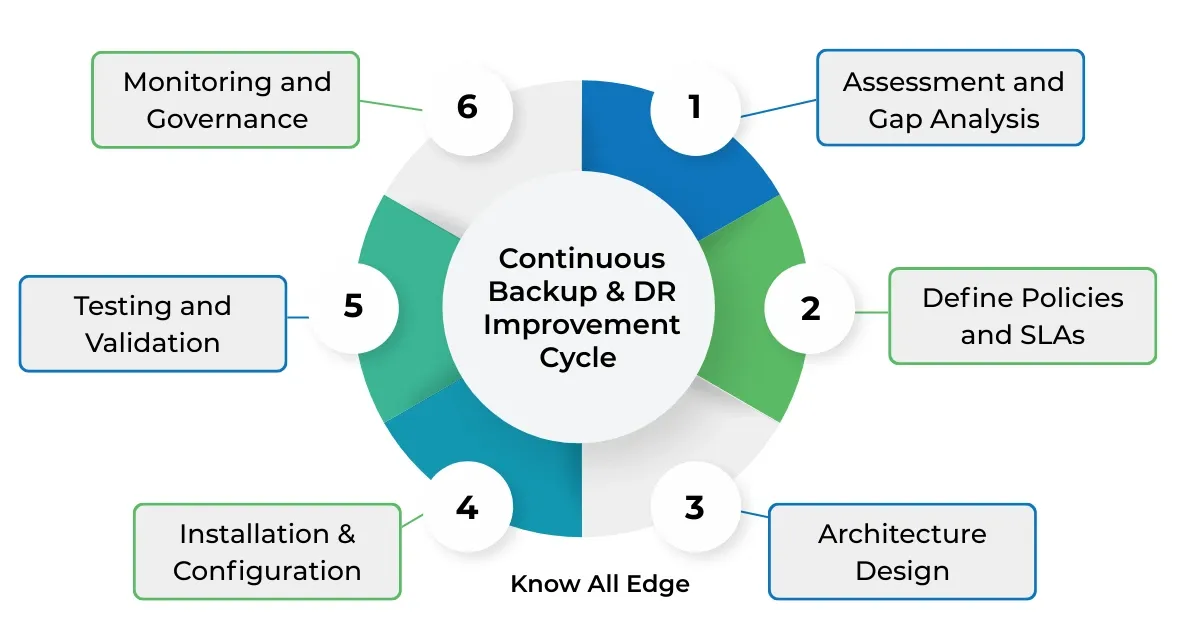
Use this checklist to ensure you have a robust backup and disaster recovery plan in place:
- Inventory Critical Assets: Document all data, applications, and dependencies.
- Define RTO/RPO: Classify workloads and set clear recovery objectives for each.
- Ensure Immutability: Verify that your backup copies are protected from ransomware and deletion.
- Automate and Orchestrate: Implement automated failover and failback processes.
- Conduct Regular Drills: Schedule and perform frequent DR tests.
- Secure the Infrastructure: Harden your backup infrastructure itself and use a cleanroom recovery environment.
- Partner for Success: Engage a trusted system integrator like Know All Edge to help you navigate the complexities and get the most out of your investment.
This graphic provides a clear, actionable summary of the key steps.
From the Server Room to the Boardroom: Making BDR a Business Priority
For CISOs, the real challenge isn’t only building the right Backup and Disaster Recovery plan — it’s communicating its value to the board and business leadership. Framing BDR in terms of:
- Risk Reduction → “How much financial impact is avoided?”
- Compliance Confidence → “Are we audit-ready?”
- Resilience Metrics → “Can we prove recovery time and data integrity?”
This ensures BDR isn’t seen as a cost center, but as a business enabler.
How Know All Edge Can Help
At Know All Edge, we are not just a solution provider; we are your strategic partner in building a resilient enterprise. Our role as a system integrator is to bridge the gap between technology and your business needs.
- Consulting & Strategy: We start with a comprehensive assessment of your current environment, helping you define your RTOs, RPOs, and risk profile to build a strategy that’s right for you.
- Solution Design & Integration: Leveraging our deep partnership with Commvault, we design and implement a tailored solution that integrates seamlessly with your existing infrastructure, whether it’s on-premises, hybrid, or multi-cloud.
- Managed Services & Support: We provide ongoing monitoring, maintenance, and support. We will run your regular DR drills, ensure your backup environment is hardened, and manage cost optimization, so your team can focus on core business operations.
- Cyber Resilience Expertise: Our team of experts provides a holistic approach to cyber resilience, including testing for clean recovery points and ensuring your entire backup infrastructure is secure.
Real-World Impact: A Case in Point
A leading financial services provider partnered with Know All Edge to modernize its Backup and Disaster Recovery. Facing strict RBI regulations and rising ransomware threats, the firm needed to reduce recovery times dramatically.
- Challenge: RTOs averaged 12+ hours across critical applications.
- Solution: With Commvault’s orchestration and immutable backups, integrated by Know All Edge, the company achieved RTOs under 45 minutes for its Tier-1 workloads.
- Outcome: Not only did the firm meet compliance requirements, but it also gained board-level confidence in its cyber resilience strategy.
This case underscores how the right strategy and partner can transform BDR from a compliance checkbox into a business enabler.
Conclusion
For CISOs and IT Heads, building a modern backup and disaster recovery strategy is about more than just technology. It’s about building a foundation for cyber resilience. It requires a strategic mindset, a clear understanding of your business needs, and the right partner to help you choose, implement, and manage a powerful solution.
The future of BDR lies in AI-driven orchestration, zero-trust data protection, and compliance-ready recovery testing. CISOs who act now will lead in resilience.
Start Preparing today with Know All Edge for secure backup and disaster recovery solutions!
FAQs Backup and Disaster Recovery
What is the difference between Backup and Disaster Recovery?
Backup refers to the process of creating copies of data to restore files in case of loss or corruption. Disaster Recovery (DR) is a broader strategy that restores entire systems, applications, and infrastructure after a major outage. While backup protects data, DR ensures business operations resume within defined RTO and RPO targets.
Why is traditional backup no longer sufficient for modern enterprises?
Traditional backups focus mainly on data copies but lack immutability, orchestration, malware validation, and rapid failover capabilities. Modern cyber threats – especially ransomware – actively target backup repositories. Organizations now require cyber-resilient backup and DR solutions that include immutable storage, automated recovery workflows, and cleanroom validation environments.
What is immutable backup and why is it critical for ransomware protection?
Immutable backups cannot be modified, encrypted, or deleted for a defined retention period. This ensures attackers cannot tamper with recovery data – even if they gain administrative access. Immutability is considered the last line of defense against ransomware.
What is Cleanroom Recovery and when is it required?
Cleanroom Recovery is an isolated recovery environment used to restore and verify backups before production deployment. It ensures data is malware-free and uncompromised. This approach is particularly important after ransomware incidents to prevent reinfection.
What are the main deployment models for Backup and Disaster Recovery?
On-Premises Backup
- Full control over infrastructure
- Lower latency
- Higher CAPEX and site-level risk
Cloud Backup
- Scalability and geo-redundancy
- Reduced hardware investment
- Potential egress costs and vendor dependency
Hybrid Backup
- Combines on-prem speed with cloud resilience
- Flexible architecture
- Requires careful cost and complexity management
How does Backup and Disaster Recovery support regulatory compliance?
Industries regulated by bodies such as:
- Reserve Bank of India
- Securities and Exchange Board of India
- European Union (GDPR framework)
require defined recovery objectives, secure retention, encryption, and periodic testing. A well-documented BDR strategy ensures audit readiness and avoids penalties.
What metrics should a CISO track on a Backup and DR dashboard?
Key indicators include:
- Backup success rate
- Recovery verification status
- Immutable storage coverage
- RPO/RTO compliance by workload tier
- DR test frequency and success rate
- Encryption and access control validation
These metrics help translate technical resilience into board-level risk reporting.
What should enterprises evaluate when selecting a Backup and DR vendor?
Decision-makers should assess:
- Support for hybrid and multi-cloud environments
- Built-in immutability and ransomware detection
- Automated DR orchestration
- Scalability and performance
- Compliance certifications
- Integration with SaaS platforms (e.g., Microsoft 365)
Enterprise leaders frequently evaluate platforms such as:
- Commvault
- Veeam
- Rubrik
- Cohesity
- Druva