 Skip to content
Email remains the backbone of business communication, but it is also one of the most exploited attack surfaces in today’s cyber threat landscape. From phishing and ransomware to business email compromise (BEC), attackers consistently target email because it blends technical vulnerabilities with human behavior.
For organizations of all sizes, email security is no longer just an IT concern. It is a critical business requirement tied directly to data protection, financial security, regulatory compliance, and brand reputation.
This guide gives you email security definition and explains why traditional approaches fall short and how modern organizations can build a resilient, future-ready email defense strategy.
What Is Email Security
As per tradition email security definition, it refers to a framework of defensive technologies, policies, and organizational practices designed to protect email systems from unauthorized access, malicious content, and data loss.
Unlike perimeter-based security, it must operate in a highly dynamic environment—one where attackers constantly adapt their tactics, impersonate trusted identities, and exploit human trust rather than just technical flaws.
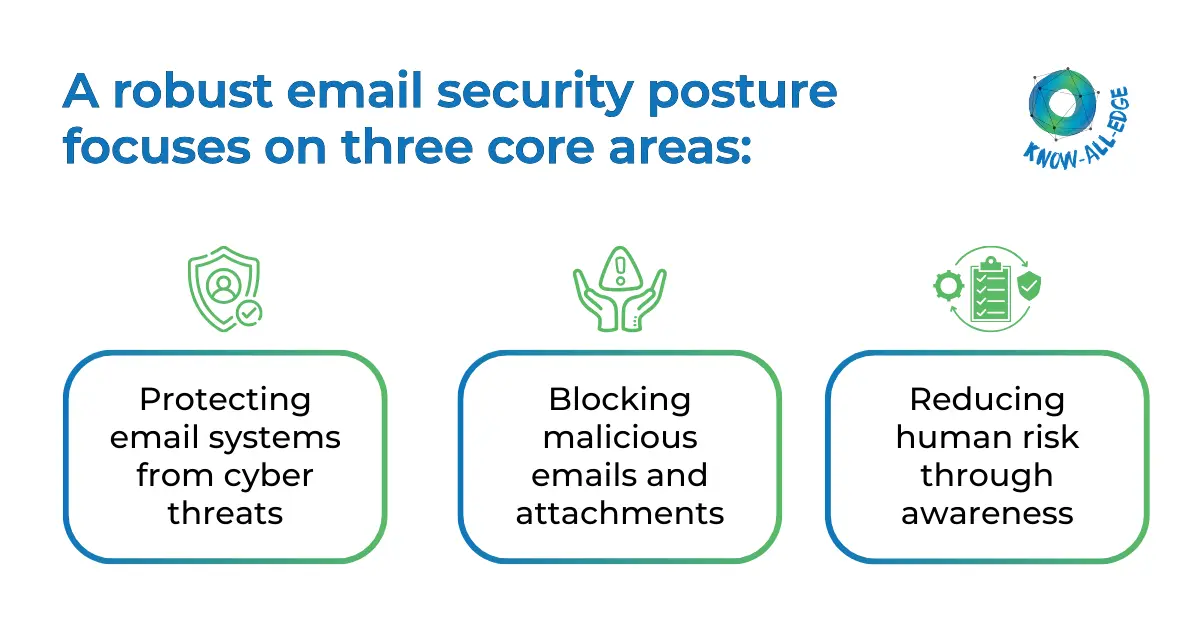
A robust security posture focuses on three core areas:
Why Email Is a Primary Target for Cyberattacks
Email is the preferred entry point for attackers because it is:
- Universally used across organizations
- Inherently trusted by employees
- Difficult to secure using static rules alone
Common email-based threats include:
These attacks often look legitimate, traditional spam filters and signature-based tools struggle to detect them.
(1) Phishing Attacks
Deceptive emails designed to trick users into revealing credentials, downloading malware, or approving fraudulent actions.
(2) Business Email Compromise (BEC)
Highly targeted attacks where threat actors impersonate executives, vendors, or partners to manipulate financial transactions or sensitive data sharing.
(3) Ransomware Delivery
Emails carrying malicious attachments or links that install ransomware once opened.
(4) Account Takeover
Credential theft leading to unauthorized access, lateral movement, and internal phishing campaigns.
Why a Layered Security Approach Matter
You cannot secure your emails with single control. Rather it can be done only through combination of multiple protection layers, each designed to address different stages of an attack. This holistic approach addresses both technical vulnerabilities and human factors, the two dimensions attackers exploit most.
Layer 1: Tradition email security gateways focus on filtering spam, known malware, and malicious attachments using signatures and predefined rules. While effective against commodity threats, these systems often struggle with socially engineered attacks that appear legitimate.
Layer 2: Email authentication mechanisms such as SPF, DKIM, and DMARC form another critical layer by verifying sender identity and preventing domain spoofing and impersonation. To address evolving threats, modern organizations are increasingly adopting behavior-based and AI-driven email security solutions that analyze communication patterns, user behavior, and contextual signals to detect phishing, business email compromise, and account takeover attempts that bypass legacy filters.
Layer 3: Additionally, human-centric controls, including security awareness training and email security policy enforcement, play a vital role in reducing risk by strengthening employee decision-making.
Together, these technical and human-focused layers create a comprehensive security framework capable of defending against both traditional and advanced email threats.
Traditional vs Modern Email Security: A Comparison
| Aspect | Traditional Email Security | Modern Email Security |
| Primary Approach | Rule-based filtering and signature detection | AI-driven behavioral and contextual analysis |
| Threat Detection Method | Known threat signatures, blacklists, and static rules | Analysis of sender behavior, user patterns, and intent |
| Focus Area | Blocking spam, known malware, and suspicious attachments | Stopping phishing, BEC, account takeover, and social engineering |
| Handling of New Threats | Limited effectiveness against zero-day and novel attacks | Designed to detect previously unseen and evolving threats |
| Email Authentication | Basic enforcement of SPF, DKIM, and DMARC | Continuous monitoring of identity, authentication, and trust relationships |
| Cloud Integration | Often gateway-based and perimeter-focused | API-based, cloud-native integration with email platforms |
| Human Risk Consideration | Minimal—assumes users will follow warnings | Central—models normal human behavior and flags anomalies |
| False Positives | Higher risk of blocking legitimate business emails | Reduced through context-aware decision-making |
| Response Capability | Manual investigation and delayed response | Automated detection and rapid remediation |
| Best Use Case | Baseline protection against common email threats | Advanced protection against targeted, high-impact attacks |
Attacks Commonly Stopped by Traditional Email Security
Traditional email security solutions are effective against high-volume, known threats, including:
- Mass phishing campaigns using previously identified malicious domains
- Malware-laden attachments (e.g., infected PDFs or executables)
- Spam emails promoting scams, fake offers, or malicious links
- Known ransomware variants with recognizable signatures
These systems work well when attacks follow familiar patterns and rely on detectable technical indicators.
Attacks Better Stopped by Modern Email Security
Modern, behavior-based email security solutions excels at stopping targeted and deceptive attacks, such as:
- Business Email Compromise (BEC) impersonating executives or finance teams
- Vendor impersonation fraud requesting invoice or bank detail changes
- Account takeover attacks originating from compromised internal email accounts
- Social engineering emails with no links or attachments but malicious intent
- Credential harvesting attacks using legitimate cloud-hosted pages
- Conversation hijacking, where attackers insert themselves into real email threads
These attacks often bypass traditional filters because they appear legitimate—making behavioral analysis and contextual understanding essential.
Why Organizations Need Both
Traditional controls provide an essential first layer of defense, while modern email security tools adds the intelligence required to detect the most damaging threats. Together, they form a layered strategy that addresses: Technical vulnerabilities, Identity-based attacks, and Human behavior risks. This combined approach significantly reduces the likelihood of successful email-based breaches.
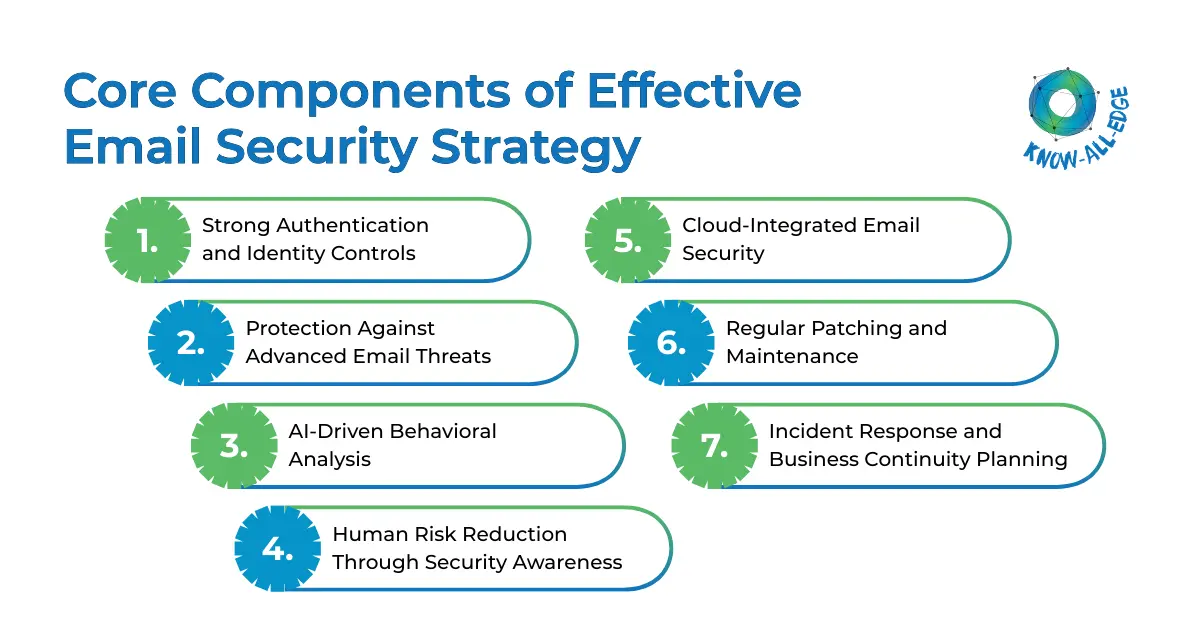
Core Components of an Effective Email Security Strategy
An effective email security strategy focuses on protecting email systems, verifying sender identity, and detecting malicious intent to prevent phishing, impersonation, and unauthorized access. Its success is reinforced through consistent implementation of email security best practices, such as strong authentication controls, regular system updates, and employee awareness measures, ensuring secure day-to-day communication.
(1) Strong Authentication and Identity Controls
Authentication is the foundation of email security strategy. Weak or compromised credentials are a primary cause of email-related breaches.
Best practices include:
- Multi-Factor Authentication (MFA) for all email accounts, especially privileged users
- Complex password policies with regular rotation
- Least-privilege access controls to reduce blast radius
Additionally, enforcing email authentication standards such as DMARC, SPF, and DKIM helps prevent domain spoofing and impersonation attacks.
(2) Protection Against Advanced Email Threats
Modern email threats often bypass traditional secure email gateways by:
- Using legitimate cloud services
- Sending text-only messages with no attachments
- Mimicking normal business language and timing
To counter this, organizations need solutions that go beyond static rules and known threat signatures.
Advanced email security solutions analyze:
- Sender behavior patterns
- Communication context and history
- Anomalies in tone, intent, and request type
This approach is particularly effective against social engineering and BEC attacks.
(3) AI-Driven Behavioral Analysis
As attackers increasingly rely on deception rather than malware, AI-driven behavioral analysis has become a critical layer of defense.
Modern platforms use machine learning to:
- Establish baseline communication behavior
- Detect subtle deviations in sender identity and intent
- Identify threats that appear legitimate at first glance
This capability allows organizations to stop attacks that traditional filters often miss—especially those involving trusted internal or external senders.
(4) Human Risk Reduction Through Security Awareness
Even the most advanced technology cannot fully eliminate email risk without addressing human behavior.
Security awareness training helps employees:
- Recognize phishing and impersonation attempts
- Verify unusual requests before acting
- Understand the real-world impact of email breaches
Effective programs are ongoing, contextual, and reinforced with real-world examples—not one-time compliance exercises. When employees become active participants in security, the organization’s overall risk posture improves significantly.
(5) Cloud-Integrated Email Security
As businesses migrate to cloud-based email platforms like Microsoft 365 and Google Workspace, security strategy must be designed for cloud environments.
Cloud-integrated solutions offer:
- Native API-level visibility
- Faster threat detection and response
- Scalability without added infrastructure complexity
This integration ensures consistent protection across remote and hybrid workforces.
(6) Regular Patching and Maintenance
Unpatched systems remain an easy target for attackers.
Organizations should ensure:
- Email servers and endpoints are regularly updated
- Third-party integrations are reviewed for security risks
- Configuration drift is continuously monitored
It is not a “set-and-forget” activity-it requires continuous attention.
(7) Incident Response and Business Continuity Planning
Despite best efforts, no organization is completely immune to attacks. What matters is how quickly and effectively you respond.
A proactive security strategy includes:
- Defined incident response workflows
- Clear escalation paths for suspicious emails
- Regular testing of response and recovery procedures
Fast containment minimizes damage, protects sensitive data, and ensures business continuity.
How We Can Help Strengthen Your Email Security
Building an effective security strategy requires more than deploying a single tool. It demands a clear understanding of your organization’s risk exposure, existing controls, user behavior, and business workflows. After that you can decide which email security solution provider to choose from, this is where we help you!
We help organizations assess, design, and implement vendor-neutral email security strategies tailored to their environment. Our approach focuses on identifying gaps across traditional defenses, cloud email platforms, authentication standards, and human risk factors, ensuring that protections are aligned with real-world threats rather than generic checklists.
Our team supports you across the entire lifecycle, including security posture assessments, email authentication alignment (SPF, DKIM, DMARC), integration of advanced threat detection capabilities, and guidance on security awareness and response planning. By combining technical expertise with practical, business-focused recommendations, we enable organizations to reduce email-borne risk while maintaining seamless communication.
To learn more about how we approach email security and explore our methodology in detail, visit our Email Security Solutions page.
Final Thoughts
Email security is no longer just about blocking spam. It is about protecting trust, workflows, and communications that keep businesses running.
As email-based attacks grow more targeted and sophisticated, organizations must evolve from reactive defenses to proactive, intelligence-driven strategies. By combining strong authentication, AI-powered detection, cloud-native integration, and ongoing employee awareness, businesses can significantly reduce their exposure to email threats, while safeguarding their data, finances, and reputation.
Frequently Asked Questions (FAQs) on Email Security
What is the difference between email security and secure email gateways?
Secure email gateways primarily focus on filtering spam, known malware, and suspicious attachments using predefined rules and signatures. Email security, in a broader sense, includes authentication standards, behavioral threat detection, cloud integration, user awareness, and incident response-addressing both technical and human-driven risks.
Are traditional email security solutions still necessary?
Yes. Traditional email security solutions provides an essential baseline by blocking high-volume and known threats. However, it is no longer sufficient on its own. Organizations need modern, behavior-based controls to defend against targeted attacks like business email compromise and account takeover.
How does AI improve security of emails?
AI enhances security by analyzing sender behavior, communication patterns, and contextual signals rather than relying only on known threat signatures. This allows organizations to detect sophisticated attacks-such as impersonation and social engineering-that appear legitimate and often bypass traditional filters.
What role does human behavior play in email security?
Human behavior is a key risk factor in email-based attacks. Even well-protected systems can be compromised if users are tricked into approving fraudulent requests or sharing credentials. Security awareness training and policy enforcement help reduce this risk by improving employee judgment and response.
Why are DMARC, SPF, and DKIM important?
These authentication standards help verify sender identity and prevent attackers from spoofing legitimate domains. Proper implementation reduces phishing, impersonation, and brand abuse while improving email deliverability and trust.
Can cloud-based email platforms be fully secured?
Cloud platforms like Microsoft 365 and Google Workspace offer strong native security, but they are not immune to advanced email threats. Additional, cloud-integrated security layers are often required to detect sophisticated social engineering and account takeover attempts.
What is business email compromise (BEC), and why is it difficult to detect?
BEC is a targeted attack where threat actors impersonate trusted individuals or accounts to manipulate payments or data sharing. These attacks often contain no malware or links, making them difficult for traditional security tools to detect without behavioral analysis.
How often should organizations review their security posture?
Review should be done regularly, especially after changes in business processes, email platforms, or threat trends. Periodic assessments help identify configuration gaps, outdated controls, and emerging risks.
How can organizations get started with improving email security?
The first step is understanding current exposure. This typically involves reviewing authentication standards, email configurations, threat detection capabilities, and user awareness levels. From there, organizations can build a layered, risk-based strategy aligned with business needs.
