 Skip to content
Email continues to be the most targeted attack vector for cyber threats, from phishing and ransomware to advanced business email compromise. Protecting enterprise communication requires strategic deployment of Email Security Solutions that go beyond basic spam filtering and cover modern threat landscapes.
This blog explains what is email security solution, highlights top offerings like Proofpoint, Mimecast, Check Point, Barracuda, Fortinet, SonicWall, Trend Micro, and Fortra, and helps enterprise decision-makers understand how to evaluate and align these technologies with business risk and operational needs.
Why Email Security Matters for Enterprises
Email remains a primary attack surface because it is universally used, deeply embedded in business workflows, and trusted by users. Threats such as business email compromise (BEC), spear-phishing, and account takeover leverage human trust and social engineering, making them difficult to detect with basic filtering alone.
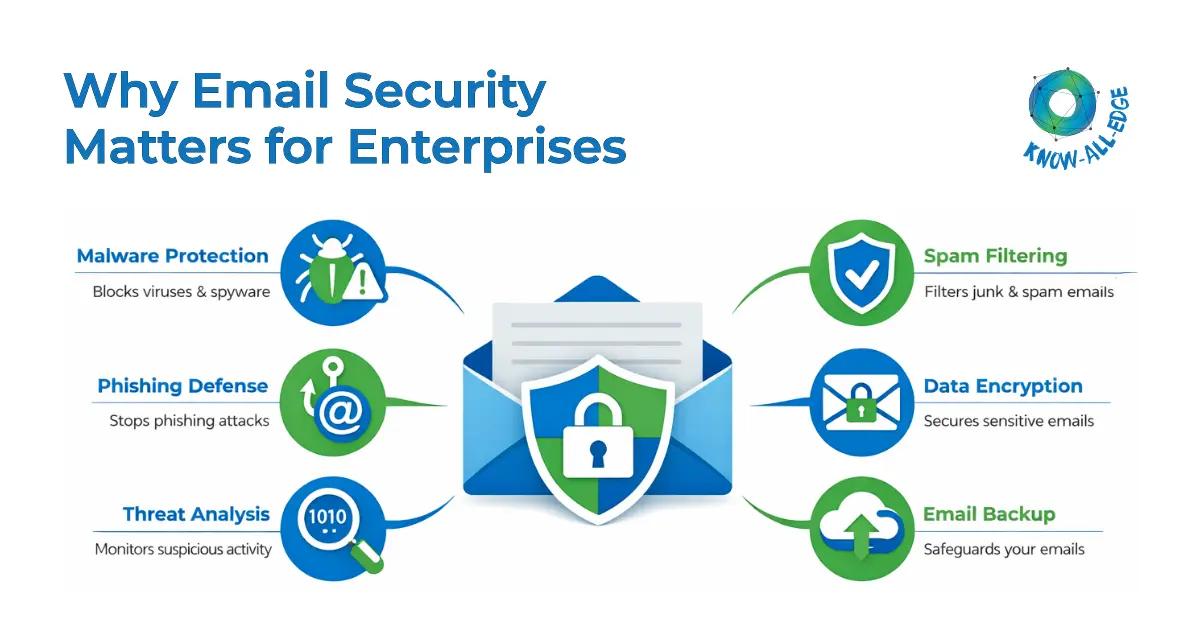
Modern email security solutions address both technical vulnerabilities and user-driven risk to protect sensitive data, financial processes, and operational continuity.
What Is Email Security Solution
Email security solutions refer to technology platforms and services designed to protect email systems from threats such as malicious attachments, phishing, impersonation, malware, and data loss. These solutions combine multiple detection techniques, authentication enforcement, and response capabilities to safeguard email communication. For a broader conceptual foundation, see our Email Security Guide.
Effective solutions often integrate threat intelligence, behavioral analysis, and policy-based controls to reduce risk in complex enterprise environments.
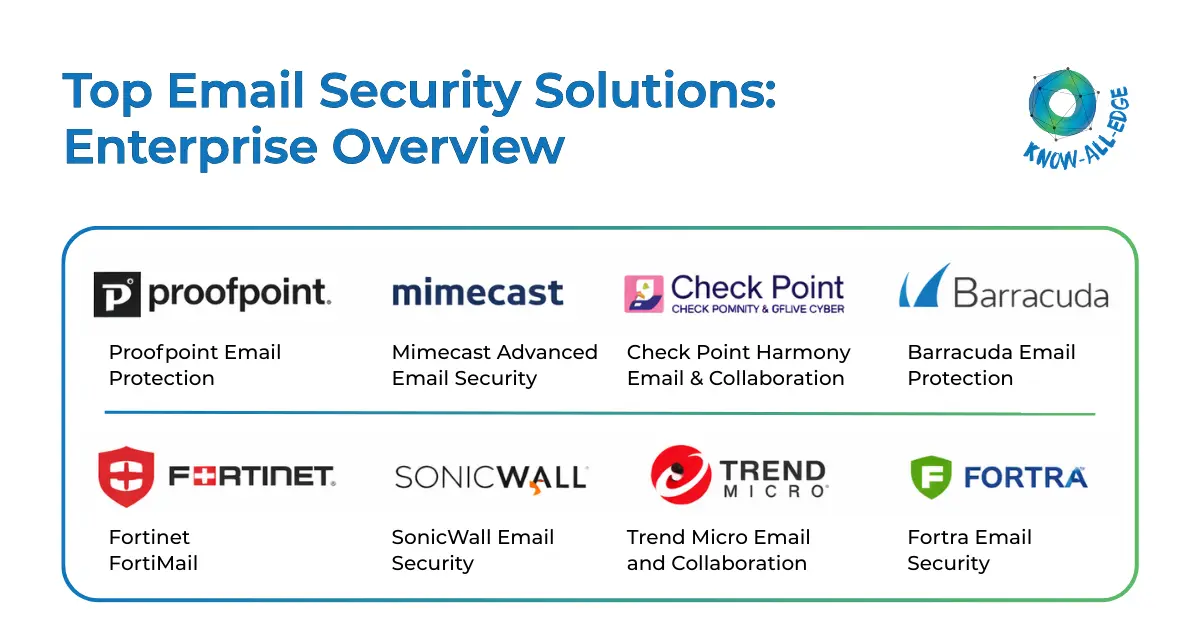
Top Email Security Solutions: Enterprise Overview
Below is an objective look at some of the top email security solutions enterprises commonly evaluate, each offering distinct approaches to email threat protection.
(1) Proofpoint Email Protection
Positioning: Threat intelligence–driven enterprise email security
Core Focus: Advanced threat detection and targeted attack prevention
Key Features:
- Advanced phishing and BEC detection
- URL rewriting and attachment sandboxing
- Impersonation protection
- Granular policy controls
- Detailed reporting and risk analytics
Benefits:
- Strong visibility into user-targeted threats
- Supports mature SOC environments
- Risk-based prioritization for incident response
Deployment Options:
- Cloud-based secure email gateway
- API-based integration with Microsoft 365
Typical Use Case:
- Large enterprises with dedicated security operations teams requiring deep threat visibility and control.
(2) Mimecast Advanced Email Security
Positioning: Integrated email security, continuity, and compliance platform
Core Focus: Threat protection with built-in resilience
Key Features:
- Spam and malware filtering
- Targeted threat protection
- Data loss prevention (DLP)
- Email archiving
- Business continuity during outages
Benefits:
- Reduces downtime risk
- Combines security and compliance in one platform
- Simplifies vendor stack for regulated sectors
Deployment Options:
- Cloud-native platform
Typical Use Case:
- Regulated industries needing email continuity and compliance alongside threat protection.
(3) Check Point Harmony Email & Collaboration
Positioning: Unified protection for email and collaboration platforms
Core Focus: AI-driven security across Microsoft 365 and Google Workspace
Key Features:
- AI-based phishing and malware detection
- API-level inbox protection
- Protection for Teams, SharePoint, Google Drive
- Real-time global threat intelligence
Benefits:
- Secures email and collaboration traffic in one framework
- Reduces shadow IT exposure
- Centralized management
Deployment Options:
- API-based cloud integration
Typical Use Case:
- Enterprises standardizing on Microsoft 365 or Google Workspace seeking unified protection.
(4) Barracuda Email Protection
Positioning: Balanced gateway + inbox security solution
Core Focus: Cloud-based threat filtering and account protection
Key Features:
- Gateway filtering
- AI-based phishing detection
- Account takeover protection
- Email encryption
- DLP capabilities
Benefits:
- Simplified administration
- Broad coverage across inbound and outbound traffic
- Suitable for mid-to-large enterprises
Deployment Options:
- Cloud-based or hybrid
Typical Use Case:
- Organizations seeking comprehensive yet manageable protection without complex SOC tooling.
(5) Fortinet FortiMail
Positioning: Integrated email security within broader security fabric
Core Focus: Email protection aligned with network security controls
Key Features:
- Anti-spam and anti-malware
- DLP and encryption
- Threat intelligence integration
- On-premises and virtual appliance options
Benefits:
- Seamless integration with Fortinet firewalls
- Consistent policy enforcement across network and email
- Strong for security fabric environments
Deployment Options:
- On-premises, virtual, or cloud
Typical Use Case:
- Enterprises already invested in Fortinet infrastructure.
(6) SonicWall Email Security
Positioning: Layered protection for mid-market and enterprise
Core Focus: Phishing, ransomware, and BEC defense
Key Features:
- Real-time threat intelligence
- Anti-spam filtering
- Outbound scanning
- Email encryption
Benefits:
- Balanced traditional and modern controls
- Straightforward deployment
- Cost-effective for distributed environments
Deployment Options:
- Cloud or on-premises
Typical Use Case:
- Organizations needing layered protection without highly complex architecture.
(7) Trend Micro Email and Collaboration Security
Positioning: AI-powered threat detection across email and collaboration
Core Focus: Machine learning–driven advanced threat protection
Key Features:
- Advanced phishing detection
- Impersonation protection
- Sandbox analysis
- Centralized management console
Benefits:
- Strong detection of emerging threats
- Integrated security across SaaS platforms
- Consolidated policy enforcement
Deployment Options:
- Cloud-native, API-based
Typical Use Case:
- Enterprises requiring advanced detection with centralized visibility.
(8) Fortra Email Security
Positioning: Compliance-driven email protection for hybrid environments
Core Focus: Content security, encryption, and regulatory compliance
Key Features:
- Inbound and outbound filtering
- Data loss prevention
- Email encryption
- Compliance enforcement tools
Benefits:
- Strong for regulated sectors
- Hybrid environment compatibility
- Focus on data governance
Deployment Options:
- Cloud, on-premises, hybrid
Typical Use Case:
- Enterprises with mixed infrastructure and strict compliance requirements.
How to Choose the Best Email Security Solutions
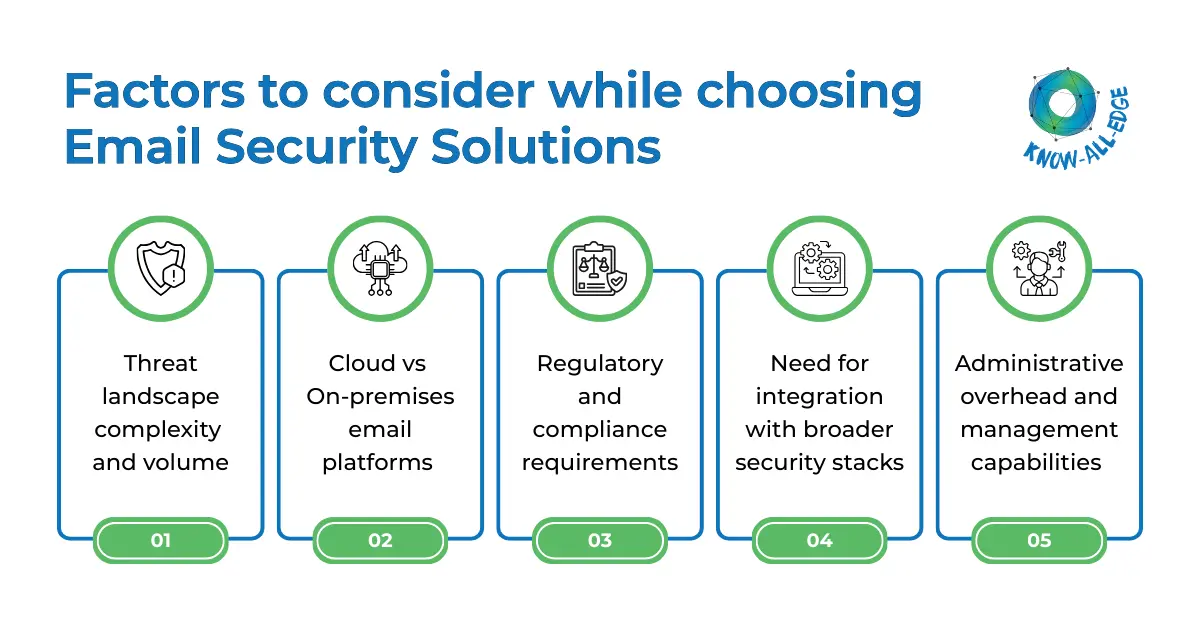
Selecting the right best email security solutions depends on organizational priorities, including:
- Threat landscape complexity and volume
- Cloud vs on-premises email platforms
- Regulatory and compliance requirements
- Need for integration with broader security stacks
- Administrative overhead and management capabilities
Enterprises should evaluate solutions through controlled pilot testing, risk modeling, and integration assessment rather than feature comparison alone. A strategic evaluation should align tool capabilities with operational needs.
For a detailed breakdown of the technology options and how they work, see our overview of Email Security Tools.
How We Help
Selecting and implementing effective and best Email Security Solutions requires careful assessment of current controls, threat exposure, and business priorities.
We help enterprises evaluate gaps across email threat detection, authentication, policy enforcement, and integration with overall security architectures. Our approach is vendor-neutral, focusing on strategic alignment and measurable security outcomes rather than product marketing.
Whether you are reviewing existing tools or evaluating new Email Security Solution Providers, we provide practical advisory support, implementation guidance, and risk-aligned strategies tailored to enterprise environments.
Conclusion
Enterprises today face increasingly sophisticated email threats that cannot be addressed by basic filtering alone. The most effective email security strategies combine threat intelligence, behavior-based detection, authentication enforcement, and integration with broader security postures.
By aligning technology selection with organizational risk and operational goals, CISOs and IT leaders can implement email security solutions that not only protect communication channels but also support secure business continuity.
Want us to help you find the best solutions to secure your emails? Connect with us today!
FAQs: Email Security Solutions
What are the top email security solutions available for enterprises?
Several established options include Proofpoint Email Protection, Mimecast Advanced Email Security, Check Point Harmony Email, Barracuda Email Protection, Fortinet FortiMail, SonicWall Email Security, Trend Micro Email and Collaboration Security, and Fortra Email Security. Selection should be aligned with enterprise risk and operational needs.
How do advanced email security solutions differ from basic filtering?
Advanced solutions use AI, behavioral analysis, real-time threat intelligence, and contextual evaluation to detect sophisticated threats such as BEC and targeted phishing, beyond what simple signature or rule-based filters offer.
Do cloud platforms eliminate the need for dedicated email security solutions?
Built-in vendor protections (e.g., from Microsoft or Google) provide basic safeguards, but enterprises with significant risk exposure typically layer dedicated email security solutions for comprehensive threat coverage.
How often should organizations reassess their email security tools?
Enterprises should periodically reassess tools in response to new threat trends, platform changes, or shifts in regulatory requirements to ensure ongoing effectiveness.
Are all email security solutions equally suited for every enterprise?
No. The right solution depends on specific business needs, cloud adoption, compliance demands, and internal security maturity.
