 Skip to content
There’s a version of your company right now where software isn’t just answering questions, it’s making calls, moving money, touching customer data, and doing it all without waiting for a human to say “go ahead.” That’s not a future scenario. That’s already happening, right now, inside real companies. Agentic AI has quietly moved from pilot projects to production systems, and most security teams are still building defenses for a threat model that no longer exists.
For years, AI security meant guarding a chatbot: watch the prompts going in, watch the outputs coming out, filter anything awful. Simple enough. But agentic AI doesn’t work like that.
These systems plan, reason, remember, and act, often across multiple tools and multiple agents, with very little human hand-holding in between. That autonomy is exactly why enterprises want them. It’s also exactly why they’re so hard to secure.
What Do We Mean by Agentic AI Security?
Agentic AI security is the practice of protecting AI agents that can plan, decide, and act on their own, rather than just responding to a single prompt.
It’s less about locking down one model and more about securing an entire chain of behavior: how an agent interprets a goal, what tools it’s allowed to touch, what it remembers, and how it talks to other agents.
Think about the difference between reviewing someone’s answer to a single question versus supervising an employee who plans their own day, uses company systems independently, and reports back only when the task is finished. That’s the shift security teams are dealing with. Agentic systems aren’t outputs anymore, they’re operators.
The numbers back up how fast this is moving. According to McKinsey’s The State of AI in 2025 survey, sixty-two percent of organizations are at least experimenting with AI agents, and nearly a quarter are already scaling agentic systems somewhere in the business.
Gartner goes further, predicting that by 2028, a third of all generative AI interactions will involve autonomous agents acting without direct human input. This isn’t a niche experiment anymore. It’s infrastructure.
Why the Old Security Playbook Doesn’t Hold Up
Traditional application security assumes a fairly predictable path: input goes in, code processes it, output comes out. Agentic AI throws that assumption out the window in a few specific ways.
Identity gets complicated fast.
An agent frequently acts on behalf of a person or another system, inheriting whatever permissions that identity carries. Get the scoping wrong, and you’ve handed an autonomous piece of software far more access than it should ever need, a classic confused-deputy problem, just running at machine speed.
Memory becomes a long-term liability.
Unlike a one-off chatbot exchange, agents retain context: what they’ve done, what they’ve observed, what they’ve concluded matters. If an attacker manages to slip false or manipulated information into that memory, the damage doesn’t stop after one bad response. It compounds, shaping every decision that follows.
Tools turn thinking into doing.
An agent that calls APIs, writes code, or updates records isn’t just generating text, it’s taking real-world action. Every tool connection is a potential doorway for something to go wrong, whether through manipulation or simple design flaws.
Autonomy means unpredictability.
Agents interpret a goal and figure out their own path there. That flexibility is the whole point, but it also means the execution path isn’t fixed the way a traditional software workflow is.
Multi-agent systems multiply the risk.
When agents pass information to each other, coordinate tasks, or validate one another’s work, a single compromised agent can quietly influence the reasoning of others. Mistakes and manipulations don’t stay contained, they spread across the system.
None of this is theoretical risk. It’s architectural risk, baked into how these systems are built to operate.
The Threats Security Teams Actually Need to Watch For
OWASP’s Agentic AI Threats framework is one of the more useful references here, giving structure to what would otherwise feel like a scattered list of new problems. A few worth knowing well:
- Memory poisoning, where attackers corrupt stored context to steer future decisions.
- Tool misuse, where an agent is tricked into calling a legitimate tool for a harmful purpose.
- Privilege compromise, where weak permission structures let an agent’s access quietly expand.
- Cascading hallucination, where false information spreads and compounds through reasoning or agent-to-agent communication.
- Agent communication poisoning, where messages between agents are corrupted to misdirect an entire workflow.
- Prompt injection, where crafted instructions manipulate an agent’s reasoning, override its intended objectives, or influence the actions it takes.
- Identity spoofing, where an attacker impersonates an agent or user to trigger unauthorized actions.
These threats rarely look like traditional attacks. There’s no malware to catch or exploit to patch, just an agent doing exactly what it was manipulated into believing was the right thing to do. That’s what makes agentic risk so different to defend against.
Building a Security Model That Actually Fits Agentic AI
Securing agentic systems means protecting the internal workflow itself, not just the edges of it. That generally breaks down into four connected areas.
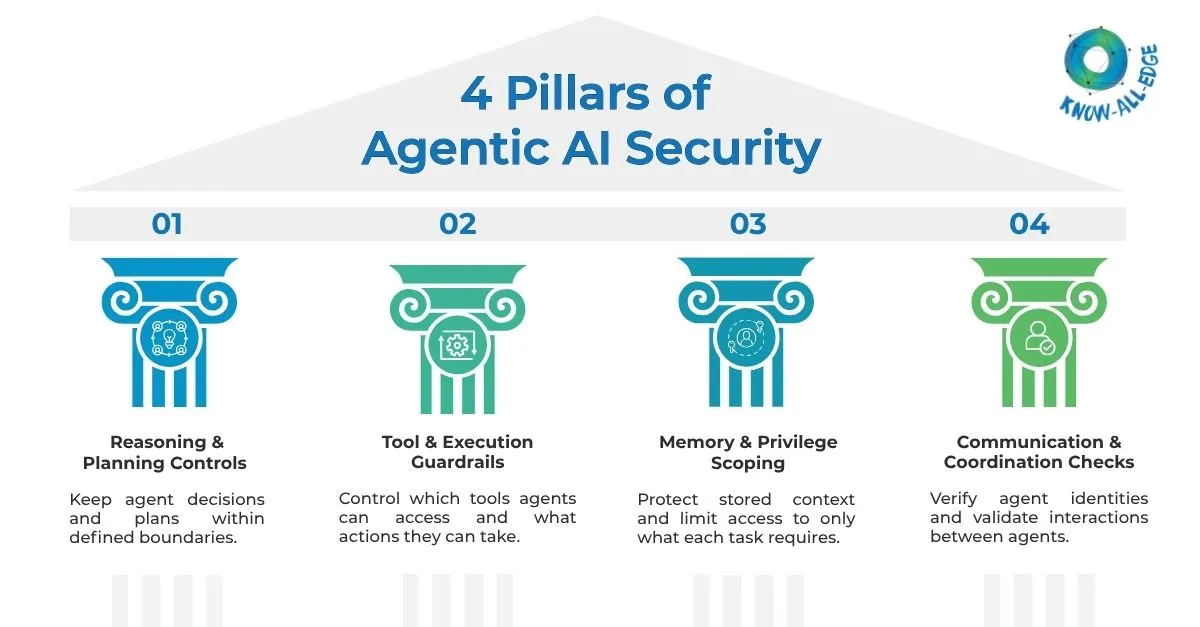
Reasoning and planning need boundaries. An agent should have limits on how far it can expand a plan or reinterpret a goal, with reflective changes reviewed rather than automatically accepted.
Tools and execution need permission checks before anything runs, isolated environments for actions to take place in, and tools made available only when genuinely needed for the task at hand.
Memory and privilege scope need validation on what gets written, segmentation so different types of information stay separate, and short-lived, minimal credentials rather than broad, standing access.
Communication and coordination between agents need verified identities, validated messages, and clear rules about which agents are even allowed to talk to each other in the first place.
Behind all four is one simple truth: AI agents are non-human identities, and most organizations already have more of them than human users.
Four Habits Worth Adopting Right Now
A few practical principles are emerging as near-universal starting points, regardless of industry:
Keep new agents on a short leash.
The same way you wouldn’t hand a brand-new hire the keys to everything on day one, agents that haven’t earned trust should operate under human oversight until they’ve proven reliable.
Sandbox and limit privilege by default.
Give agents only the access a task requires, only for as long as it’s needed. Least privilege isn’t a new idea, but it matters more here than almost anywhere else.
Treat training and reference data as sensitive.
Research has shown that inserting as few as five manipulated documents into a dataset of millions can influence an AI system’s behavior with alarming consistency. If data can poison an agent, it deserves the same protection as your other sensitive assets.
Secure the action layer, not just the output.
With agentic systems, the real risk usually isn’t what the model says, it’s what it does next: the API it calls, the transaction it triggers, the code it executes.
Where This Leaves CISOs and Security Teams
None of this means organizations should slow down on agentic AI. The productivity gains are real, and the pressure to adopt is only growing. What it does mean is that security can’t be an afterthought bolted onto agents after deployment. It has to be built into how agents reason, what they’re allowed to touch, and how their actions are tracked from the very first line of code.
This is exactly where a lot of internal teams get stuck, not because they lack awareness, but because operationalizing identity, monitoring, and access controls across a growing fleet of autonomous agents is a genuinely complex, ongoing job.
That’s where having the right implementation partner matters. At Know All Edge, we work with organizations to design and roll out practical AI workforce security frameworks, and we stick around to provide ongoing support as agentic systems scale and evolve, so your security model grows alongside your AI, instead of playing catch-up with it.
FAQs on Agentic AI
How is agentic AI security different from regular AI or LLM security?
Traditional AI security mostly focuses on prompts and outputs. Agentic AI security has to cover the entire decision-making process, including memory, tool access, identity, and communication between multiple agents, since these systems take real actions rather than just generating text.
Why do AI agents need their own identity management approach?
Agents are often ephemeral, created for a specific task and then retired, and they frequently act on behalf of a user or another system. Traditional identity tools built for human logins weren’t designed to handle that kind of short-lived, delegated access at scale.
What happens when AI agents transact without verified identity?
Without a verified identity, there’s no way to know who authorized the action or who’s accountable if something goes wrong. The agent could end up with access it was never meant to have, act on someone’s behalf without real oversight, or get impersonated by an attacker. And since there’s no clear record of what happened or why, tracing the problem afterward becomes nearly impossible.
How can agentic AI services be safely deployed without compromising security?
Give each agent its own verified identity instead of treating it as anonymous. Grant only the access it needs, only for as long as it needs it. Run new or untrusted agents in a controlled environment until they’ve proven reliable, and log every action so it can be traced later. Add human review for higher-risk tasks. Done this way, security doesn’t slow deployment down, it just becomes part of how the system is built from the start.


