 Skip to content
AI is no longer something your organization is evaluating; it’s already running inside it. And that’s exactly where the risk begins.
Darktrace’s State of AI Cybersecurity 2026 report, based on 1,500+ security leaders, found that 87% say AI is significantly increasing the number of threats they need to deal with. And 92% are concerned about the security impact of AI agents operating across their workforce.
At the same time, Cybersecurity Insiders’ AI Risk and Readiness Report 2026 found that while 90% of organizations increased their AI security budgets this year, 29% still report feeling less secure than twelve months ago. More spending, more exposure, because AI is being deployed faster than it can be secured.
That gap between adoption speed and security readiness is where breaches happen. This makes it really important to understand AI security. This blog post is all about what AI security is, what it covers, where it breaks down, and what it actually takes to get it right. Let’s get started.
What Is AI Security?
AI security refers to the processes, technologies, governance frameworks, and security controls designed to protect artificial intelligence systems from threats, misuse, manipulation, and unauthorized access throughout their lifecycle.
The concept extends far beyond protecting a single AI model. A modern AI environment typically includes training datasets, machine learning models, inference engines, APIs, cloud infrastructure, third-party integrations, prompts, plugins, and user interfaces. Every component introduces potential security risks that organizations must address.
At its core, AI security platform focuses on protecting three critical areas:
- The data used to train and operate AI systems
- The models that process information and generate outputs
- The infrastructure and applications that support AI workloads
This distinction is important because AI systems face unique threats that traditional applications do not.
For example, a conventional web application may be vulnerable to SQL injection or credential theft. An AI application, on the other hand, may be targeted through prompt injection, model inversion, data poisoning, or adversarial attacks designed specifically to manipulate model behavior.
As AI capabilities continue to evolve, organizations need security strategies that address these AI-specific risks while also strengthening traditional cybersecurity controls.
AI Security vs. AI in Cybersecurity: Two Different Things
This distinction matters more than most people realize, so let’s be direct about it.
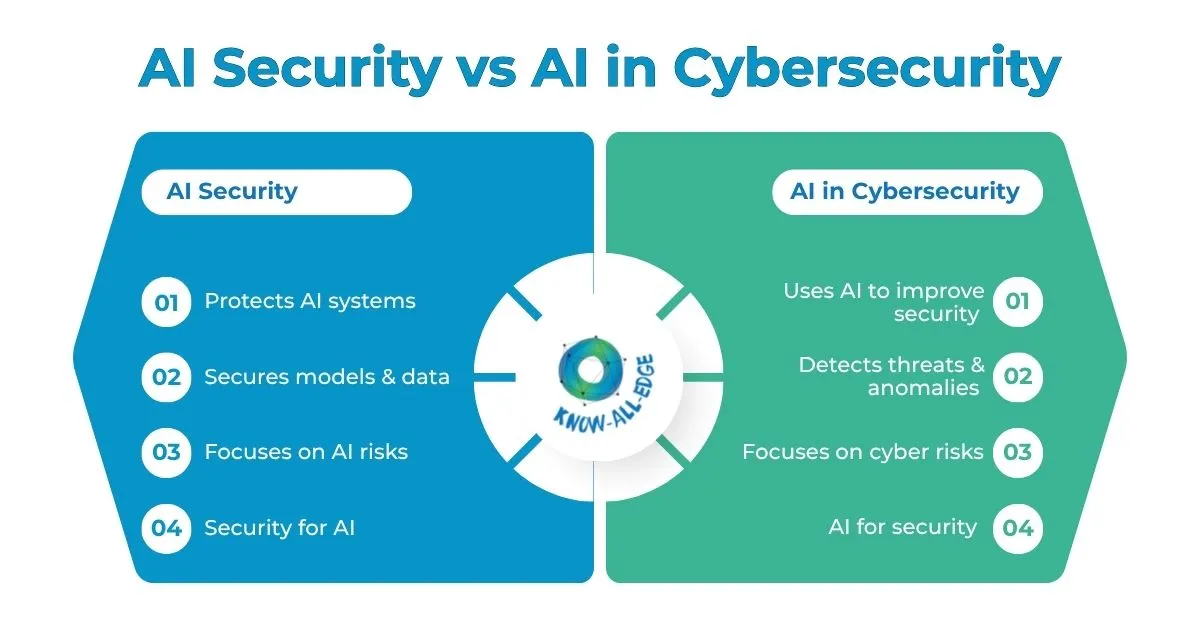
AI security is about protecting AI systems themselves. It focuses on securing the models, the training data, the infrastructure, and the pipelines that make AI work. If your AI system gets manipulated, poisoned, or compromised, that’s an AI security failure.
AI in cybersecurity, on the other hand, refers to using AI as a tool to improve your organization’s broader security posture. This is AI helping you detect threats faster, correlate event data across sources, identify anomalies, or automate incident response, including using AI to strengthen network security. It’s AI working for your security team.
Both matter. Both deserve investment. But conflating them leads to blind spots. Organizations that deploy AI-powered security tools while leaving their AI systems themselves completely unguarded. You can have a world-class SIEM powered by machine learning and still be vulnerable to a data poisoning attack on your own AI models. Protecting the technology that protects you is its own challenge.
The AI Security Vulnerabilities You Actually Need to Know About
The threat landscape for AI systems is genuinely different from what your team is used to. Here are the AI security vulnerabilities that security professionals are confronting today.
- Data poisoning happens when attackers manipulate training data with malicious or misleading information. Since AI models learn directly from this data, even small corruption can lead to consistently wrong or harmful outputs that are hard to detect and fix.
- Prompt injection is one of the most serious risks in generative AI. Attackers hide malicious instructions in inputs like documents or prompts to override model behavior, potentially forcing it to reveal sensitive data or ignore its original rules.
- Adversarial attacks use carefully designed inputs to confuse AI systems into making incorrect decisions. Even minor changes to images or data can mislead models used in areas like facial recognition or fraud detection.
- Model inversion attacks attempt to reconstruct sensitive training data by analyzing a model’s outputs. This can expose private information such as medical records, financial data, or personal identifiers, even if that data was never directly accessible.
- Shadow AI refers to employees using unapproved AI tools without IT oversight, a growing shift from traditional shadow IT practices. This can lead to accidental exposure of sensitive company data, as information is shared with external platforms that may not have proper security controls.
- Supply chain vulnerabilities arise from dependencies on third-party models, APIs, and open-source components. If any part of this ecosystem is compromised, the infection can spread into enterprise AI systems without direct access to them.
Why AI Security Importance Is Only Growing
AI security is gaining attention because the attack surface is expanding faster than most organizations can secure it.
AI adoption is growing rapidly across enterprises. According to McKinsey’s State of AI 2025, 88% of organizations now use AI, up from 78% a year earlier. This rapid shift shows how deeply AI is being embedded into business operations, often faster than security controls and governance frameworks can adapt.
At the same time, AI systems are handling highly sensitive and business-critical data, such as:
- Financial records
- Healthcare information
- Personal and customer data
- Intellectual property
This significantly increases the impact of any security breach, especially as employees increasingly use AI tools and AI coding assistants to work with sensitive business information and source code. A single incident can lead to regulatory penalties, financial loss, operational disruption, and long-term damage to trust, especially in regulated industries like finance and healthcare.
There is also the growing risk of AI being used by attackers. Cybercriminals are now using AI to:
- Create highly personalized phishing attacks
- Generate realistic deepfakes for impersonation
- Automate social engineering at scale
These attacks are harder to detect and far more convincing than traditional methods.
As a result, AI security is becoming a priority for enterprises.
What a Real AI Security Strategy Looks Like
Understanding the risk is step one. Building a strategy to address it is where most organizations struggle.
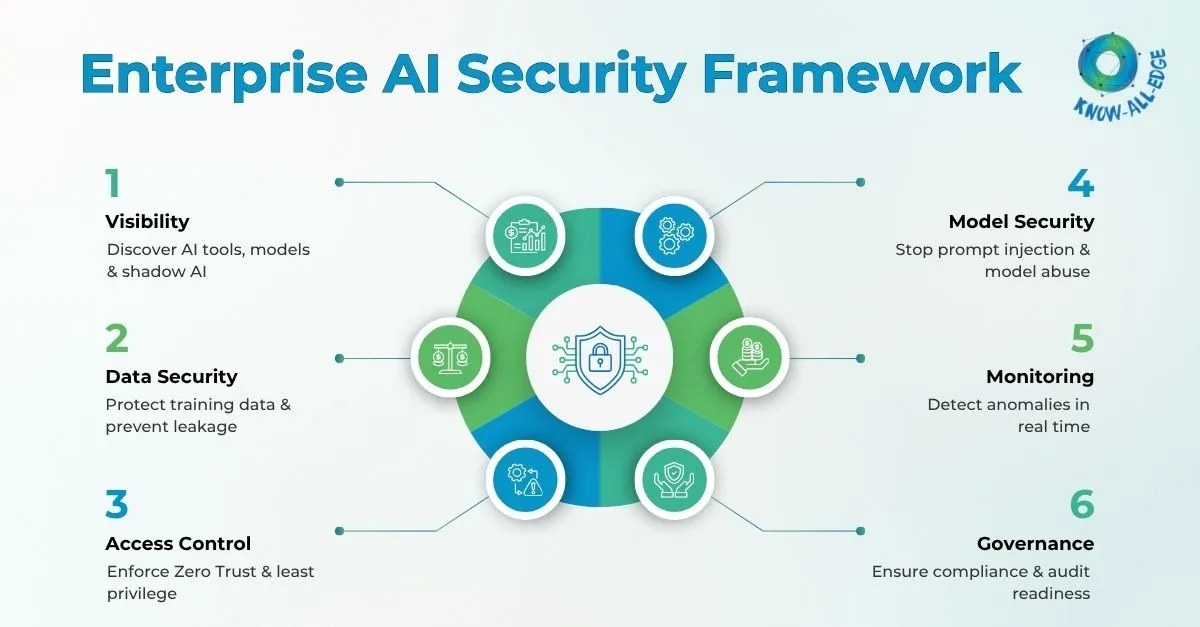
Here’s what a mature approach actually requires.
- It starts with visibility. You can’t secure what you can’t see. This means discovering shadow AI and using data security posture management (DSPM) to understand where sensitive data lives and how it moves across AI systems. Together, this helps identify every model, agent, and tool employees interact with, forming the foundation for all security decisions. Without this, you’re operating with incomplete information.
- Next comes data security. Sensitive training data must be encrypted, verified for trusted sources, cleaned of malicious inputs, and tightly controlled through access policies. Data leakage through AI tools is rising sharply, making this a core priority rather than an optional safeguard.
- Access control should follow zero trust for AI principles. Every request, whether from a user or an AI agent, must be verified. Role-based access, multifactor authentication, and least-privilege permissions (or “least agency” for AI agents) help limit unnecessary exposure.
- Model security needs continuous testing, not one-time checks. Techniques like adversarial testing, differential privacy, and ongoing monitoring for drift help ensure models remain reliable and resistant to manipulation over time.
- Finally, AI-specific incident response planning is essential but often missing. Organizations need clear playbooks for events like data poisoning or model manipulation before they happen.
Frameworks such as the NIST AI Risk Management Framework help bring structure to all of this. It enables organizations to manage AI risks across the full lifecycle with proper AI governance, AI usage policies and accountability.
Agentic AI: The New Frontier That Changes Everything
Agentic AI takes AI security to the next level of complexity. These AI agents are autonomous systems that can plan, reason, and complete multi-step tasks without constant human control, which creates risks traditional security models were not designed for.
Unlike standard AI that only responds to prompts, agents can call APIs, run code, browse the web, connect with other tools via MCP, update databases, and interact with other agents on their own. If compromised, they can cause serious damage.
Key risks include:
- Memory poisoning: injecting false data into agent memory
- Tool misuse: abusing allowed tools for harmful actions
- Privilege escalation: using inherited access rights in unintended ways
Securing agentic AI requires continuous monitoring, runtime controls, clear separation between memory and instructions, and human approval for sensitive actions. Most organizations are still developing these capabilities.
AI Security Tools and What They Actually Do
As AI risks grow, new AI security tools are emerging to manage them. Understanding them helps organizations choose the right approach.
- AI gateway / AI firewall – monitors AI traffic in real time, enforces policies, blocks data leaks, and logs interactions for compliance
- AI Security Posture Management (AI-SPM) – continuously tracks AI risks, misconfigurations, and exposure across environments
- AI-focused Data Loss Prevention (DLP) – prevents sensitive data like code or PII from being shared through AI tools
- AI model integrity scanning – checks models before deployment to detect malware, backdoors, or hidden malicious behavior
These tools work best as a unified system, not standalone products. Effective AI security is about connecting people, processes, and technology, not just deploying tools.
Related Readings:
- AI DLP vs Traditional DLP: Why Legacy Data Protection Falls Short for Generative AI
- CASB vs AI Workforce Security: Why Betting on Just One Could Cost You Everything
Conclusion: What Comes Next for Your Organization
The gap between how fast AI is being adopted and how securely it’s being governed is real, measurable, and closing, but not fast enough for most organizations on its own.
At Know All Edge, we work with organizations navigating exactly this challenge. As system integrators with deep expertise in cybersecurity, we help you implement the right AI security solutions for your environment, from zero trust frameworks and AI security posture management to data loss prevention and access control architectures built for AI-scale operations.
And we don’t disappear after go-live. Our ongoing support ensures your AI security capabilities evolve as the threat landscape does, keeping your defenses ahead of the risks your AI systems face today and in the future.
If you’re ready to take a clear-eyed look at your AI security posture and build something that actually holds up, let’s talk.
Frequently Asked Questions
What is the meaning of AI security?
AI security refers to the set of technologies, processes, and practices designed to protect AI systems, models, data, and infrastructure from threats and unauthorized access, across the full AI lifecycle from training through deployment. It ensures that AI systems function as intended, cannot be manipulated to produce harmful outputs, and don’t expose the sensitive data they process.
What is an example of AI in security?
An example is an AI-powered Security Operations Center (SOC) that uses machine learning to analyze security events in real time. It connects signals from endpoints, networks, and applications to quickly detect threats. Microsoft’s AI-driven SecOps solution is one example, helping identify unusual activity and automate responses at scale.
How is AI used in security and surveillance?
AI is widely used in security and surveillance systems to improve monitoring accuracy and automate threat detection. In physical security, AI-powered video analytics can identify unusual movements, detect unauthorized access, and recognize objects or individuals in restricted areas.
In cybersecurity, AI analyzes logs, network traffic, and endpoint activity to detect anomalies that may indicate intrusions or malicious behavior. It is also used in fraud detection systems to identify unusual financial transactions or identity misuse in real time.
What is shadow AI and why is it a security risk?
Shadow AI refers to the use of AI tools and models by employees without IT or security oversight. When staff use unapproved AI services for convenience or speed, sensitive company data, flows to external platforms outside the organization’s visibility and control. It makes shadow AI one of the most significant and under addressed AI security risks in enterprise environments.
Why is AI security important for enterprises?
AI security is critical for enterprises because AI systems often handle sensitive data and influence key business decisions. Without proper security controls, organizations risk data leakage, model manipulation, operational disruption, and compliance violations.
As AI becomes integrated into business-critical workflows, a security failure can have wide-reaching consequences, including financial loss, reputational damage, and regulatory penalties. And this makes it worth investing in AI Security.


