 Skip to content
Every senior security leader managing a hybrid workforce faces this question at some point:
- Do we invest deeper in CASB, or
- Do we move toward ZTNA?
- And if both, then how?
The two are often mentioned together. Sometimes even used interchangeably. But they do different jobs and treating them as the same is one of the quieter mistakes enterprise security teams make.
This blog breaks down CASB vs ZTNA clearly. Let’s begin.
Why This Conversation Is Happening Now
Cloud adoption moved fast. The shift to remote and hybrid work moved even faster.
Traditional perimeter-based security, built on the assumption that everything inside the network wall is trusted, simply could not keep up.
As per MarketsandMarkets, the global ZTNA market is projected to grow from USD 1.34 billion in 2025 to USD 4.18 billion by 2030, at a CAGR of 25.5%. On the other side, as per Mordor Intelligence, the CASB market is expanding at a healthy 17.04% CAGR through 2030.
Both are growing for the same reason: organizations have realized that VPNs and firewall-first models are not enough for a world where work happens everywhere and applications live in the cloud.
What Is CASB?
A Cloud Access Security Broker sits between your users and the cloud services they access. Think of it as a security checkpoint, built specifically for cloud apps like Microsoft 365, Salesforce, or any SaaS product your teams use daily.
It does not just watch traffic. It applies policies, flags risky behavior, enforces compliance rules, and blocks threats.
The four things CASB handles well:
- Visibility: Shows you what cloud apps people are actually using, including the ones IT never approved. Shadow IT is a real risk, and most organizations discover dozens of unsanctioned apps the moment a CASB goes live.
- Compliance enforcement: For industries under GDPR, HIPAA, or PCI-DSS, CASB automates the monitoring and reporting that auditors expect.
- Data protection: Applies data loss prevention (DLP) rules across cloud storage and transfers. If someone tries to upload a sensitive file to a personal cloud account, a CASB catches it.
- Threat detection: Surfaces abnormal login behaviors, malware in cloud storage, and compromised accounts before they escalate.
CASB is a mature technology. It is well understood, relatively straightforward to deploy in cloud-heavy environments, and fits comfortably into most existing security stacks.
What Is ZTNA?
Zero Trust Network Access works on one principle: no user, device, or system is trusted by default.
Not inside the office. Not outside. Every access request is verified, every time, based on who the user is, what device they are on, where they are connecting from, and what they are trying to reach.
ZTNA does not give broad network access. It gives application-specific access. You get in only to what you need, and only after identity and context are confirmed.
This is what makes it fundamentally different from a VPN. A VPN, once connected, typically opens up a large slice of the network. ZTNA keeps the blast radius small.
Zero trust implementation also makes internal applications invisible to the public internet by default. An attacker cannot target what they cannot find.
Common situations where ZTNA tools add real value:
- Securing remote and hybrid workforce access without broad VPN tunnels
- Managing third-party and contractor access with strict limits
- Protecting internal applications that were never designed to be exposed externally
- Replacing legacy VPN infrastructure that cannot scale or enforce granular policy
- Meeting ZTNA compliance requirements tied to data governance and access control
Where They Overlap and Where They Do Not
There is genuine overlap between CASB vs ZTNA, especially as vendors bundle them into unified SASE (Secure Access Service Edge) platforms. Both deal with access control. Both support compliance. Both are better than what most organizations had five years ago.
But the overlap should not blur the boundaries.
CASB does not cover private or on-premises applications. If your organization runs workloads in a private data center, or has internal tools that are not SaaS, CASB will not protect those. ZTNA will.
ZTNA was not designed for SaaS governance or cloud DLP. Shadow IT discovery and cloud data protection are where CASB earns its keep.
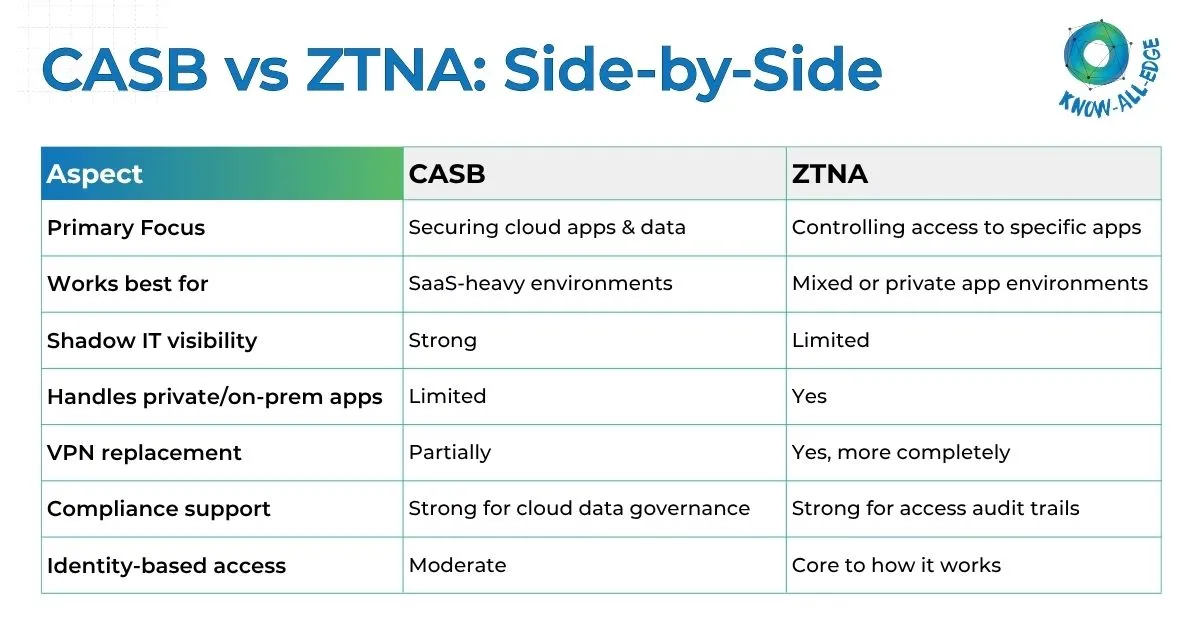
For organizations with a mixed environment and most enterprises today need both working together.
A ZTNA framework without CASB leaves cloud data exposure unchecked. CASB without ZTNA means private apps and internal resources are still vulnerable.
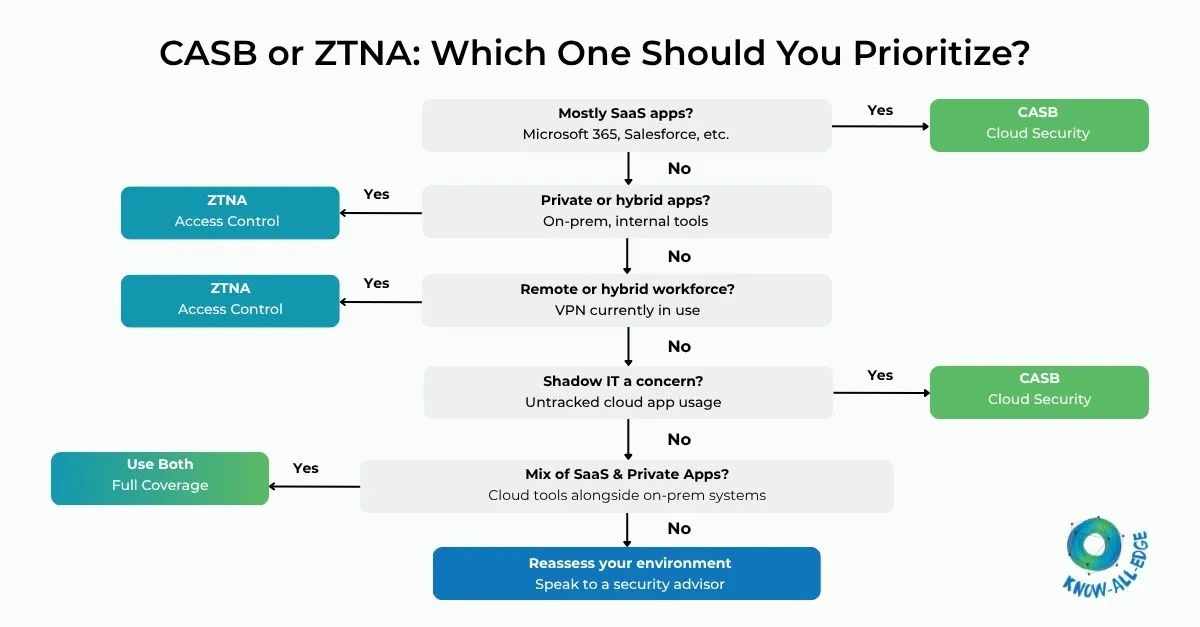
CASB vs ZTNA: Which One Should You Prioritize?
The answer to prioritizing CASB vs ZTNA depends on where your actual risks are.
Start with CASB if:
- Most of your critical workloads live in SaaS platforms
- You are in a regulated industry and need cloud compliance visibility now
- Shadow IT is a known or suspected problem
- You are trying to extend visibility beyond what your existing VPN infrastructure offers
Start with ZTNA if:
- You have a distributed workforce accessing private or hybrid applications
- You are actively reducing reliance on VPN
- Third-party and contractor access is a gap in your current setup
- You need identity-based access control for internal applications
Consider both if:
- Your environment is genuinely mixed (most large enterprises fall here)
- You are moving toward a SASE architecture
- Your compliance team is asking for end-to-end access governance
What Matters When You Actually Implement This
Unified management is underrated.
If your CASB and ZTNA solutions run on separate consoles with separate policy engines, your team spends time reconciling tools instead of managing threats. Look for platforms that bring these into a single view.
Identity is the new perimeter.
Both CASB and ZTNA depend on strong identity verification. If your IAM foundation is weak, neither solution performs well. Zero trust implementation starts with identity, not the network.
Phased rollout is realistic.
You do not have to rearchitect everything at once. Start with the highest-risk access points- privileged users, third parties, remote workers, and expand from there.
ZTNA solutions have become easier to deploy.
What was complex three years ago is now available through simpler, cloud-delivered models. The barrier to zero trust implementation has come down significantly.
Conclusion
CASB and ZTNA each do something the other cannot fully cover.
CASB owns cloud visibility, shadow IT governance, and SaaS data protection. ZTNA owns access control, private application security, and the zero trust framework that modern distributed work demands. Used together, they form the foundation of a genuinely resilient security posture.
We take time and help organizations plan and implement the best cybersecurity solutions like ZTNA and CASB that fit their actual environment. Whether you are replacing an aging VPN, securing a hybrid workforce, or building toward a full SASE architecture, we work through the design, vendor selection, and phased rollout alongside your team. Get in touch and start your security journey with us.
FAQ’s On CASB vs ZTNA
Do we need CASB if we already have ZTNA?
Possibly, yes. ZTNA controls secure access to applications, but it does not provide deep visibility into how users interact inside SaaS platforms. If your teams heavily use cloud apps like Microsoft 365, Salesforce, or Google Workspace, CASB adds important controls around data protection, shadow IT discovery, and compliance monitoring.
Many organizations adopt ZTNA first for access control, then add CASB as cloud usage expands.
If we already use CASB, should we still invest in ZTNA?
That depends on your remote access and application security needs. CASB secures cloud applications well, but it does not replace identity-based access control for private applications or internal systems. If your organization still relies on VPNs, hybrid infrastructure, or third-party access, ZTNA becomes highly relevant. Most enterprises eventually realize CASB alone cannot fully support a zero-trust implementation strategy.
Can CASB and ZTNA help with compliance requirements?
Yes, both technologies support compliance in different ways.
- CASB helps organizations monitor cloud usage, apply data protection policies, and maintain visibility required for regulations like GDPR or HIPAA.
- ZTNA supports compliance by enforcing least-privilege access and maintaining detailed access logs.
Together, they strengthen audit readiness and reduce the risk of unauthorized data exposure.
Which should I prioritize first, CASB or ZTNA?
It depends on your biggest security challenge. If cloud visibility, SaaS governance, and data protection are the priority, start with CASB. If remote access security, VPN replacement, and application-level access control matter more, ZTNA is usually the better first step. Many organizations eventually implement both together.


