
Over the past few years, Zero Trust Network Access (ZTNA) has become a foundational element of modern secure access strategies. Many organizations initially adopted ZTNA to replace VPN-based remote access and reduce exposure of internal networks.
However, as enterprises expand cloud adoption, support hybrid workforces, and integrate SaaS applications, many security leaders are realizing that application-level access alone is not enough.
Traditional ZTNA implementations were primarily designed to protect access to specific applications. But enterprise environments today involve far more complex connectivity patterns: unmanaged devices, legacy applications, multi-cloud workloads, and third-party users accessing resources from anywhere.
This is where Universal ZTNA comes into the picture.
It extends the Zero Trust model beyond application access and enforces consistent security policies across all user-to-resource connections – whether users are accessing SaaS platforms, internal applications, or services across hybrid environments.
What is Universal ZTNA?
It is an evolution of traditional ZTNA that applies Zero Trust principles across all users, devices, applications, and network connections.
Instead of focusing only on application-level access, it ensures that every connection is verified continuously, regardless of where the user is located or what device they are using.
Key principles:
- Identity-first security
- Device posture validation
- Continuous trust verification
- Least-privilege access
- Application and network traffic protection
In ZTNA architecture, users never receive implicit trust based on network location. Instead, access decisions are dynamically evaluated based on identity, device health, context, and policy.
For organizations transitioning from legacy remote access models, it helps to understand how this approach differs from older architectures such as VPN. Our comparison of ZTNA vs VPN explores that shift in detail.
Why Organizations Need Universal ZTNA
Security leaders are increasingly moving toward ZTNA because traditional access models struggle to keep up with modern IT environments.
Several trends are driving this shift.
Hybrid Workforces
Employees now access corporate resources from home networks, personal devices, and mobile environments. Security policies must apply consistently regardless of location.
Cloud and SaaS Adoption
Applications are no longer confined to corporate data centers. Organizations now run workloads across SaaS platforms, public clouds, and private infrastructure.
ZTNA allows security teams to apply the same access controls across all these environments.
Third-Party Access
Vendors, contractors, and partners often require access to internal systems. Granting VPN-based network access to external users creates unnecessary risk.
ZTNA enables secure, application-level access without exposing internal networks.
Zero Trust Initiatives
Many organizations are actively implementing Zero Trust architectures. ZTNA aligns closely with these frameworks by enforcing continuous verification and least-privilege access.
How Universal ZTNA Works
It acts as an intermediary between users and the resources they want to access.
Instead of connecting directly to the network, users connect through a policy enforcement layer that validates access requests before allowing communication.
A typical access request follows these steps:
- A user attempts to access an application or service.
- The Universal ZTNA platform verifies the user’s identity through an identity provider.
- The device posture is evaluated to confirm it meets security requirements.
- Contextual factors such as location, time, and risk signals are analyzed.
- Access is granted only to the specific application or service permitted by policy.
Importantly, the internal network remains hidden from the user. This approach significantly reduces the attack surface compared to traditional remote access models.
Architecture of Universal ZTNA
The architecture behind Universal ZTNA is built around several core components.
Identity Provider Integration
Access decisions begin with identity verification. ZTNA platforms integrate with identity providers such as Azure AD or Okta to authenticate users.
Policy Engine
The policy engine evaluates access requests using predefined rules that consider identity, device posture, and contextual risk signals.
Policy Enforcement Points
These components enforce the security policies by allowing or blocking access to specific applications.
Secure Application Connectors
Connectors create secure outbound connections from internal applications to the ZTNA platform, ensuring applications remain invisible to external networks.
Continuous Monitoring
ZTNA platforms continuously evaluate user activity and device posture to detect suspicious behavior.
To understand how these components interact, our breakdown of ZTNA architecture provides a deeper look at Zero Trust access design.
Benefits of Universal ZTNA
For organizations building long-term Zero Trust strategies, it offers several advantages.
Reduced Attack Surface
Applications are hidden behind identity-aware access brokers rather than exposed to the internet.
Consistent Policy Enforcement
Security policies apply across all users, devices, and environments.
Better Visibility
Security teams gain centralized visibility into user access and activity across applications.
Improved User Experience
Users access applications directly without needing to connect to corporate networks through VPN tunnels.
Scalability for Cloud Environments
ZTNA platforms are typically designed to integrate with multi-cloud and SaaS environments.
Real-World Use Cases
Universal ZTNA supports a wide range of enterprise security scenarios.
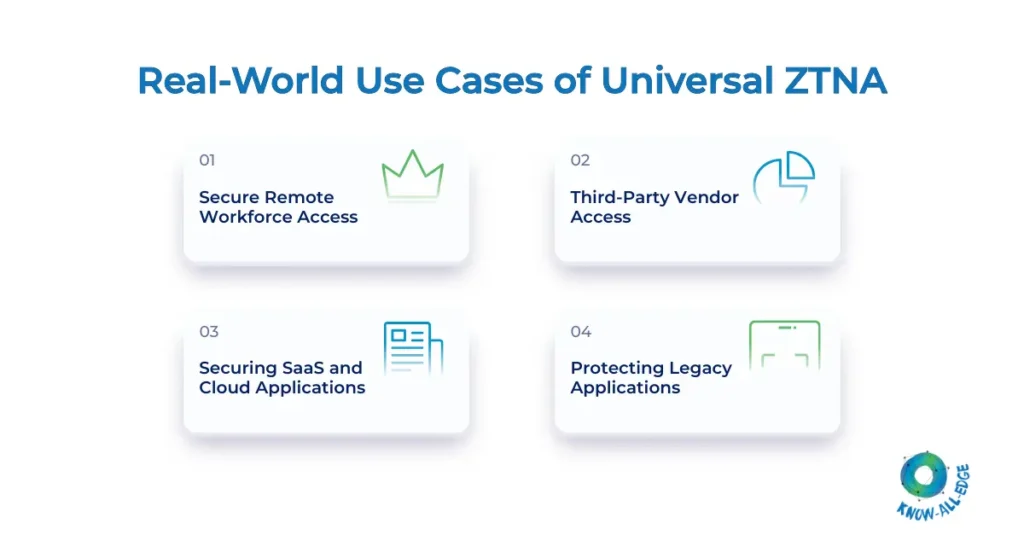
Secure Remote Workforce Access
Employees can securely access internal applications without exposing corporate networks.
Third-Party Vendor Access
Organizations can grant contractors access to specific applications without granting network connectivity.
Securing SaaS and Cloud Applications
ZTNA enables secure access to cloud-based applications without relying on network perimeter controls.
Protecting Legacy Applications
Legacy applications can be protected behind Zero Trust access controls even if they were not originally designed for internet exposure.
Vendors Offering Universal ZTNA
Several security vendors have expanded their platforms to support Universal ZTNA capabilities.
Examples include:
Many of these vendors integrate Universal ZTNA within broader SASE (Secure Access Service Edge) platforms that combine networking and security services.
Organizations evaluating vendors should consider integration capabilities with identity providers, endpoint security tools, and existing network infrastructure.
Implementation Considerations
Adopting ZTNA is not simply a technology deployment. It often requires architectural planning and phased implementation.
Security leaders typically consider several factors when planning deployment.
Identity Strategy
Strong identity management is essential because access decisions depend heavily on user identity.
Device Security
Endpoint posture checks ensure devices meet security requirements before accessing applications.
Application Mapping
Organizations must identify which applications require secure access controls and how they should be segmented.
Migration from VPN
Many organizations adopt ZTNA gradually, securing specific applications first while maintaining VPN for legacy environments.
Understanding the broader transition from legacy remote access models is important. Our comparison of Traditional ZTNA vs Universal ZTNA explains how this evolution is happening.
Conclusion
As enterprise environments become more distributed and cloud-driven, the limitations of traditional remote access models are becoming increasingly clear.
Universal ZTNA represents the next stage in the evolution of secure access architecture. Instead of protecting only specific applications, it extends Zero Trust enforcement across users, devices, and network connections.
For organizations pursuing Zero Trust strategies, it provides a more comprehensive approach to securing modern digital environments.
By combining identity verification, device posture validation, and continuous policy enforcement, it helps security teams reduce risk while enabling secure access from anywhere.
Planning to extend Zero Trust Across Organization?
If you are planning to extend Zero Trust across users, devices, and applications, we can help. At Know All Edge we help enterprises implement Universal ZTNA solutions that provide secure access regardless of device or network location. Speak with our team today.
Frequently Asked Questions
What is Universal ZTNA?
It is an advanced Zero Trust architecture that secures all user-to-resource connections across applications, networks, and devices rather than protecting only specific applications.
How is it different from traditional ZTNA?
Traditional ZTNA focuses primarily on securing access to web-based applications. Universal ZTNA extends Zero Trust controls across all applications, protocols, and devices in an organization.
Can it replace VPN completely?
In many environments, ZTNA can replace VPN for application access. However, some legacy infrastructure or administrative workflows may still require VPN connectivity.
Is Universal ZTNA part of SASE?
Yes. Many Universal ZTNA solutions are delivered as part of broader SASE platforms that combine network security services such as SWG, CASB, and firewall capabilities.
Does it work with unmanaged devices?
Yes. Many ZTNA platforms can enforce identity-based policies even when users access applications from unmanaged or personal devices.
What types of applications can it protect?
It can protect SaaS applications, internal web applications, cloud workloads, and legacy applications across hybrid environments.