 Skip to content
Modern enterprise security looks very different now. Users work from everywhere. Applications run across clouds. Data moves between SaaS tools faster than most IT teams can track. Because of this shift, old perimeter-based security models are struggling to keep up.
That is exactly why terms like ZTNA, SASE, and CASB are now part of almost every cybersecurity discussion. Many confuse these solutions with each other.
This guide explains the differences between ZTNA vs SASE vs CASB in a practical way. We will look at how they work, where they fit, and how businesses are using them today.
What is ZTNA?
Zero Trust Architecture based security works on a simple principle, never trust anyone automatically.
Zero Trust Network Access (ZTNA), verifies every user, device, and session before allowing access to applications. It does not expose the full network like a VPN usually does. Instead, users only access the exact resources they are authorized to use.
A modern ZTNA framework continuously checks:
- User identity
- Device posture
- Location and context
- Risk level
- Access behavior
This makes ZTNA solutions useful for organizations with remote employees, third-party vendors, and cloud-hosted applications.
Many companies now use ZTNA to replace legacy VPN infrastructure because VPNs often provide broad network-level access once connected.
What is SASE?
Secure Access Service Edge is a broader architecture model.
Instead of focusing only on access control, SASE combines networking and security into one cloud-delivered framework. It connects users securely while also improving network performance.
A SASE platform usually combines:
- SD-WAN
- ZTNA
- Secure Web Gateway
- Firewall-as-a-Service
- Data Loss Prevention
- Cloud security controls
The biggest advantage is consolidation. Instead of managing disconnected security tools, organizations manage policies from a centralized cloud platform.
SASE is especially useful for enterprises with multiple branch locations, global remote teams, heavy cloud usage, and hybrid infrastructures.
What is CASB?
Cloud Access Security Broker focuses specifically on cloud application security.
A CASB sits between users and cloud applications. Its job is to monitor SaaS usage, enforce policies, and protect sensitive data inside cloud environments.
CASB platforms help organizations:
- Detect shadow IT
- Monitor SaaS activity
- Prevent data leaks
- Enforce compliance policies
- Control file sharing
- Identify risky behavior
CASB became popular because companies adopted SaaS applications faster than security teams could manage them.
Today, businesses use hundreds of cloud applications without centralized visibility.
As per the 2025 SaaS Security Report by CSA, many organizations still face problems with unmanaged SaaS apps, overprivileged access, and inconsistent security enforcement.
This is where CASB becomes important.
ZTNA vs SASE vs CASB In Detail
Core Difference
The easiest way to understand ZTNA vs SASE vs CASB is this:
- ZTNA framework secures user access to applications
- CASB secures SaaS applications and cloud data
- SASE is a broader framework that can include both ZTNA and CASB along with other security services
So, ZTNA and CASB can work as standalone solutions, while SASE often combines multiple technologies into a single cloud-delivered platform.
Architecture
- ZTNA creates application-level access tunnels. Users never directly connect to the internal network. Access decisions happen dynamically based on policies. This reduces lateral movement risks during attacks.
- SASE uses a distributed cloud architecture. Security inspection happens close to users through cloud points of presence. This improves both performance and security management.
- CASB operates between users and SaaS platforms. It can work through APIs, proxies, or inline inspection methods. The focus stays on cloud visibility and governance.
Access Control
- ZTNA tools gives very granular access control. Users access only approved applications. This supports strong zero trust implementation strategies.
- SASE controls access across the entire network edge. It combines identity, networking, and security policies together.
- CASB mainly controls SaaS application access and cloud data usage. It helps security teams monitor who is accessing cloud services and what data is being shared.
Deployment Style
- ZTNA deployment is usually cloud-based or hybrid. Many vendors also support agent-based and agentless models.
- SASE is mostly cloud-native. The idea is centralized delivery from the cloud rather than hardware-heavy deployments.
- CASB solutions are generally deployed as cloud services integrated with SaaS platforms.
Visibility
- ZTNA gives strong visibility into user sessions and application access. However, it may not provide deep SaaS activity monitoring.
- SASE provides wider visibility across users, devices, applications, and network traffic.
- CASB offers the strongest visibility into SaaS usage. It can identify unsanctioned applications, risky file sharing, and abnormal cloud behavior.
Compliance Support
Compliance has become one of the biggest reasons companies adopt these technologies.
- ZTNA compliance initiatives help organizations enforce least-privilege access. This becomes important for regulations involving sensitive data access.
- CASB platforms help organizations monitor cloud activity and apply compliance controls for standards like:
- GDPR
- HIPAA
- PCI-DSS
- ISO 27001
- SASE supports compliance indirectly by unifying security controls and policy enforcement.
Performance Impact
- ZTNA improves security without exposing the entire network, but poor policy planning can create friction for users.
- SASE improves performance because traffic inspection happens closer to the user instead of routing everything through centralized data centers.
- CASB performance depends on deployment methods. API-based CASB usually creates less latency compared to proxy-based models.
Also Read:
CASB vs ZTNA: Understanding the Difference and Where Each Fits
SASE vs ZTNA: Understanding the Difference and Where They Fit
Can Organizations Use All Three?
Yes, and many enterprises already do.
In fact, modern SASE platforms often include ZTNA capabilities. Some also integrate CASB features directly into the platform. Still, dedicated CASB solutions may provide deeper SaaS visibility compared to bundled offerings.
The real decision depends on your environment, maturity level, and existing infrastructure.
Common Mistakes Companies Make
Here are some of the common mistakes you can avoid implementing any of three or all:
- Treating ZTNA as a VPN Replacement Only: ZTNA is much more than remote access. Proper implementation requires identity controls, device posture checks, and continuous verification.
- Assuming SASE is a Single Product: SASE is an architecture approach, not just one appliance or tool.
- Ignoring SaaS Risks: Many organizations secure endpoints but ignore SaaS applications completely.
- Rushing Zero Trust Implementation: Poor discovery and incomplete policy mapping can disrupt business operations during rollout.
Final Thoughts
The discussion around ZTNA vs SASE vs CASB is not about picking one winner.
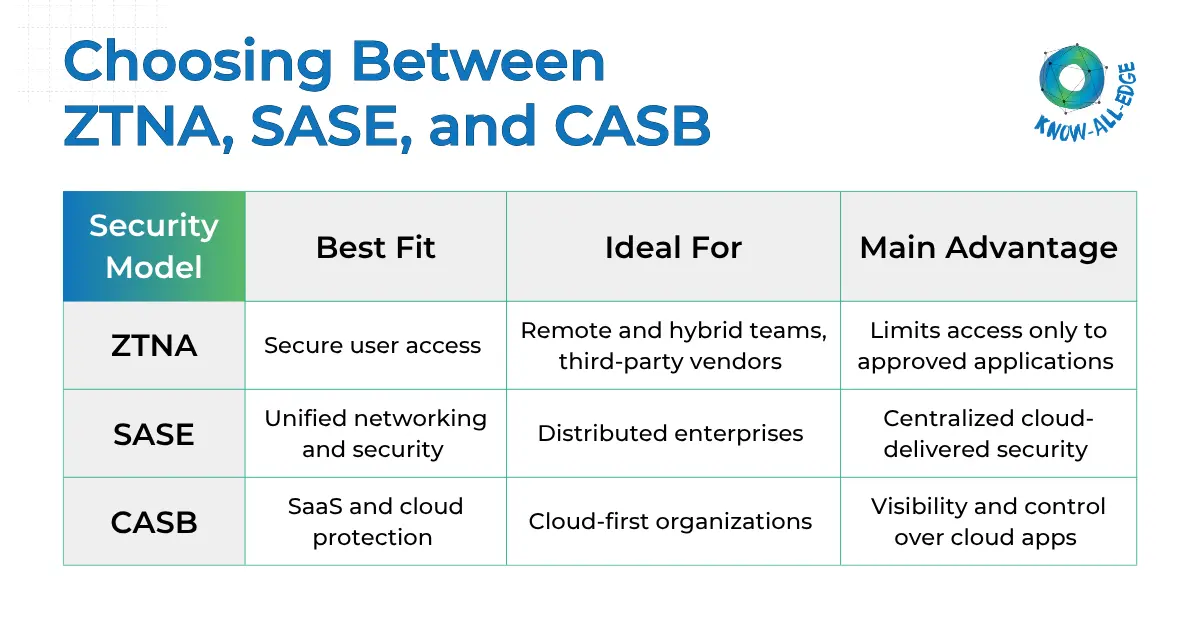
Each technology solves a different security problem. ZTNA focuses on secure application access. CASB protects SaaS environments and cloud data. SASE combines networking and security into a unified cloud-delivered model.
For many organizations, the right approach is not choosing one over another. It is building a security strategy where these technologies work together. The biggest priority should always be alignment with your business architecture, workforce model, compliance needs, and cloud adoption plans.
If you need help modernizing your security architecture, our team is here!
We evaluate, design, and implement ZTNA, SASE, and CASB solutions based on your infrastructure and business needs. Talk to our experts today.
FAQs on ZTNA vs SASE vs CASB
How do SASE, CASB, and ZTNA connect with each other?
SASE acts as the overall security framework, while CASB and ZTNA are key components within it.
- ZTNA handles secure, identity-based access to applications, ensuring users only reach what they are authorized to use.
- CASB focuses on securing and monitoring cloud applications and SaaS data.
- SASE brings both together with networking and security functions in a unified, cloud-delivered model, so organizations can manage access, usage, and policy from a single architecture.
Can CASB, ZTNA, and SASE be deployed together?
Yes, they are often deployed together in modern enterprise environments. CASB handles cloud app security, ZTNA manages secure access to applications, and SASE integrates both along with networking and security controls. Many organizations adopt them in phases depending on maturity and infrastructure readiness.
Is SASE dependent on CASB and ZTNA?
Yes, in most real-world implementations, SASE depends heavily on both CASB and ZTNA. CASB secures cloud environments, ZTNA secures application access, and SASE acts as the delivery framework that integrates both with networking functions. Without these components, SASE cannot provide complete security coverage.


