 Skip to content
Key Takeaways
- DSPM is built on interconnected components – data discovery, classification, risk assessment, access governance, and compliance monitoring that work together to reduce data exposure.
- Missing even one component creates security blind spots that attackers and auditors are likely to find first.
- DSPM components are increasingly being extended to cover AI pipelines, where data risk is growing fastest.
- Organizations that combine all DSPM components see measurably faster breach detection and significantly lower remediation costs.
Introduction
Most organizations know they have a data security problem. What they often don’t realize is exactly why their current tools aren’t solving it.
- You might have a cloud security posture management tool for flagging misconfigurations.
- You might have a DLP policy watching suspicious file transfers.
- You might even have an IAM platform managing access to critical systems.
And still, sensitive data ends up somewhere it shouldn’t be – in an unsecured S3 bucket, in the hands of a former employee whose access was never revoked, or quietly flowing into a third-party AI tool without anyone’s knowledge.
This is the gap that Data Security Posture Management (DSPM) was built to close.
DSPM is a framework of components, each addressing a distinct problem in the data security lifecycle.
A DSPM Adoption Report found that 83% of IT and cybersecurity leaders say lack of visibility into data contributes significantly to a weak security posture. That’s not a technology failure.
These are specific gaps in the data security chain that leave organizations exposed.
The Problem That Made DSPM Necessary
Before breaking down the components, it’s worth understanding the specific conditions that created the need for DSPM in the first place.
Data is the fastest-growing enterprise attack surface. Organizations can no longer rely on perimeter-based security when data lives across dozens of cloud platforms, SaaS applications, and on-premises systems simultaneously.
IBM’s 2025 Cost of a Data Breach Report documented global average breach costs at $4.44 million, while U.S. organizations faced record expenses of $10.22 million per incident. The financial stakes have made it impossible to treat data security as an afterthought.
The maturity gap is widening even as the risk grows.
DSPM fills this gap, but only if components of DSPM are fully understood and properly deployed.
This blog walks through what those components of DSPM are, what each one does, and critically, what goes wrong when any of them is missing or underdeveloped.
What Is DSPM and Why Are Its Components the Right Starting Point?
DSPM gives security teams continuous visibility into where sensitive data exists, who can access it, how it moves, and where exposure is growing. It’s a data-centric approach to security, focused on the asset itself rather than only the infrastructure or network surrounding it.
Knowing where sensitive data exists is only the first step. DSPM adds context by analyzing who can access that data, how it is protected, and whether it is exposed through misconfigurations, excessive permissions, or insecure data flows.
That “context” is precisely what each component provides. Together, they form a complete picture. Separately, each one answers a different question that no other security tool was designed to ask.
The Core Components of DSPM
So, what are the components of DSPM, and how do they work together to secure sensitive data? Let’s discuss this in detail.
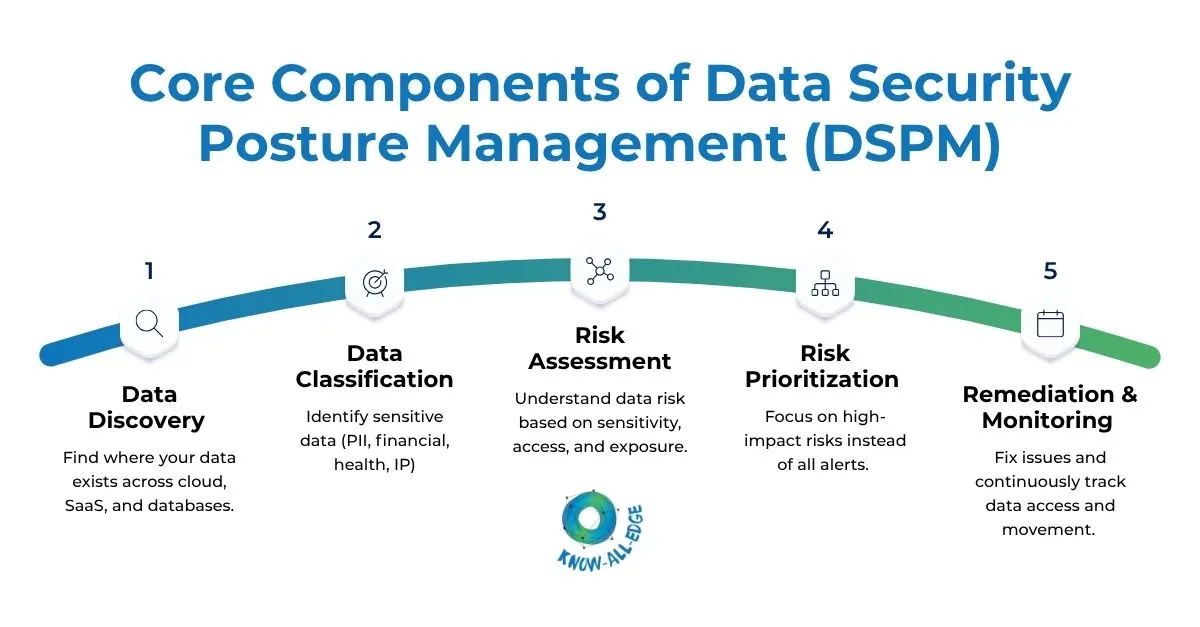
(1) Data Discovery
You Cannot Protect What You Cannot See.
The first and most foundational of all DSPM components is data discovery. Before any classification, governance, or remediation can happen, organizations need a reliable, continuously updated inventory of where data actually lives.
This sounds simpler than it is. In modern cloud environments, data moves constantly across storage buckets, databases, SaaS platforms, backup systems, and data lakes. Some of the data is intentional. Much of it isn’t.
DSPM also addresses dark data and shadow data.
- Dark data includes information the organization doesn’t realize it has.
- Shadow data represents duplicated, abandoned, or overshared content found across cloud and SaaS systems that fall outside formal governance.
These two categories alone account for a disproportionate share of security incidents, precisely because no one is watching them.
(2) Data Classification
Not All Data Carries the Same Risk.
Once discovered, it’s important to classify the data. Classification is the component of DSPM that transforms a raw inventory into something actionable. It tells what the data is, and therefore how much risk it represents.
DSPM uses pattern detection and machine learning to classify PII, PHI, PCI, financial data, intellectual property, and other categories. Modern classification analyzes meaning and context, not just keywords, which reduces false positives.
This matters enormously in practice. Traditional classification tools operated on rigid rules – look for strings resembling a Social Security Number, flag email-shaped text, match known keywords.
That worked when data lived in predictable places and formats. It doesn’t scale to unstructured cloud environments where context changes constantly.
Modern DSPM classification addresses this by analyzing the full context of a document or dataset, not just its surface patterns. It makes it far more accurate and far less prone to the alert fatigue that overwhelms security teams.
(3) Risk Assessment and Prioritization
Not Every Risk Deserves Equal Attention.
Classification tells you what data exists. Risk assessment tells you how much danger it’s actually in.
DSPM analyzes factors such as
- Exposure levels
- Access patterns
- File age
- Content sensitivity
- And business context.
It correlates these signals to prioritize risk.
Risk scoring in a well-designed DSPM solution combines multiple dimensions simultaneously. A file with customer PII in a public location, accessed by unexpected users and not reviewed for years, poses far greater risk than a new financial document with proper access controls.
The risk assessment component is also where DSPM delivers its most compelling ROI argument. Organizations using extensive AI and automation in security operations saved $1.9 million in breach costs while reducing breach lifecycles by 80 days. That speed improvement is largely a product of better prioritization – security teams spending their time on the right risks rather than triaging noise.
(4) Access Governance
Access Without Control Becomes Exposure.
Most people think of access control as an identity problem, something IAM tools handle. What DSPM addresses is subtly different: not just who has access to a system, but
- who has access to specific sensitive data,
- whether that access is still necessary,
- and whether the permissions structure makes sense given what the data actually contains.
DSPM highlights public or external sharing, inactive accounts, and overshared folders, with deep visibility into permissions via directory integrations.
This component of DSPM provides the data-level view that IAM tools miss. It can tell you not just that a user has access to a storage bucket, but that
- The bucket contains regulated financial data.
- The user’s team hasn’t interacted with that data type in six months.
- Three other users in the same bucket were recently offboarded without permission revocation.
(5) Compliance Monitoring and Reporting
Security Must Be Provable, Not Assumed.
The fifth core component of DSPM bridges the gap between internal security practice and external obligation. Compliance monitoring in DSPM takes everything discovered, classified, risk-assessed, and governed, and maps it against the frameworks that regulators, auditors, and business partners actually care about.
This includes:
- GDPR and its requirements around personal data inventory and access justification
- HIPAA and PHI protection requirements across healthcare data
- PCI DSS for organizations handling payment card information
- India’s Digital Personal Data Protection (DPDP) Act, which imposes obligations similar to GDPR with India-specific requirements
- Emerging AI governance frameworks including the EU AI Act
Compliance and reporting in DSPM involves generating dashboards, audit trails, and framework-aligned reports that map regulatory requirements to actual data posture.
What makes this component particularly valuable is automation.
Manual compliance is costly, slow, and prone to gaps auditors uncover at the worst time. DSPM’s continuous monitoring keeps compliance always current, not rushed before reviews.
Check out our blog on how DSPM helps with DPDP Act compliance.
Components of DSPM in AI Environments: The Expanding Frontier
The component framework described above was designed for traditional data environments. But use of AI in modern infrastructure introduces additional complexity and urgency.
Here also, DSPM for AI data protection helps. It involves tracking how sensitive data flows across training, inference, and storage environments.
It also helps detect shadow AI projects operating outside official governance, while enforcing least-privilege access for developers, data scientists, and AI operators.
According to a KPMG report, 67% of executives intend to budget for protections around AI models – a recognition that AI pipelines have become a new and significant data risk surface.
The core DSPM components extend into this territory in specific ways.
- Discovery must now reach into model training datasets, vector stores, and inference pipelines.
- Classification needs to handle novel data formats that conventional tools weren’t built to recognize.
- Access governance must account for AI agents and automated processes, not just human users.
At the same time, the shift toward AI and evolving regulations is pushing DSPM solutions to support stronger compliance capabilities, including automated reporting and data and AI risk assessments.
Organizations that have deployed DSPM components for traditional data but haven’t extended them into AI environments are essentially operating with a security posture that reflects last year’s threat model- not this one.
DSPM Strategies: Making the Components Operational
Knowing the components of DSPM is one thing. Using them effectively is another.
Good DSPM strategies usually start by finding all your data first, even if it’s not perfectly classified yet. A complete view of your data is more useful than a partial but highly accurate one.
They also treat risk as something that keeps changing. As data moves and access changes, risks change too, so assessments need to be continuous, not occasional.
Strong strategies also connect DSPM insights to everyday workflows, like ticketing systems or access controls, so issues actually get fixed.
And increasingly, they include AI systems from the start, instead of trying to secure them later.
We have written an in-depth article on DSPM best practices to execute these DSPM strategies.
Conclusion
The components of DSPM are the practical building blocks of a security posture that can actually keep pace with how data moves today.
- Discovery without classification leaves you with a list, not an understanding.
- Classification without risk assessment generates findings without priorities.
- Risk assessment without access governance identifies problems you can’t trace.
- Governance without compliance monitoring doesn’t produce the evidence that accountability requires.
The DSPM market is expected to grow at a 23.4% CAGR through 2029, reaching over $8.7 billion as organizations shift toward data-centric security.
That growth reflects a hard-won recognition: infrastructure security alone doesn’t protect data. The components of DSPM exist because each one closes a specific security gap.
If you’re evaluating gaps in your data security, our team can help assess your DSPM components and strengthen your overall posture. We help you identify risks, improve visibility, and extend coverage across modern environments, including AI.
Want help strengthening your data security with the right DSPM approach? Connect with us today!
FAQs on DSM Components
What are the components of DSPM?
The core components of DSPM include data discovery, classification, risk assessment and prioritization, access governance, and compliance monitoring. Each addresses a different layer of data risk. They are most effective when implemented together as an integrated system.
Is DSPM just for cloud environments?
DSPM started with cloud environments but now extends across SaaS and on-premises systems as well. Its components operate across all environments to provide a complete view of data risk. Limiting DSPM to cloud-only setups creates visibility gaps.
How does DSPM differ from DLP?
DLP focuses on preventing sensitive data from leaving controlled environments. DSPM focuses on understanding where data exists, how it is classified, and who has access to it. While DLP controls movement, DSPM provides context and visibility.
How do DSPM components support compliance with regulations like DPDP or GDPR?
DSPM supports compliance by maintaining data inventory, classifying sensitive data, and monitoring access and risk continuously. It also helps generate audit-ready reports and track data usage. This makes compliance ongoing rather than a one-time effort.
