 Skip to content
A developer types one sentence about what they need. A few minutes later, a working script, dashboard, or internal tool shows up on screen. Nobody tested it. Nobody reviewed it. But it’s already touching company data.
It feels like magic. It works, so most teams stop there.
They shouldn’t. Somewhere between “it works” and “it’s safe,” a gap has opened up. And it’s growing faster than most security teams can keep up with.
Welcome to the fast-moving world of AI coding assistants. They’re changing how software gets built. And source code exposure has quietly become one of the biggest, most overlooked risks that comes with them.
Why AI Coding Assistants Turned Everyone into a Developer
AI coding assistants have created a new kind of job title, one nobody officially handed out: the citizen developer. Marketing managers, finance analysts, and operations staff are now building automation scripts, reports, and dashboards. All using plain language prompts, no coding background needed.
On the surface, this looks great:
- Innovation spreads faster
- IT teams get some breathing room
- Work that used to take weeks now takes an afternoon
But ask a security leader a few simple questions, and the mood changes fast:
- How much access does this tool have to company data?
- Who is reviewing what it builds?
- If something goes wrong, who’s responsible?
Most of the time, nobody has a clear answer. And that silence is exactly where risk likes to hide.
Also Read: What Is AI Security? Threats, Risks, and Best Practices Explained
The New Face of Shadow IT
Shadow IT used to mean employees quietly using apps IT never approved. With AI coding assistants, the pattern has changed. Employees aren’t just using unauthorized tools anymore, they’re building new ones from scratch. Often inside live systems IT doesn’t even know exist.
Research already shows that a large share of organizations struggle to catch breaches caused by shadow IT. Now add AI-built tools into the mix, ones with no oversight, no documentation, and no security review. That blind spot grows fast.
Also read: From Shadow IT to Shadow AI: How the Enterprise Visibility Gap Has Evolved?
Where AI Coding Assistants Actually Expose Your Code
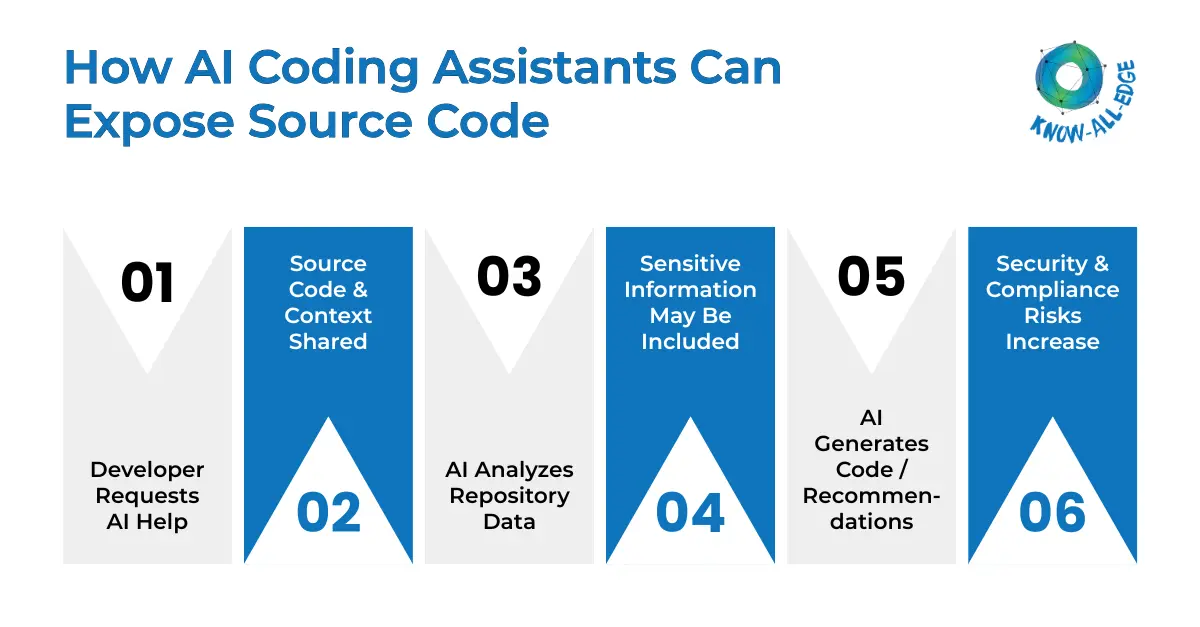
1. Data Shared Without a Second Thought
A customer list. A financial projection. An internal record. All it takes is pasting one of these into a chatbot with a casual “analyze this.” Where does that data actually go? Under data protection rules, this one action can be enough to trigger a compliance problem nobody saw coming.
2. Code That Skips Every Security Check
Speed is the whole point of AI-assisted development. That usually means security testing and code review get skipped. The result is the same old mistakes, an exposed API key, an unvalidated form, an unencrypted transfer. Except now they’re showing up in tools built outside the engineering team entirely.
3. Trusting Files the Sandbox Never Questioned
Here’s where things get more technical. Security researchers recently found a wave of sandbox bypass issues across popular AI coding agents, including Cursor, OpenAI’s Codex, and Google’s Gemini CLI.
The sandbox itself wasn’t broken. The problem was simpler: files created inside the sandbox were later trusted and run by tools outside of it. Things like Git integrations, extension resolvers, and local daemons.
One flaw in Cursor lets a hidden configuration file trigger commands well outside its intended boundary. Vendors have patched these issues since. But the lesson stays the same: an AI agent’s real risk isn’t just the sandbox. It’s everything the sandbox later hands off and trusts.
4. Hidden Instructions Nobody Meant to Give
Prompt injection is becoming one of the more unsettling risks tied to AI coding assistants. A harmful instruction can hide inside a README file, a code comment, or even a third-party dependency. It can quietly steer an AI agent into bypassing safeguards or running commands it was never meant to run. Traditional scanners often miss this completely, because the target isn’t the application. It’s the model’s own reasoning.
5. Supply Chains Built on Blind Trust
AI coding assistants often suggest and pull in third-party libraries without much scrutiny. History has already shown what unchecked dependencies can lead to. And the more code gets generated at scale, the more that risk quietly builds up in the background.
6. Nobody Left to Answer “Who Built This?”
This might be the most overlooked risk of all. A tool with no documentation, no clear owner, and no trace in any official repository. Built by someone who may have already left the company. If that tool is still processing sensitive data, it’s not just a security gap. It’s a business continuity problem waiting to surface.
So, Who’s Actually Responsible?
Here’s an uncomfortable truth: most major security incidents don’t start with bad intent. They start with well-meaning employees moving fast, without enough oversight. AI coding assistants haven’t changed that pattern. They have just sped it up.
As this technology becomes part of everyday work, accountability needs to grow with it. Every employee might now have the power to build software. But that power only stays safe when real oversight comes with it.
Ask yourself honestly:
- How many people in your organization are already generating code with AI tools?
- How many of them are doing it inside any kind of AI security policy?
If you’re not sure, the exposure has probably already begun.
Closing Thoughts
AI coding assistants aren’t going anywhere, and they shouldn’t. The productivity gains are real. The innovation is hard to ignore. But power without guardrails has a way of turning convenience into risk.
The organizations that come out ahead won’t be the ones that adopted AI the fastest. They’ll be the ones that adopted it responsibly, with visibility, accountability, and control built in from day one.
At Know All Edge, this is exactly the kind of gap we help close. From designing the right access controls and monitoring frameworks, to rolling out practical policies that keep AI-driven development safe without slowing teams down. If your organization is ready to bring structure to how AI tools are used across your workforce, our team can help with end-to-end AI workforce security, from implementation through ongoing monitoring.
FAQs on AI Coding Assistants
Can AI coding assistants actually leak source code or company data?
Yes, and it happens in more ways than people expect.
- Direct leaks: An employee pastes proprietary code or a customer record into a prompt for “quick analysis.” That data now sits on a third-party server, outside company control.
- Accidental leaks: AI-generated code sometimes includes hardcoded API keys or credentials, which can end up in a public repository by mistake.
- Indirect leaks: Sandbox related flaws have let files created by an AI agent get trusted and run by tools outside the sandbox, exposing source code or configs without anyone noticing in the moment.
What is a “sandbox escape” in the context of AI coding tools?
Most AI coding agents run inside a sandbox, a restricted space meant to limit what they can touch.
A sandbox escape doesn’t always mean the sandbox was broken into. In several real cases found in tools like Cursor, Codex, and Gemini CLI, the AI agent never left its sandbox at all.
The real issue was a handoff problem:
- The AI agent creates a file inside the sandbox
- A separate tool outside the sandbox later reads that file
- That outside tool treats the file as safe and acts on it
That handoff is where the risk lives. The AI’s real reach ends up much bigger than the boundary it was supposed to stay inside.
How can organizations reduce risks from AI coding assistants without banning them?
Banning these tools outright usually backfires. Employees find workarounds, and the organization loses visibility entirely. Governance works better than prohibition. That means:
- Set a policy: Write clear rules on which AI tools are approved and what data can never be shared with them.
- Run a security check: Put every AI-built tool through a basic review before it touches production.
- Train the whole team: Educate both technical and non-technical staff, since most risk today comes from well-meaning employees who just don’t know the rules
- Keep monitoring: Watch for unauthorized AI-built tools running on the network before they turn into a bigger problem.


