 Skip to content
A decade ago, the biggest headache for most security teams was an employee quietly signing up for a cloud app the IT department had never approved. Today, that same employee doesn’t need to sign up for anything. They just open a chat window that’s already built into their browser or their favorite work app, paste in a sensitive file, and get an answer in seconds. No download, no approval request, no trace left behind for anyone to find.
That’s the difference a few years of AI adoption has made, and it’s exactly why the shift from Shadow IT to Shadow AI deserves far more attention than it’s currently getting.
Gartner estimates that by 2027, 75% of employees will acquire, modify, or create technology outside IT’s visibility, up from 41% in 2022. As generative AI becomes increasingly embedded in everyday tools and workflows, this growing visibility gap is creating a new challenge: Shadow AI.
The old version of this problem was hard enough to manage. The new one hides in places most security tools were never designed to look.
Understanding how we got from one to the other, and what’s actually different about the risk, is the first step toward doing something about it. So let’s start where the story begins.
Check out our in-depth guide: What Is AI Security? Threats, Risks, and Best Practices Explained
Where It Started: Shadow IT
Rewind to the early days of workplace computing. As personal computers, office software, and eventually cloud storage flooded into companies faster than IT teams could track them, a familiar pattern emerged. Employees started using tools nobody in IT had approved, whether that meant emailing a document to a personal account, spinning up a spreadsheet-based “system” to fill a gap, or adopting a cloud app simply because it was easier than waiting for a formal rollout.
That’s shadow IT in a nutshell! Most of the time it’s born out of convenience, urgency, or a genuine lack of better options. But convenience comes at a cost, and that cost usually lands on the security team’s desk.
The risks here are well documented by now:
- No oversight. Unmonitored tools mean nobody is watching the data flowing through them.
- Unpatched vulnerabilities. Unverified software can sit exposed for years without anyone noticing.
- Scattered sensitive data. Information ends up spread across apps nobody vetted, opening the door to privacy violations and licensing issues.
- Malware exposure. Unauthorized software is a common entry point for spyware and ransomware.
None of this is new to anyone who has spent time in a security operations center. What’s new is what came next.
Enter Shadow AI: An Old Problem With a New Face
Just as organizations were getting a handle on shadow IT, generative AI tools arrived and reopened the same gaps, only wider and harder to close.
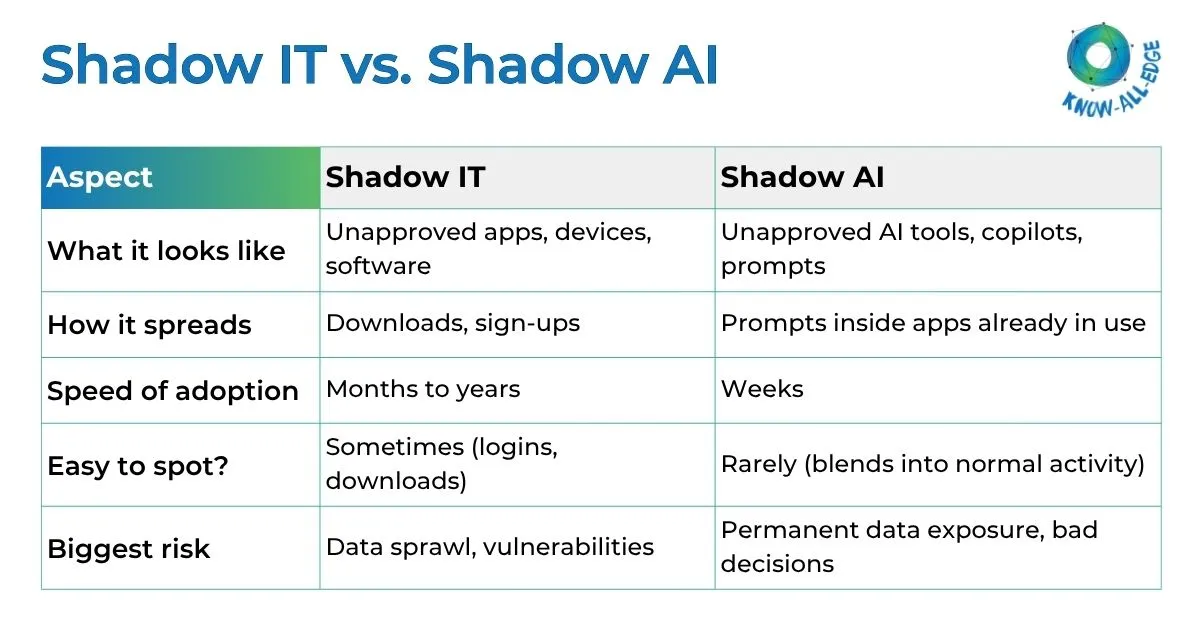
Shadow AI refers to employees using AI tools or applications without formal approval or oversight from IT. On paper, that sounds like the same issue wearing a new label. In practice, the shift from Shadow IT to Shadow AI represents a genuine leap in complexity, not just a fresh coat of paint on an old problem.
Consider how this plays out in an average week:
- A team leans on a free generative AI tool to draft internal reports.
- A developer plugs a generative AI API into a product without reading the fine print on data handling.
- A department starts feeding customer data into a model, never pausing to ask whether that data was ever meant to leave the building.
None of this looks like traditional software installation. There’s no server to spot and no obvious download to flag. It happens quietly, inside browser tabs and embedded copilots already sitting inside tools employees use every day.
That’s really the core reason Shadow AI spreads so much faster than shadow IT ever did. Shadow IT required someone to sign up, download, or install something. Shadow AI often needs nothing more than typing a prompt into a box that’s already built into an approved platform. With that friction gone, adoption curves that used to take years now play out in weeks.
The Risks Hiding Behind Shadow IT to Shadow AI Shift
As the shift from Shadow IT to Shadow AI accelerates, the concerns don’t just mirror shadow IT’s old playbook, they build on it in ways that make traditional defenses look outdated.
Data exposure that doesn’t go away.
When employees paste source code, HR files, or customer records into a public AI tool, that information may be stored, reused, or absorbed into a model’s training data. This is a different kind of leak than an email sent to the wrong inbox. It’s often permanent, and it stays invisible until it isn’t.
A traceability problem.
Many AI tools generate summaries, answers, or decisions without clearly showing their work. Combine that with the very real risk of hallucinated or biased outputs, and employees end up making decisions based on information that sounds confident but might simply be wrong.
Growing regulatory exposure.
Frameworks like GDPR, HIPAA, and the EU’s AI Act are tightening expectations around how organizations handle data and automated decision-making. An employee using an unapproved tool can put a company on the wrong side of these rules without ever realizing it.
Blind spots traditional tools can’t cover.
Discovery tools built to spot new logins, unusual downloads, or unfamiliar network traffic have nothing to grab onto when the “unauthorized software” is really just a feature quietly switched on inside a platform that’s already approved. AI-generated actions often get logged as if a human performed them, which complicates incident investigations and makes it difficult to trace who actually did what.
There’s also a risk worth calling out directly: prompt injection, where crafted inputs manipulate an AI system into behaving in unintended or unsafe ways. When that kind of manipulation happens inside a tool nobody even knew was in use, catching it becomes far harder than it should be.
Building Governance That Actually Works
Blocking AI outright rarely works in practice. Employees find a workaround, and the organization loses visibility entirely instead of gaining any. Governing the shift from Shadow IT to Shadow AI is less about bans and more about building structure around usage rather than pretending it doesn’t exist.
A few things consistently make a real difference:
- Set clear usage policies. Spell out which tools are approved, what data can and can’t be shared with them, and what happens when the rules are broken.
- Keep an actual inventory. You can’t govern what you don’t know exists. A living registry of AI tools in use, reviewed regularly, closes that gap.
- Train people like it matters. Most risky AI use isn’t malicious, it’s uninformed. Helping employees understand what a careless prompt can expose goes a long way.
- Use visibility tools, not just blocks. Detection technology that watches for unusual data flows and AI-driven activity gives security teams something they’ve been missing: actual eyes on the problem.
- Assign real ownership. Whether that’s a dedicated AI governance role or clear responsibility sitting with the CISO’s office, someone needs to own this.
Strong AI governance isn’t about slowing innovation down. It’s about making sure the organization can actually see what it’s adopting before that adoption turns into a headline.
Wrapping It Up
The journey from Shadow IT to Shadow AI isn’t just the next chapter in an old story, it’s a genuine escalation.
- Shadow IT left organizations with uncontrolled devices and apps to worry about.
- Shadow AI hands them algorithms that generate, decide, and influence outcomes, often without anyone fully understanding how those conclusions were reached.
What you can’t see is usually what causes the most damage. Getting ahead of the Shadow IT to Shadow AI shift isn’t only a technical exercise anymore, it’s become a genuine business priority for any organization that wants to protect its data, its reputation, and its ability to operate with confidence.
This is exactly where the right partner makes a difference.
Know All Edge works alongside security and technology teams to design, implement, and support the frameworks that bring unapproved AI usage into full view, rather than reacting only after damage is already done. If your organization is ready to move from guessing what’s out there to actually knowing, it might be worth exploring what stronger AI workforce security could look like for your teams, backed by hands-on implementation and support that doesn’t disappear after go-live.
FAQs
Why is Shadow AI harder to detect than Shadow IT?
Shadow IT usually leaves a trace, like a new login or a download. Shadow AI often just needs a prompt inside an app employees already use, so there’s no new software event for security tools to catch.
Is using free AI tools like ChatGPT at work considered Shadow AI?
Yes, if it’s not approved or monitored by IT or security. Even simple tasks like drafting an email or summarizing a document can expose sensitive data if the tool isn’t sanctioned.
What data is most at risk with Shadow AI?
Source code, HR records, financial details, customer data, and any confidential business information typed into a public AI tool. Once shared, that data may be stored or reused by the model, with no guarantee it can be removed later.
Can Shadow AI cause compliance problems?
Yes. Feeding regulated data into an unapproved AI tool can violate frameworks like GDPR or HIPAA, even if the employee had no intention of breaking any rules.


