 Skip to content
One in five organizations has already suffered a data breach linked to shadow AI usage. Those breaches cost roughly $650,000 more on average than a standard incident, according to IBM’s Cost of a Data Breach Report.
What makes that number worse is ‘how’ it happens.
No file gets attached. No email trips a filter. No USB drive gets plugged in. An employee simply opens a browser tab, pastes something they shouldn’t, and hits enter. The entire event sails past a DLP system that was never designed to look there.
This gap is why organizations are paying much closer attention to AI DLP vs Traditional DLP.
For nearly two decades, traditional data loss prevention did its job well. It watched email attachments, USB drives, and file uploads, catching sensitive data the moment it tried to leave through one of those doors. But generative AI didn’t walk through any of those doors. It opened a completely new one, and most DLP systems are still standing guard at the old entrance.
Why Traditional DLP Wasn’t Built for This
Traditional DLP was designed around one core assumption: sensitive data lives in files, and files move through channels a security tool can watch, like a mail gateway, an endpoint agent, or a network exit point.
Here’s how it typically works:
- Fingerprints documents and matches them against known patterns
- Flags structured data, like credit card numbers or ID formats
- Blocks the transfer the moment something looks wrong
That logic works beautifully for structured data in predictable formats. It falls apart the moment someone types a sentence like:
“We’re offering $340 million for the acquisition, board votes Thursday.”
There’s no file here. No regex pattern to trip. No classification label. Just plain language carrying enormous risk, and traditional DLP simply isn’t built to understand meaning, only patterns.
The exit point has changed too. When an employee sends data to an AI tool, it travels as an encrypted HTTPS request to a domain the network usually trusts. Your DLP sees a normal connection to an allowed website, and that’s the end of the story as far as it’s concerned. The actual content inside that prompt stays completely invisible.
Where AI DLP Steps In
This is precisely the blind spot AI DLP was built to close, and it’s the core of the AI DLP vs Traditional DLP debate playing out across security teams right now.
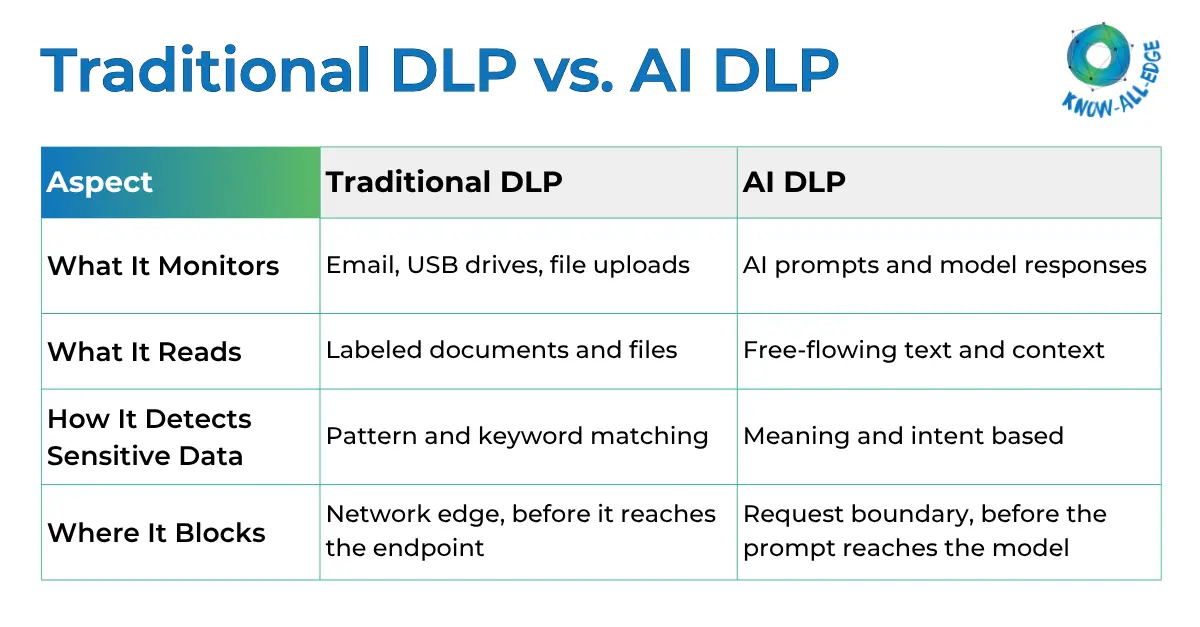
Instead of watching files move across a network boundary, it inspects the AI interaction itself: the prompt heading toward the model, and the response coming back from it. To do that, it has to sit at the point where the traffic is decrypted and the actual payload is readable, right at what’s often called the AI request boundary.
Rather than matching a document against a known fingerprint, AI DLP looks at the context window (the actual text someone typed or pasted) and figures out whether it’s safe to send. It doesn’t matter if the sensitive information was ever saved as a file. If it exists as text in a prompt, that’s enough for it to matter.
If you want to go deeper into how this layer of protection actually works day to day, our detailed breakdown on AI Security unpacks the mechanics in more depth.
AI DLP vs Traditional DLP: Three Places Where They Genuinely Diverge
1. Who They Can Identify
Traditional DLP ties a data transfer to a person through their corporate laptop or company email account, which makes attribution fairly straightforward.
AI tools complicate this. Many employees connect using personal API keys or personal accounts, and the system only sees the key, not the human behind it. AI DLP has to pull in identity context at the moment of the request itself, so a security team can actually tell who sent what.
2. What They’re Actually Classifying
Traditional DLP classifies documents. It’s brilliant at recognizing a labeled spreadsheet or a scanned PDF with a “confidential” watermark.
But the same sensitive numbers, typed freehand into a chat window instead of saved in a spreadsheet, slip past it completely, simply because there’s no document to compare against. AI DLP classifies the free-flowing text of the prompt itself, using natural language understanding rather than pattern matching.
3. Where the Blocking Actually Happens
Traditional DLP enforces underneath the encryption layer, at the endpoint or the network gateway.
AI DLP enforces after decryption, right at the request boundary, where both the content and the identity behind it are visible together. This is also what allows it to act instantly, blocking or redacting a risky prompt in real time instead of just logging an alert after the data has already gone out the door.
The Real Cost of Ignoring This Gap
This isn’t a theoretical concern dreamed up by vendors trying to sell something new. It’s the clearest real-world proof of why AI DLP vs Traditional DLP isn’t just an industry buzzword.
In 2023, engineers at a major electronics company pasted proprietary source code into ChatGPT while debugging an issue. No file moved. No email got flagged. Their legacy DLP system stayed completely silent, and the company lost control of that code permanently.
The numbers since then paint an even bigger picture:
- Roughly 1 in 5 organizations has already dealt with a breach tied to unsanctioned or “shadow” AI usage
- Shadow AI breaches take considerably longer to detect than standard incidents
- A large share of enterprise employees admit to pasting company data into AI tools regularly, most of it through a browser channel legacy DLP simply cannot see into
Add agentic AI into the mix, autonomous systems that don’t just chat but actually take actions like calling APIs or pulling data from internal systems, and the blind spot grows even wider. Traditional DLP has no concept of what an AI agent is doing behind the scenes, which tools it’s calling, or what data it’s quietly moving between systems.
AI DLP vs Traditional DLP: Not Rivals, But Teammates
Here’s the part that often gets lost in the noise: nobody is suggesting you rip out your existing DLP stack.
Email, endpoints, and file transfers haven’t disappeared, and traditional DLP still does a solid job protecting those channels. AI DLP isn’t a replacement, it’s the missing layer for the one channel your current stack was never designed to watch. Think of it less as an upgrade and more as covering a door that didn’t even exist when your original security architecture was built.
Running AI traffic through a system that was never meant to inspect it doesn’t close the gap, it just gives you a false sense of coverage. The organizations that treat this seriously are the ones building both layers together, not swapping one for the other.
Where This Leaves You
The uncomfortable truth is that most companies today have a security stack that looks complete on paper but has a wide-open gap in practice. Your firewalls, email filters, and endpoint protection are all doing exactly what they were built to do. They just were never built to watch a chat window.
Closing that gap doesn’t mean starting from scratch. It means recognizing that prompts and AI responses are now a data channel just as real as email or file transfers, and treating them with the same seriousness. That’s really the whole point of understanding AI DLP vs Traditional DLP: not choosing sides, but knowing exactly where each one’s job ends and the other’s begins.
If your organization is still figuring out how to bring visibility and control to how your teams actually use AI day to day, that’s exactly the kind of gap Know All Edge helps close, from setting up the right controls to keeping them running smoothly as your usage grows. You can explore how we approach securing your AI-using workforce and see what a practical rollout looks like for a team like yours.
FAQs on AI DLP vs Traditional DLP
Can I just point my existing DLP at AI traffic?
Not really, not without major rework. Your current DLP sits below the encryption layer and only sees an encrypted connection to a known website. Even if you decrypt that traffic, it’s still built to match documents against known patterns, not to understand plain language typed into a chat box. It also can’t tell who’s really behind a personal API call. These are structural gaps, not settings you can toggle on.
What actually counts as a prompt-level data leak?
Anything sensitive that gets typed or pasted into an AI tool without proper authorization counts, even if it was never saved as a document. This could be a snippet of source code, financial figures, customer details, or confidential business plans written out in plain sentences. Since it never existed as a labeled file, traditional DLP has nothing to match it against.
Does AI DLP check what the AI sends back, or just what employees type in?
Both directions matter, and a proper AI DLP setup checks each one. A model’s response can accidentally surface sensitive information pulled from internal documents, retrieved data, or even a flawed generation. Inspecting only the outgoing prompt and ignoring the response leaves half the risk uncovered.
Is shadow AI usage really as big a risk as it sounds?
Yes. A large share of employees across industries use AI tools that were never approved or reviewed by security teams, often through personal accounts or browser extensions. Since these interactions don’t touch any monitored channel, they stay invisible until something goes wrong, and by then the data is usually already out.


