 Skip to content
Somewhere in your organization, right now, an employee is pasting a chunk of confidential text into a chatbot that has nothing to do with your approved software stack. Nobody told them to stop because now, AI is everywhere!
And they are not aware of the risks of pasting confidential data into AI. They just wanted to finish a task faster. That single, well-meaning moment is what security teams have started calling “Shadow AI,” and it’s spreading through offices faster than most policies can keep up.
This isn’t a story about careless staff or rogue employees plotting against IT. It’s a story about speed. AI tools move at the pace of a prompt. Governance moves at the pace of a meeting. Somewhere in that gap, Shadow AI is born.
And the gap is wider than most leaders realize. According to WatchGuard’s 2026 Cybersecurity Hygiene Report, 64% of employees admit to using unauthorized AI tools for work, a number that has grown fast enough to outpace most companies’ ability to even track it.
What Exactly Is Shadow AI?
Shadow AI refers to the use of artificial intelligence tools, models, or features inside a company without the knowledge, approval, or oversight of IT and security teams. Think of employees signing up for a free chatbot account, plugging an AI writing assistant into their workflow, or relying on an AI feature that quietly got switched on inside a SaaS tool nobody re-reviewed.
Most of the time, there’s no bad intent behind it. People are simply trying to work smarter. But because these tools sit outside sanctioned channels, they aren’t covered by your data protection rules, your compliance checks, or your usual AI governance processes. And that’s exactly where things start to get messy.
Shadow AI vs Shadow IT: What’s the Difference?
If the term sounds familiar, that’s because it borrows heavily from an older problem: shadow IT. Shadow IT is any unapproved app, tool, or service employees start using without sign-off from IT, usually because the “official” option feels slow, clunky, or missing entirely.
Shadow AI takes that same rebellious spirit and adds a twist. It isn’t just about unauthorized software anymore, it’s about unauthorized intelligence. These systems don’t just store your data, they learn from it, generate new outputs based on it, and sometimes retain it in ways nobody can fully trace. That’s a meaningfully different risk profile than a rogue spreadsheet tool ever posed.
Also Read: From Shadow IT to Shadow AI: How the Enterprise Visibility Gap Has Evolved?
How Does Shadow AI Actually Creep In?
It usually does not appear suddenly. It starts with small, everyday decisions:
- It’s free and frictionless. Most AI tools require no procurement process, no invoice, no approval chain. Anyone with a browser can start using one in seconds.
- Speed wins over process. When the “proper” tool is slower or clunkier, employees quietly route around it.
- Policies haven’t caught up. Many companies still don’t have a clear AI usage policy, so staff either assume everything is fine or simply don’t think to ask.
- AI hides inside tools you already trust. A SaaS platform your team has used for years might silently roll out a new AI feature, and suddenly you have an unmanaged capability sitting inside an already-approved app.
What Shadow AI Looks Like in the Real World
To make this less abstract, picture these everyday scenes:
- A developer, stuck on a stubborn bug, pastes a slice of proprietary source code into a public AI assistant to get a quick fix.
- A product manager runs an internal strategy deck, complete with unreleased timelines, through an AI summarizer before a client call.
- A marketing designer feeds brand assets and campaign copy into an AI image generator, unaware of where that data ends up being stored.
None of these people think they’re doing anything wrong. They’re just trying to hit a deadline. But each interaction quietly hands sensitive information to a system that operates well outside your organization’s line of sight.
This is where AI security becomes essential, helping organizations understand how AI is being used, what data is being shared, and where that information is going.
Why This Is a Bigger Deal Than It Sounds
Here’s the uncomfortable truth: visibility alone doesn’t fix Shadow AI. A report showing which tools employees are using is helpful, but it can’t undo a prompt that’s already been submitted or a file that’s already been processed. By the time there’s a log entry, the risky decision has already happened.
The real dangers tend to fall into a few buckets:
Data leakage and privacy exposure
Once information lands inside an unmanaged AI tool, you lose control over where it’s stored, how long it’s kept, or whether it gets reused to train future models.
Compliance headaches
Regulations like GDPR, HIPAA, or region-specific data laws expect organizations to know exactly how sensitive data is handled. Shadow AI usage can quietly violate those requirements long before anyone notices.
A wider attack surface
Many of these tools ask for broad permissions or connect through unsecured APIs, opening doors that a determined attacker would be more than happy to walk through. This is also where risks like prompt injection come into play, where a manipulated input can trick an AI system into leaking data or taking unintended actions.
Shaky trust in outputs
AI-generated content can be biased, outdated, or simply wrong. When decisions get made based on unverified AI output, the consequences can ripple well beyond a single mistake.
Busting a Few Popular Myths
A lot of misunderstanding floats around this topic, so let’s clear some up.
“Banning AI tools will stop the problem.” Not really. Outright bans tend to push usage further underground, making it even harder to track.
“Shadow AI only happens in technical teams.” Far from it. Marketing, HR, sales, operations, basically any team hunting for a productivity boost can end up using unsanctioned AI.
“It’s always malicious.” Almost never. Most people are just trying to work faster, not cause harm.
How to Actually Get Ahead of Shadow AI
The good news is that this problem is manageable, and it doesn’t require slamming the brakes on innovation. A few practical moves go a long way:
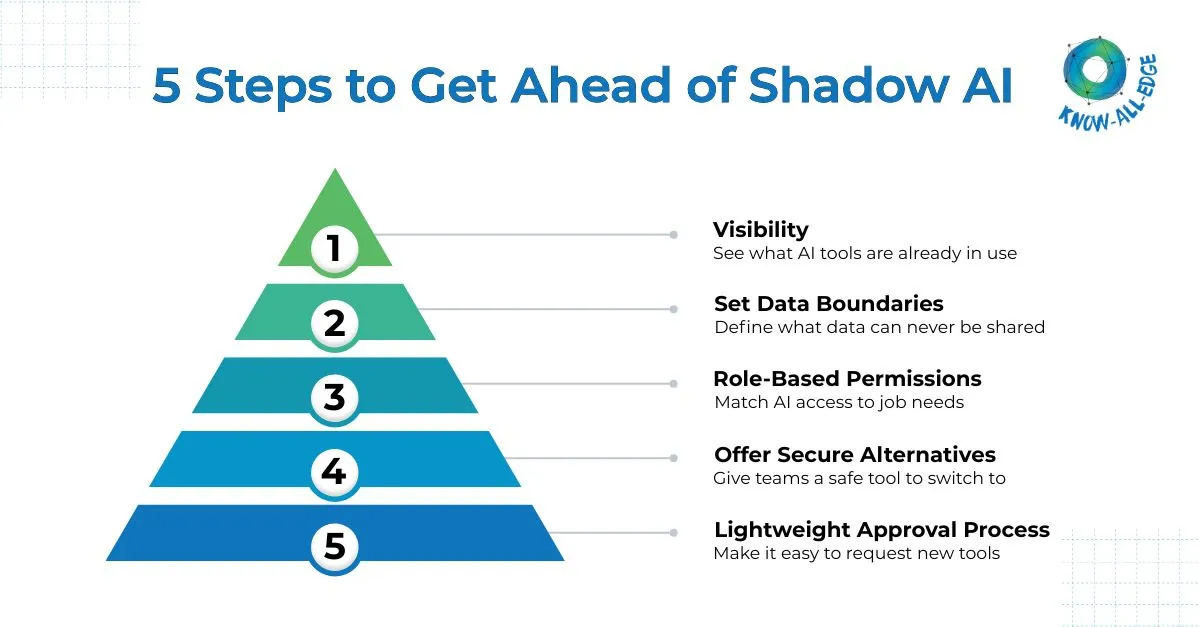
- Start with visibility. You can’t govern what you can’t see. Use DSPM tools, browser audits, or network monitoring to understand what’s already being used.
- Set clear data boundaries. Decide upfront what categories of information (customer records, source code, financial data) should never be typed into an unmanaged AI tool.
- Build role-based permissions. Not every team needs the same access. Tailor what’s allowed based on function and risk level.
- Offer a real alternative. Employees reach for outside tools when the approved option feels inferior. Give them something fast, secure, and easy to use, and much of the temptation disappears.
- Create a lightweight approval path. When someone finds a new tool they want to try, give them a quick, simple way to request a review instead of forcing them to go around the system entirely.
- Treat this the way you treated shadow IT. The same lessons apply: enablement paired with guardrails beats lockdowns every time.
Bringing Shadow AI into the Light
Shadow AI isn’t a sign that your workforce doesn’t care about security. It’s a sign that AI adoption has outpaced the policies meant to guide it. The organizations that handle this well aren’t the ones chasing every unauthorized tool with a ban hammer, they’re the ones building visibility, sensible guardrails, and safer alternatives directly into daily workflows.
That’s precisely the gap Know All Edge helps close. From identifying where unmanaged AI is already operating inside your environment to designing and implementing the right AI workforce security framework, and staying on as an ongoing partner for ongoing support, monitoring, and fine-tuning as your AI usage evolves. Because managing Shadow AI isn’t a one-time fix, it’s a continuous discipline, and having the right team behind you makes all the difference.
FAQs on Shadow AI
Can Shadow AI be completely eliminated?
Realistically, no. As long as free, easy-to-access AI tools exist, some employees will find and use them faster than any policy can be written. The more practical goal is reducing the risk, not chasing zero usage. Strong visibility, clear guardrails, and fast, secure alternatives can shrink Shadow AI down to a manageable size rather than eliminate it outright.
What industries are most exposed to Shadow AI risk?
Any industry that handles sensitive data is exposed, but the stakes are highest in finance, healthcare, legal, and technology sectors, where compliance requirements are strict and the cost of a data leak is high. That said, Shadow AI shows up everywhere, including marketing, HR, and operations teams that may not think of themselves as security-relevant at all.
How do I know if Shadow AI is already happening in my organization?
Start by looking for indirect signals: spikes in traffic to public AI domains, browser extensions that weren’t centrally deployed, SaaS tools that have quietly added AI features since their last review, or simply asking teams directly what tools they’re using to get work done faster.
Most organizations are surprised by how much AI usage is already happening the moment they actually go looking.
What’s the very first step a company should take?
Visibility. Before writing a single policy or blocking a single tool, you need a clear picture of what’s already being used across the organization. Every other step, from setting data boundaries to offering secure alternatives, depends on knowing where you actually stand today.


