 Skip to content
AI use at work has nearly doubled in just two years, with 40% of employees reporting they use AI in their roles, according to Gallup. At the same time, Gallup found that 70% of employees say their organization has no clear guidance or policy for using AI at work.
This growing gap between AI adoption and AI governance is creating new security, compliance, and data privacy challenges for organizations.
Employees are using AI to draft emails, summarize documents, write code, analyze data, and automate repetitive tasks. While these tools improve productivity, they can also expose confidential information, create compliance risks, or lead to poor decisions when used without proper safeguards.
That’s why every organization needs a well-defined AI usage policy template. Instead of restricting innovation, it provides employees with clear guidance on what is acceptable, what should be avoided, and how to use AI responsibly.
In this guide, we’ll explain the key elements of an effective AI usage policy and share a practical AI usage policy template that organizations can adapt to their own security and governance needs.
Why Can’t Companies Skip an AI Usage Policy Anymore?
Most technology teams already know their people are using AI, whether it’s sanctioned or not. Survey after survey shows the majority of knowledge workers now lean on AI tools to save time and cut down on repetitive tasks. That’s the upside.
The downside is what happens when nobody’s watching how it’s used. A few real examples of what goes wrong without guardrails:
- An employee pastes confidential client data into a public AI tool, not realizing the vendor might use that input to train its own models.
- A team member trusts AI-generated content at face value, including fabricated facts or “hallucinated” details, and ships it without a second check.
- A manager uses AI to draft performance reviews and the output carries hidden bias, opening the door to a discrimination complaint.
- Someone connects an AI agent to internal systems without proper vetting, unknowingly creating a backdoor a security team never approved.
None of these employees set out to cause a problem. They just didn’t have a rulebook. That’s precisely the gap an AI usage policy template is meant to close, and why it deserves a permanent spot in your company’s AI security documentation, right alongside your data protection and acceptable use policies.
What Exactly Is an AI Usage Policy?
An AI usage policy is a straightforward internal document that spells out how employees are allowed to use artificial intelligence tools at work. It covers what data can and can’t be shared with AI systems, which tools are approved, who to ask when a new use case comes up, and what happens if someone breaks the rules.
It is like a map that shows employees where they can move freely, where they need to slow down and ask first, and where they simply shouldn’t go at all. Done right, it protects the business without making people feel like AI is banned altogether, because let’s be honest, banning it outright rarely works. People find workarounds anyway.
How an AI Usage Policy Helps?
A well-written AI usage policy template does more than tick a compliance box. It genuinely changes behavior on the ground:
- It brings clarity. Employees stop guessing whether a tool is “probably fine” to use and instead know exactly where they stand.
- It lowers risk. When the boundaries are spelled out, people are far less likely to accidentally expose sensitive information or break vendor terms.
- It encourages smarter innovation. Ironically, clear rules make people more comfortable experimenting with AI, not less, because they’re no longer worried about accidentally breaking a rule they didn’t know existed.
Building Your AI Usage Policy Template: The 5 Sections That Matter
Here’s the part everyone actually wants: what should go into the template itself. A solid AI usage policy template usually breaks down into five practical sections. You don’t need to reinvent this from scratch, just adapt each part to how your organization actually works.
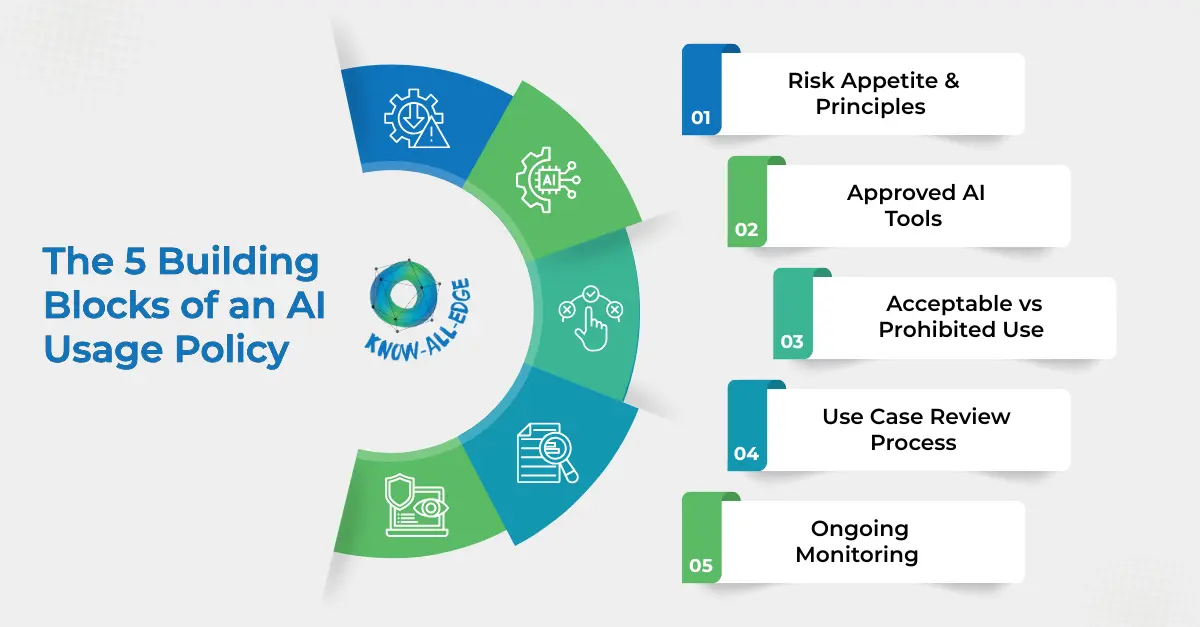
1. State Your Risk Appetite Upfront
Before writing a single rule, decide where your company stands. Are you an early-adopter type of business that wants employees experimenting freely, or a more cautious one that prefers everything vetted first?
Spell this out in plain language so employees understand the “why” behind the rules that follow, not just the “what.”
2. List the AI Tools Employees Can Actually Use
Name the approved tools. This might include mainstream platforms like ChatGPT or Gemini, along with any AI features already built into tools your team uses daily, such as meeting summarizers or email assistants. If certain tools come with enterprise agreements that protect your data from being used for model training, say so clearly. This section should also state whether AI use is permitted on personal devices (usually, it shouldn’t be, for company-related work).
3. Define What’s Acceptable, Prohibited, and “Needs a Second Look”
This is the heart of any AI usage policy template. Break it into three buckets:
- Always acceptable: Low-risk tasks with no sensitive data involved, like drafting a generic email or brainstorming ideas.
- Always prohibited: Anything involving protected data without consent, or use cases explicitly banned by regulations.
- Needs review: Grey-area situations, like AI influencing a hiring decision or handling customer-facing content, that deserve a quick sign-off from the right team before moving forward.
4. Create a Simple Process for New Use Cases
Employees will keep coming up with fresh ideas for using AI, that’s a good thing. But without a clear submission process, new use cases either get blocked entirely or slip through unreviewed. Set up a lightweight intake form and a small review group covering legal, data privacy, and security so requests don’t pile up or get ignored.
5. Monitor Usage on an Ongoing Basis
Approving a use case isn’t the finish line. High-value, higher-risk AI applications, like tools that help rank job candidates, need regular check-ins to catch bias or performance drift over time. Your policy should say who’s responsible for this ongoing review and how often it happens.
Turning the Template into a Habit, Not Just a Document
Writing the policy is only half the job. The other half is making sure people actually read it, understand it, and remember it exists the next time they’re tempted to paste something sensitive into a chatbot.
A short training session during onboarding, a quick refresher whenever a new AI tool gets approved, and an easy way to ask questions all go a long way. The goal isn’t to slow employees down, it’s to make safe AI use feel like second nature rather than an extra step.
Wrapping Up
AI isn’t going anywhere, and honestly, it shouldn’t. Used well, it saves time, sharpens decision-making, and frees people up for more meaningful work. But that upside only holds if employees know where the guardrails are. A thoughtful AI usage policy template gives your team the confidence to use these tools productively while keeping company and customer data out of harm’s way.
Writing the policy is a strong first step. Making sure it’s actually implemented, monitored, and adapted as new tools and risks emerge is where most organizations need a hand.
That’s exactly where Know All Edge comes in: we help businesses put practical guardrails around their AI workforce security, from initial rollout to the ongoing support that keeps policies working long after launch. If your team is ready to move from “we should probably write a policy” to “our AI usage is actually secure,” get in touch with our team and let’s build it together.


