 Skip to content
A new AI tool can go from an employee’s browser to a business process in a matter of days, often before security teams have visibility into how it is being used, what data it processes, or what decisions it influences.
That is where AI governance becomes essential.
AI governance is not simply a set of ethical principles or a compliance exercise. From a security perspective, it creates the policies, responsibilities, controls and monitoring processes needed to manage AI throughout its lifecycle. It helps organizations understand where AI is being used, what risks it introduces, how sensitive data is handled and who is accountable when something goes wrong.
As enterprises accelerate AI adoption, governance is becoming an important part of AI Security. Without the right controls, AI can increase the attack surface, expose sensitive information, create compliance challenges and introduce decisions that are difficult to explain or audit.
What Is AI Governance?
At its core, AI governance is the set of rules, processes and guardrails that keep AI systems accountable. Think of it as the rulebook that decides how AI models are built, trained, monitored and used, so they don’t drift into bias, unfairness or outright harm.
AI governance isn’t just a compliance checkbox. It’s a living framework that brings together policies, oversight structures and monitoring tools to make sure AI behaves the way it’s supposed to, ethically, transparently and safely.
Because AI models learn from human-generated data, they inherit human blind spots too. Left unchecked, those blind spots can snowball into flawed hiring decisions, unfair loan approvals or discriminatory outcomes at scale. Good governance exists to catch these issues before they cause damage.
Why AI Governance and AI Security Are Two Sides of the Same Coin
Here’s something many teams overlook: AI governance and AI Security aren’t separate conversations, they’re deeply connected.
- Security protects AI systems from external threats like data poisoning, model theft or adversarial attacks.
- Governance, on the other hand, ensures the system itself is trustworthy, well-documented and used responsibly from the inside out.
Without governance, even the most secure AI environment can quietly cause harm through biased logic or unchecked decision-making.
And without security, even the most well-governed AI model remains vulnerable to attackers looking to manipulate its outputs or steal sensitive training data.
One protects the system from outside threats, the other protects everyone from the system’s own mistakes. You genuinely need both working together, and organizations that have already published a clear AI Security approach alongside a defined AI usage policy tend to catch problems far earlier than those relying on either one alone.
The Real Cost of Skipping AI Governance
Without proper governance, AI can expose sensitive data, create new attack paths, produce unreliable outcomes and introduce compliance gaps.
Sensitive Data Exposure
Employees may unknowingly share confidential data with unapproved AI tools. Governance defines what data can be used, who can access AI systems and which controls are required.
Shadow AI and Limited Visibility
Unapproved AI usage creates shadow AI, making it difficult to identify tools, users and data flows. Discovery, policies and monitoring help bring AI usage under control.
AI-Specific Cyber Threats
Attackers may manipulate prompts, extract sensitive data or exploit AI applications and connected systems. AI security must therefore extend across the wider enterprise environment.
Unreliable or Biased Decisions
Poor data quality, bias and model drift can affect AI outcomes. Continuous monitoring helps identify performance changes and reduce risk.
Compliance and Accountability Gaps
Organizations need visibility into their AI systems, the data they process and who is responsible for managing associated risks.
What Strong AI Governance Actually Looks Like
Good AI governance isn’t a single policy document sitting in a shared drive. It’s built on a handful of core principles that shape how an organization designs, deploys and monitors its AI systems:
- Fairness and bias control: Rigorously testing training data so AI doesn’t quietly reinforce real-world prejudices, particularly in sensitive areas like hiring, lending or healthcare.
- Transparency: Making sure AI decisions can be explained in plain language, not buried inside an unreadable black box.
- Accountability: Assigning clear ownership so that when something goes wrong, there’s a defined path to investigate and fix it.
- Privacy and data protection: Treating the personal data feeding these models with the same care as any other sensitive business asset.
- Security by design: Building in protections against tampering, unauthorized access and misuse from day one, not as an afterthought.
Organizations that get this right usually rely on a mix of dashboards, automated monitoring, audit trails and performance alerts, essentially a continuous health check for every AI system in production rather than a one-time review.
The Regulatory Momentum Behind AI Governance
Regulatory expectations around AI governance are building steadily. Data protection requirements are pushing organizations to think harder about how AI systems collect, store and use personal information, well beyond what traditional IT policies ever covered.
At the same time, national digital transformation agendas are increasingly weaving responsible AI principles into how public and private sector organizations are expected to operate.
The direction is unmistakable: regulators want AI that is explainable, secure and fair, and they expect businesses to prove it rather than simply claim it. Waiting for enforcement to catch up before acting is a risky bet. Businesses that build governance into their AI strategy now will have a natural head start when stricter rules inevitably arrive.
Building a Governance Framework That Actually Works
Turning governance principles into daily practice takes more than good intentions. A practical framework generally covers:
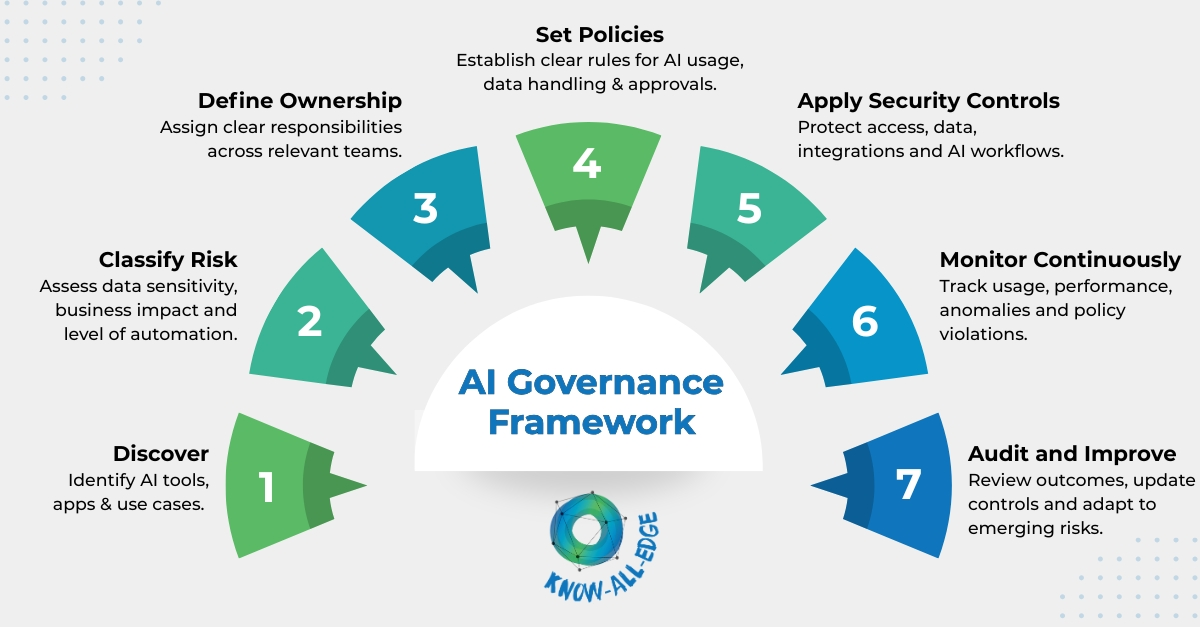
- Aligning governance with business risk: A customer support chatbot doesn’t need the same scrutiny as a system approving financial transactions.
- Defining clear roles: Cross-functional teams spanning security, legal, data science and business leadership, with decision rights everyone understands.
- Setting concrete standards: Documented risk classifications, approval thresholds and incident response steps, so teams aren’t left guessing.
- Continuous monitoring: Automated systems that flag bias, performance drift or unusual behavior before it snowballs into a real problem.
This is precisely where governance and security intersect most visibly. A framework built without security considerations is incomplete, and a security program without governance oversight is just as exposed.
Who Actually Owns AI Governance?
It’s tempting to assign this responsibility to a single department, but that rarely works in practice.
Senior leadership sets the tone and secures buy-in, legal and compliance teams track shifting regulations, IT and security teams manage the technical guardrails, and everyday employees are the ones actually using these tools day to day.
AI governance succeeds when it’s treated as a shared responsibility rather than one team’s burden.
Bringing It All Together
AI isn’t slowing down, and neither are the risks that come with deploying it carelessly. AI governance gives organizations the structure to innovate confidently instead of nervously, catching bias, security gaps and compliance issues before they turn into headlines.
The businesses that will thrive aren’t necessarily the ones with the flashiest AI models. They’re the ones that pair innovation with real accountability, treating governance as a foundation rather than an afterthought.
That’s precisely where Know All Edge comes in. Beyond just advising on frameworks, our team helps businesses put these safeguards into action, implementing the right controls and providing ongoing support to keep AI systems secure, compliant and genuinely trustworthy as they scale. If you’re ready to move from theory to practice, it’s worth exploring how a resilient and well-governed AI workforce can be built into your organization from the ground up.
FAQs on AI Governance
Is AI governance the same as AI security?
Not quite. AI security focuses on protecting AI systems from external threats such as data poisoning, model theft or adversarial attacks. AI governance is broader. It covers the policies, oversight and accountability that ensure an AI system behaves fairly, transparently and responsibly in the first place. The two work best when they’re built together, not treated as separate checklists.
Who is responsible for AI governance within an organization?
It’s rarely just one person or team. Senior leadership sets the direction and secures buy-in, legal and compliance teams track evolving regulations, IT and security teams build the technical guardrails, and data teams manage the day-to-day quality and monitoring. Real governance works when it’s shared across functions rather than owned by a single department.
What happens if a business skips AI governance altogether?
- Biased or inaccurate outputs go unnoticed until they cause real harm
- Regulatory penalties become far more likely as AI-specific rules tighten
- Customer and employee trust erodes once errors surface publicly
- Internal AI adoption slows down because teams don’t trust the systems they’re using
Does AI governance slow down innovation?
This is a common worry, but it usually plays out the opposite way. Clear governance actually speeds things up over time. When teams have defined risk tiers, approval steps and documentation standards, they stop second-guessing every decision and start moving with confidence, because the guardrails are already in place.


