
Introduction
Email remains the number one entry point for cyberattacks. Creating a strong perimeter still doesn’t protect you from threats if your inbox is vulnerable.
Moreover, organizations are continuously shifting to cloud-based environments; the old on-premise email filters just don’t cut it anymore. This makes cloud-based email security solutions extremely important to have.
A report by market research firm Market.us says, the global cloud-based email security market is about to reach USD 12.63 billion by 2034. This is approximately a CAGR of 10.2%. These numbers make it clear that organizations have started taking email-borne threats seriously.
But the problem is getting worse with time. So, how can you protect yourself from being trapped into threats through your emails. If you are still looking for the best cloud email security solution for your company, this guide is for you.
Let’s first discuss a brief about the traditional security approaches and what to look for in a modern cloud email security solution.
Why Traditional Email Security Is No Longer Enough
Traditional email gateways were built for a different era. Back when everything sat on-premise, static rules and signature-based filters were good enough. That’s not the world we live in now.
Attackers are using AI to create convincing phishing emails. They’re running business email compromise (BEC) campaigns that look exactly like messages from your CFO. They’re bypassing MFA. They’re hiding malicious links inside QR codes.
Here’s what that looks like in practice if we don’t take care of email security:
- Phishing remains the most common threat, with attacks growing more targeted every year.
- BEC attacks are costing organizations billions, and they often involve zero malware, so signature-based tools miss them entirely.
- QR code phishing is now a mainstream attack vector, with a noticeable increase in incidents reported by organizations over the past year.
- Account takeover (ATO) is one of the top concerns for CISOs, because once an attacker is inside a trusted account, traditional tools can’t detect the threat.
This is exactly why the shift toward best cloud email security solutions makes sense. Cloud-native platforms offer real-time threat intelligence, AI-driven detection, and continuous updates without waiting for IT to push a patch.
What to Look for in Cloud-Based Email Security Solutions
A strong email security solution should cover:
- Advanced threat protection against phishing, malware, and zero-day attacks
- Data loss prevention (DLP) to stop sensitive information from leaving via email
- Email encryption for compliance and data privacy
- Anti-spoofing and impersonation protection
- Integration with your existing cloud email platform (Microsoft 365, Google Workspace, etc.)
- Compliance reporting to satisfy regulatory requirements like HIPAA, GDPR, or PCI-DSS
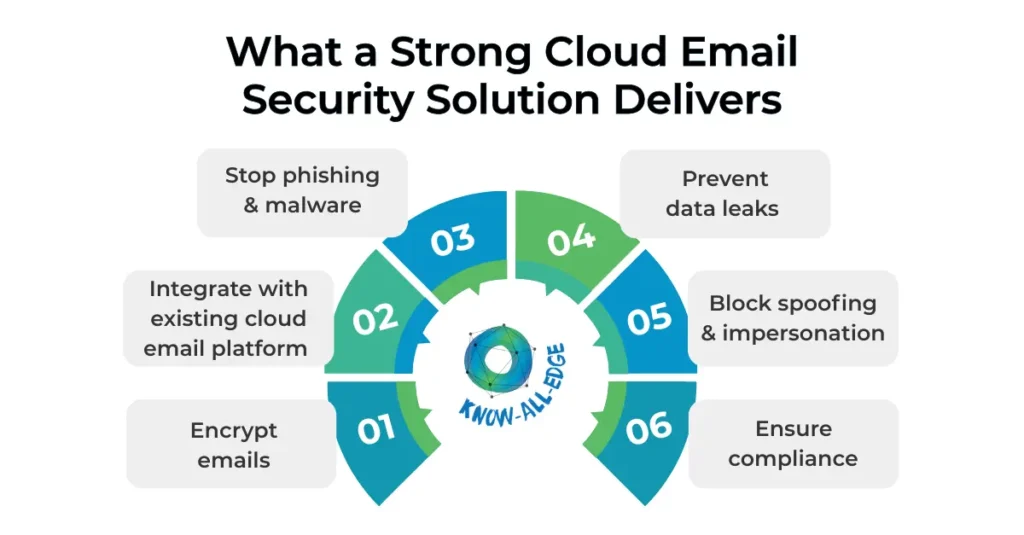
A solid email security policy framework also needs to sit underneath all of this. Technology alone isn’t enough without clear governance, user awareness, and incident response processes tied to it.
Top Cloud Email Security Solutions to Consider
Here’s an honest look at five vendors that are widely used and worth evaluating. Each brings something different to the table.
Check Point (Harmony Email & Collaboration)
Check Point’s Harmony Email and Collaboration suite is built specifically for cloud-first environments. It integrates directly with Microsoft 365 and Google Workspace via API. It functions without requiring changes to your mail routing, providing a seamless layer of defense for modern cloud environments.
Key Features:
- API-based inline deployment with no MX record changes required
- Protection against BEC, spear phishing, supply chain attacks, and zero-day threats
- Coverage across email, Teams, SharePoint, OneDrive, and Google Workspace
- Unified management console for email and collaboration threats in one dashboard
- AI-powered threat prevention, leveraging 50+ AI engines
- Prevents data leakage with built-in DLP across cloud applications
Mimecast
Mimecast is an established leader providing a comprehensive suite that spans inbound protection to long-term data management. It is particularly effective for organizations with strict email security compliance needs that require deep visibility and auditability.
Key Features:
- AI-driven threat detection against phishing, malware, impersonation, and BEC
- Email continuity to keep communications running during outages
- Secure email archiving with long-term retention and e-discovery support
- Built-in security awareness training and phishing simulation
- URL and attachment protection with sandbox analysis
- Integration with SIEM tools, SOC workflows, and Microsoft 365
- Compliance reporting for HIPAA, GDPR, and other regulatory frameworks
Fortra Cloud Email Protection (Agari)
Built on Agari’s technology, this platform focuses on behavioral identity models rather than traditional signatures. It is designed for high-stakes environments where impersonation and complex supplier-based attacks are the primary risks.
Key Features:
- Behavioral identity intelligence to detect impersonation and BEC attempts
- Brand protection against domain spoofing and lookalike attacks
- Sender trust scoring based on historical communication patterns
- Outbound DLP controls with automated encryption policies
- DMARC enforcement and email authentication management
- Compliance support with detailed audit trails and reporting
- Integration with Microsoft 365 and Google Workspace environments
Sophos Email Security
Part of the Sophos Central ecosystem, this cloud email security solution offers a “better together” approach by connecting email data with endpoint and network telemetry. It is optimized for lean IT teams who prioritize simplicity and unified management.
Key Features:
- Machine learning-based threat detection with behavioral analysis
- Sandboxing for safe detonation and analysis of suspicious attachments
- Time-of-click URL rewriting and protection
- Impersonation and anti-spoofing controls
- Integration with Sophos Central for unified endpoint and email management
- XDR correlation to connect email threats with endpoint and network activity
- Simple deployment with no complex mail flow configuration needed
Cynet
Cynet embeds email security within its autonomous XDR platform, treating email as one piece of a larger attack surface. This approach is ideal for organizations seeking a managed, “all-in-one” security posture that automates the response process.
Key Features:
- Email threat detection integrated with endpoint, network, and user behavior analysis
- Full attack chain visibility from initial phishing email to lateral movement
- Autonomous response capabilities to contain threats without manual intervention
- 24/7 managed detection and response (MDR) support included
- Credential theft detection and account takeover prevention
- Correlation of email events with broader XDR telemetry
- Suitable for lean security teams needing managed coverage alongside the platform
How to Choose the Right Cloud Email Security Solution
Picking the right email security tools isn’t just about features. It’s about fit. A few questions worth asking before you commit:
- Does it integrate cleanly with your existing email platform without disrupting mail flow?
- How does it handle false positives? Too many, and your users start ignoring alerts.
- What kind of reporting does it provide for compliance audits?
- How does the vendor handle threat intelligence updates?
- What does the support model look like?
It also helps to think about how email security fits within your broader security stack. Standalone tools are fine, but solutions that tie into your SIEM, SOAR, or XDR environment give your team much better context during an investigation.
Conclusion
Email threats are not slowing down. The tools and tactics attackers use are getting sharper, and the consequences of a successful breach are getting heavier. Cloud email security solutions give organizations the speed, scale, and intelligence needed to stay ahead.
But technology is only part of the answer. The right vendor, the right configuration, and the right policy framework all need to work together.
As a system integrator, we help you design and implement the best cloud email security solutions that
- fit your infrastructure,
- align with your compliance needs,
- and integrate with your broader security stack.
We bring the hands-on expertise to make the transition smooth and the protection real. Let’s talk about what the right email security setup looks like for your organization.
FAQs on Cloud Email Security Solutions
What is the difference between a secure email gateway (SEG) and an integrated cloud email security (ICES) solution?
A secure email gateway sits in the mail flow path and filters messages before they reach the inbox. An integrated cloud email security solution connects directly to your cloud email platform via API and doesn’t require mail rerouting.
ICES solutions can scan emails already in the inbox, access historical data, and apply more context to decisions. They are generally better at catching sophisticated attacks like BEC and account takeover.
- SEGs are better at filtering high volumes of spam and known malware.
- ICES platforms are stronger against advanced, low-volume, targeted attacks.
- Many enterprises use both in combination for layered protection.
How does AI improve cloud email security compared to traditional rule-based systems?
AI improves cloud email security by going beyond fixed rules and known threat signatures. While traditional systems stop familiar attacks, AI learns from behavior patterns to detect anomalies, suspicious language, and new threats, even without known indicators. It also reduces false positives over time as it learns what’s normal for your environment.
Is cloud email security sufficient for regulatory compliance, or do I need additional tools?
Cloud email security alone won’t fully cover regulatory compliance. It covers a large part of it, particularly email encryption, data loss prevention, and audit logging. But compliance also involves user training, incident response documentation, access control policies, and vendor risk management.
- Solutions like Mimecast and Fortra include strong compliance reporting features.
- You’ll still need to configure those features against your specific regulatory requirements.
- Periodic audits and policy reviews are essential and not replaced by any tool.
How long does it typically take to deploy a cloud-based email security solution?
Deployment depends on the setup. API-based solutions like Check Point Harmony Email & Collaboration or Cynet 360 AutoXDR can go live in a day or two, while gateway-based solutions take longer. Fine-tuning for accuracy and compliance usually takes a few weeks, but proper planning can speed it up.