 Skip to content
Every few years, a category in cybersecurity becomes necessary from just being optional.
Data Security Posture Management (DSPM) is firmly in that phase now.
Organizations are no longer struggling to store data. They are struggling to see it, understand it, and control its risk across cloud, SaaS, AI pipelines, and on-prem systems.
And attackers have noticed.
Recent industry estimates suggest that over 80% of enterprise data is unstructured and largely unmonitored, while data-related breaches continue to rise year over year. At the same time, Gartner expects DSPM to become a core capability in modern data security architectures by 2026–2027, especially as AI adoption increases.
This shift is not driven by hype. It is driven by visibility gaps.
Before diving into the DSPM vendors list, let’s ground the concept clearly.
What Is DSPM and Why It’s Becoming Critical
Data Security Posture Management (DSPM) focuses on one core problem:
You cannot secure data you cannot see.
DSPM platforms continuously discover, classify, and assess sensitive data across environments, then prioritize and remediate risks based on exposure, access, and business impact.
Unlike traditional tools:
- DLP reacts to data movement
- CSPM focuses on cloud misconfigurations
- DSPM connects data sensitivity + access + risk
That combination is what modern security teams have been missing.
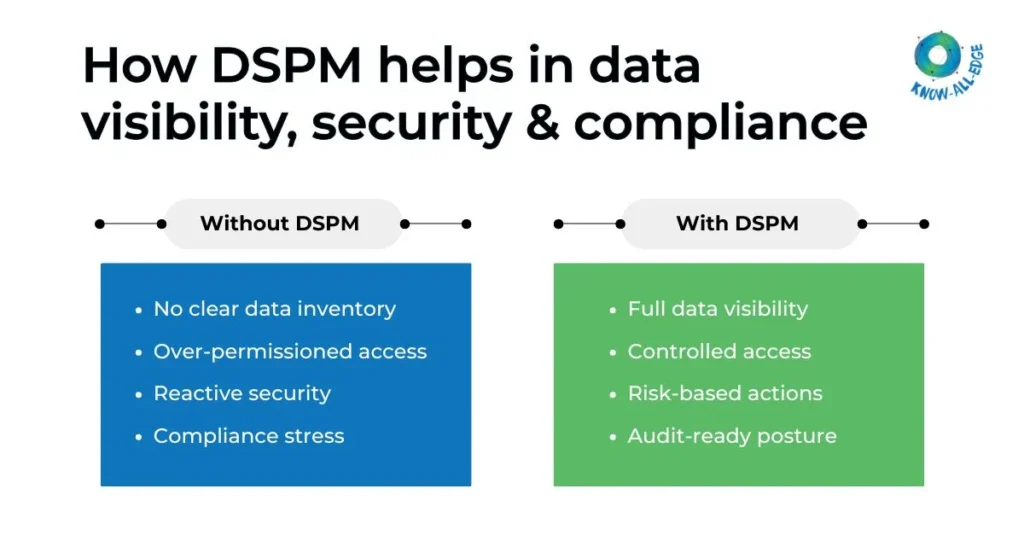
Instead of static reports, DSPM gives you:
- Where sensitive data exists
- Who has access to it
- Whether that access is risky
- And how to fix it
This becomes even more critical with AI systems, where training data, prompts, and outputs introduce entirely new exposure points.
Why Choosing the Wrong DSPM Vendor Can Backfire
Not all DSPM vendors solve the same problem equally well.
Some platforms are data-intelligence heavy, great for discovery but weaker in enforcement.
Others are security-first, strong in detection and response but less mature in classification accuracy.
A few integrate deeply into broader ecosystems, while others operate as standalone tools.
The result?
Choosing the wrong DSPM solution can lead to:
- Visibility without action
- Alerts without prioritization
- Or worse, compliance gaps you thought were covered
What follows is a practical breakdown of the top DSPM vendors in India and globally, along with where each one actually fits.
Best DSPM Vendors You Should Evaluate in 2026
The DSPM vendors list below focuses on platforms that stand out in visibility, risk prioritization, and real-world usability.
| Vendor | Core Strength | Best For |
| Forcepoint DSPM | Risk visibility + remediation | Enterprises with compliance focus |
| Fortra DSPM | Integrated data protection stack | Mid-to-large enterprises |
| Palo Alto Cortex DSPM | Real-time detection & automation | Cloud-first organizations |
| Proofpoint DSPM | Risk prioritization & AI governance | Data-sensitive enterprises |
| SentinelOne | Unified cloud + AI security | Security consolidation use cases |
| BigID | Data intelligence & discovery at scale | Data-heavy organizations |
Let’s break these down.
1. Forcepoint
Forcepoint positions its DSPM platform around a simple idea: see everything, miss nothing, control risk before it escalates.
It is particularly strong in combining data discovery with actionable remediation, rather than stopping at visibility.
Key Features
- AI Mesh-based classification that improves accuracy across structured and unstructured data
- Continuous discovery across cloud, on-prem, and endpoints to uncover hidden sensitive data
- Built-in risk assessment across platforms like Microsoft 365, Salesforce, and Google Workspace
- Automated remediation of ROT (redundant, obsolete, trivial) data and overexposed files
- Data Detection and Response (DDR) to monitor insider risk and stop misuse in real time
- Least privilege enforcement to reduce unnecessary access and limit breach impact
Best Suited For: Enterprises that need strong compliance alignment + active risk reduction, not just discovery.
2. Fortra
Fortra takes a more integrated approach, combining DSPM with DLP and broader data protection capabilities.
It focuses on reducing fragmentation across tools.
Key Features
- Real-time data discovery across cloud apps, services, and environments
- Context-aware classification that distinguishes critical data from low-value noise
- Integrated DLP capabilities to control data movement across endpoints and cloud
- Policy enforcement across tools like Box, Dropbox, Microsoft Teams, and Slack
- Controls to restrict risky actions like unauthorized uploads or external sharing
- Built-in ecosystem that connects discovery, classification, and protection workflows
Best Suited For: Organizations looking for a single platform approach to DSPM + DLP + data control
3. Palo Alto Networks Cortex
Cortex DSPM focuses heavily on automation and real-time risk detection, aligning closely with cloud-native environments.
It is built for teams that cannot rely on manual processes anymore.
Key Features
- Automated discovery and classification of shadow and unmanaged data across cloud environments
- Real-time risk analysis and anomaly detection to identify threats early
- Continuous monitoring of data exposure across SaaS, cloud, and AI systems
- Visibility into access patterns, IAM policies, and over-privileged accounts
- Context-driven prioritization based on sensitivity, exposure, and business impact
- Support for securing data used in AI training and deployments
Best Suited For: Cloud-first organizations needing real-time visibility and automated response
4. Proofpoint
Proofpoint brings a risk-first approach, focusing on prioritization and governance, especially in complex, data-heavy environments.
Key Features
- Agentless, in-place data discovery across SaaS, IaaS, PaaS, and hybrid environments
- Risk scoring using 200+ predefined findings to prioritize what matters most
- Visualization of attack paths and exposure risks for faster remediation
- AI data access governance to monitor human and machine access to sensitive data
- Integration with DLP and Microsoft Information Protection for unified control
- Continuous compliance monitoring across 500+ frameworks with real-time reporting
- Detection of sensitive data usage in AI workflows (AWS Bedrock, Azure ML, GCP Vertex AI)
Best Suited For: Organizations where risk prioritization, compliance, and AI governance are critical
5. SentinelOne
SentinelOne approaches DSPM as part of a broader unified cloud and AI security platform, rather than a standalone tool.
Key Features
- Unified platform combining CSPM, CDR, CIEM, AI-SPM, and DSPM framework
- Autonomous AI engines for real-time threat detection and response
- Protection across cloud assets including VMs, containers, and serverless environments
- Visual mapping of cloud assets, relationships, and potential attack paths
- Low-code/no-code workflows for faster remediation
- Built-in forensic insights and sensitive data scanning to prevent leaks
Best Suited For: Organizations aiming for security consolidation across cloud, identity, and data
6. BigID
BigID is widely recognized for its data intelligence-first approach, going deeper into discovery and classification than most vendors.
Key Features
- AI-powered, agentless data discovery using NLP and machine learning
- Deep visibility into structured, unstructured, and “dark” data
- Data mapping and context enrichment for better governance decisions
- Support for a wide ecosystem including Hadoop, AWS, SAP HANA, MongoDB, and more
- Deployment flexibility across cloud, on-prem, and hybrid environments
- Scales to petabyte-level data environments
Best Suited For: Data-heavy organizations needing deep discovery, classification, and governance
How to Choose the Right DSPM Vendor in 2026
Choosing a DSPM vendor is less about features and more about fit.
- Start with visibility- how well the platform discovers sensitive, unstructured, and even shadow data across your environment.
- Then comes risk prioritization. The better tools don’t just generate alerts; they help you focus on what actually matters.
- Access visibility is just as important. You need to clearly see who has access to what, and where permissions are excessive.
- Integration also plays a big role, especially how easily the solution connects with your existing DLP, IAM, SIEM, and cloud stack.
- With AI becoming part of data workflows, it’s worth considering whether the platform can secure data used in training and inference.
- And of course, it should scale easily as your data grows across environments.
For organizations in India, compliance requirements, data residency, local support, and cost efficiency also influence the final decision.
The Honest Summary
The reality about DSPM vendors is simple:
There is no single “best” platform- only the best fit for your data environment.
- Forcepoint stands out for risk remediation and compliance alignment
- Fortra excels in integrated data protection workflows
- Palo Alto delivers automation and real-time security
- Proofpoint leads in risk prioritization and governance
- SentinelOne is strong in platform consolidation
- BigID dominates in data discovery and intelligence depth
What unites them is a shift toward data-centric security.
If ZTNA changed how we secure access, DSPM is changing how we secure the data itself.
And as data continues to spread across cloud, SaaS, and AI systems, DSPM is quickly becoming a non-negotiable layer in modern security architecture.
Ready to Choose the Right DSPM Vendor for Your Business?
Evaluating DSPM vendors is only the first step.
The real challenge is identifying:
- Which platform fits your data landscape
- How it integrates with your existing security stack
- And how to operationalize it without adding complexity
We work with leading DSPM vendors to help organizations shortlist the right solutions, streamline deployment, and reduce data risk faster.
If you are exploring DSPM or planning to strengthen your data security posture, now is the right time to get it right. Reach out to our experts to implement the best solution.
Frequently Asked Questions About DSPM Vendors
What are some best DSPM vendors?
Some of the best DSPM vendors to evaluate in 2026 include Forcepoint, Fortra, Palo Alto Networks (Cortex DSPM), Proofpoint, SentinelOne, and BigID. Each offers different strengths, from deep data discovery and classification to real-time risk detection and compliance-driven remediation. So, the right choice depends on your specific data environment and security priorities.
What are the key features to look for in DSPM tools?
The most effective DSPM tools go beyond basic data discovery. Look for capabilities like:
- Sensitive data classification across structured and unstructured environments
- Risk-based prioritization
- And clear visibility into who has access to what data.
Strong DSPM solutions also offer automated remediation, integration with existing security tools, and support for securing data across cloud, SaaS, and AI systems.
Do organizations in India need DSPM for compliance?
Yes, DSPM is becoming increasingly important for compliance in India, especially with evolving regulations like the Digital Personal Data Protection Act (DPDPA). DSPM helps organizations continuously discover and classify sensitive data, monitor exposure risks, and generate audit-ready reports, making compliance more proactive rather than reactive.
Can DSPM tools secure data used in AI and machine learning?
Modern DSPM tools are designed to secure data across AI pipelines, including training datasets, prompts, and model outputs. They help identify sensitive data exposure in AI workflows, enforce access controls, and reduce risks like data leakage or unauthorized usage in generative AI systems.
What should you look for when choosing a DSPM solution?
When evaluating DSPM solutions, focus on data discovery accuracy, risk prioritization capabilities, access intelligence, and integration with existing tools like DLP, IAM, and SIEM. It’s also important to assess scalability and whether the platform can support cloud, SaaS, and AI environments without adding operational complexity.


