 Skip to content
Every organization depends on data to operate, make decisions, and serve customers. But the same information that fuels business growth also attracts cyber attackers and increases regulatory responsibilities. A single exposed database, an employee sharing sensitive files with the wrong recipient, or a misconfigured cloud application can result in financial losses, regulatory penalties, and lasting reputational damage.
As organizations embrace cloud technologies, hybrid work, and AI-driven operations, protecting personal and business information has become more challenging than ever. Regulations such as the Digital Personal Data Protection Act (DPDPA) have also raised the expectations for how organizations collect, process, store, and secure personal data.
This is why adopting strong Data Privacy Best Practices is no longer just about meeting compliance requirements. It is about reducing risk, building customer confidence, and creating a resilient security framework that supports long-term business growth.
Why Data Privacy Deserves More Attention Than Ever
Data privacy is often confused with data security. While they are closely connected, they address different aspects of protecting information.
Data security focuses on safeguarding information from cyber threats through technical controls such as encryption, authentication, and endpoint protection. Data privacy, on the other hand, governs how personal information is collected, processed, shared, and retained throughout its lifecycle.
Organizations today manage enormous volumes of customer records, employee information, financial data, healthcare records, and intellectual property. Without proper privacy controls, even legitimate users can accidentally expose sensitive information.
Maintaining compliance is also an important aspect and is no longer achieved through only policies. Your organization must be able to prove that appropriate technical and operational controls are actively protecting sensitive information.
Common Challenges That Put Data Privacy at Risk
Before implementing privacy controls, it is important to understand where organizations commonly struggle.
Expanding Attack Surface
Cloud platforms, remote work, SaaS applications, and connected devices have significantly expanded the number of locations where sensitive data resides. Each environment introduces new security and privacy risks.
Lack of Visibility Into Sensitive Data
Many organizations simply do not know where their confidential information is stored. Sensitive files often exist across employee laptops, email platforms, collaboration tools, file servers, and cloud storage, making them difficult to identify and secure.
Insider Risks
Not every data breach originates from external attackers. Employees, contractors, and third-party vendors can unintentionally expose confidential information through accidental sharing, weak passwords, or improper handling of sensitive files.
Evolving Regulatory Requirements
Organizations operating across multiple regions must navigate various privacy regulations, each with its own compliance requirements. Keeping pace with changing legal obligations requires continuous monitoring and governance.
Excessive Data Collection
Collecting information “just in case” often creates unnecessary privacy risks. The more sensitive information an organization stores, the larger its potential attack surface becomes.
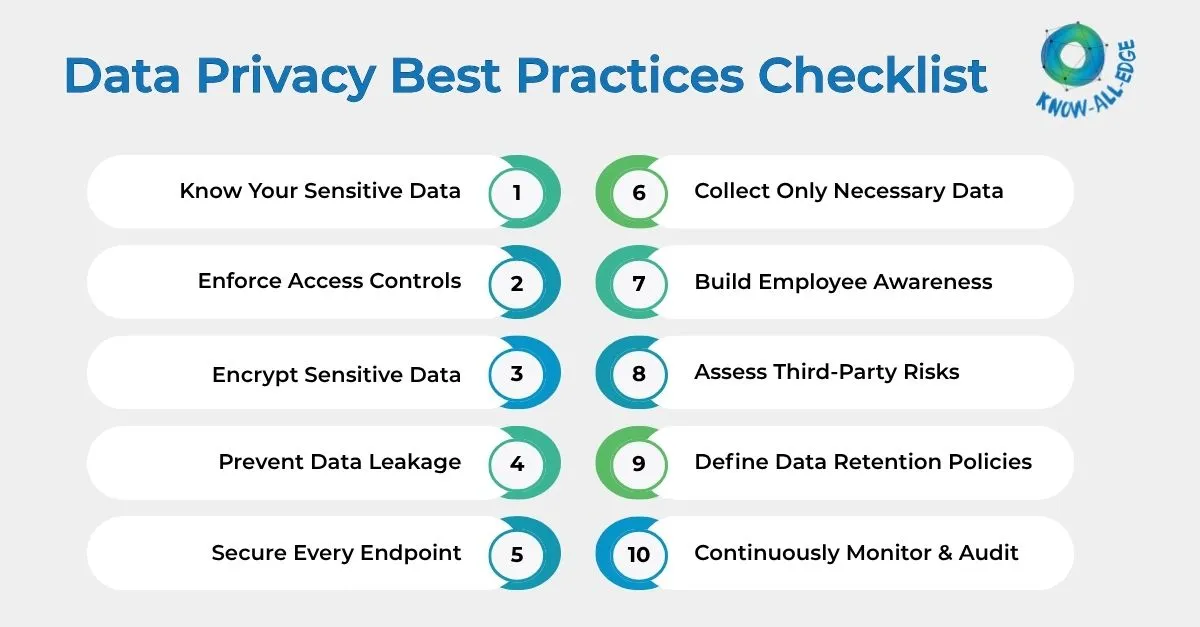
10 Data Privacy Best Practices Every Organization Should Follow
Protecting sensitive information requires a combination of governance, people, and technology. With frameworks like the DPDPA raising the bar on how organizations handle personal data, getting these fundamentals right matters more than ever. The following data privacy best practices provide a practical foundation for strengthening your privacy program.
(1) Know What Data You Have
You cannot protect data you cannot find.
The first step is discovering where sensitive information exists across your environment. Customer records, employee information, financial documents, healthcare records, and intellectual property may be spread across endpoints, cloud storage, databases, and collaboration platforms.
Classifying data based on sensitivity allows security teams to apply appropriate protection policies while supporting compliance initiatives.
A DSPM solution can further help organizations discover, classify, and continuously monitor sensitive data across hybrid environments.
(2) Limit Access Based on Business Need
Providing unrestricted access to sensitive information increases the likelihood of both insider threats and accidental exposure.
Organizations should implement Identity and Access Management (IAM) with role-based access controls and follow the principle of least privilege, ensuring employees can only access the information required for their responsibilities.
Multi-Factor Authentication (MFA) and Single Sign-On (SSO) further strengthen identity verification, reducing the risk of compromised credentials while simplifying secure access across applications.
(3) Encrypt Sensitive Information
Encryption acts as one of the strongest safeguards for protecting confidential information.
Whether data is stored in databases, transferred between systems, or shared across networks, Data Encryption and Tokenization ensures that intercepted information remains unreadable without the appropriate keys.
This becomes especially valuable if devices are lost, storage systems are compromised, or attackers gain unauthorized access.
(4) Prevent Unauthorized Data Sharing
Many privacy incidents occur because sensitive information is unintentionally shared through email, USB devices, personal cloud storage, or messaging applications.
Rather than relying solely on employee awareness, organizations should implement controls that actively monitor and restrict unauthorized movement of confidential information.
Data Loss Prevention (DLP) solutions identify sensitive data in real time and help prevent accidental or intentional leakage before it leaves the organization’s control. Complementing DLP, a Cloud Access Security Broker (CASB) solution provides visibility and control over data moving through cloud applications and SaaS platforms – a growing source of uncontrolled data exposure.
Under the DPDPA, organizations are expected to implement reasonable security safeguards to protect personal data. Preventing unauthorized sharing is an important part of meeting these obligations.
(5) Strengthen Endpoint Security
Every employee device represents a potential entry point for attackers and a storage location for sensitive information.
While endpoint protection platforms defend against malware and ransomware, organizations should also ensure endpoints are continuously monitored, patched, and managed to reduce vulnerabilities.
Combining endpoint security with data protection controls creates stronger defense against both cyber threats and privacy incidents.
(6) Collect Only the Data You Actually Need
One of the simplest ways to reduce privacy risk is to minimize unnecessary data collection.
Before requesting personal information, organizations should ask whether it is genuinely required for business operations. Reducing excess data lowers storage costs, simplifies compliance, and limits the potential impact of future breaches.
This approach also aligns with the purpose limitation principles emphasized by privacy regulations. Where required, organizations should obtain and manage consent for collecting and processing personal data. A centralized consent management solution helps maintain consent records and supports DPDPA compliance.
(7) Build Privacy Awareness Across the Organization
Technology alone cannot eliminate privacy risks.
Employees remain one of the most important components of any privacy strategy. Regular awareness programs should educate staff about recognizing phishing attempts, securely handling sensitive information, reporting suspicious activity, and following organizational privacy policies.
Well-informed employees are far less likely to become the cause of preventable privacy incidents.
(8) Monitor Third-Party Security
Organizations increasingly rely on vendors, cloud providers, consultants, and outsourcing partners to process sensitive information.
Before sharing confidential data, evaluate whether third parties maintain appropriate security controls and comply with applicable privacy regulations. Vendor risk assessments should become a routine part of procurement and governance processes.
(9) Establish Clear Data Retention and Deletion Policies
Holding on to data indefinitely increases both security and compliance risks. Information that no longer serves a business purpose should be securely deleted according to a well-defined retention policy.
Organizations should document:
- What data needs to be retained
- How long it should be stored
- Who is responsible for managing it
- When and how it should be permanently deleted
A structured retention policy reduces storage costs, lowers privacy risks, and simplifies compliance.
(10) Continuously Monitor, Audit, and Improve
Data privacy is not a one-time initiative. New applications, changing business processes, evolving cyber threats, and updated regulations require organizations to review their privacy posture regularly.
Continuous monitoring helps security teams detect unusual user activity, identify policy violations, and respond to incidents before they escalate.
Regular audits also provide valuable insights into:
- Whether access controls remain appropriate
- Where sensitive data has moved
- Which systems require stronger protection
- Whether compliance obligations are being met
A proactive approach helps organizations stay ahead of both attackers and regulatory expectations.
Final Thoughts
Strong privacy practices have become a business necessity rather than a compliance checkbox. As organizations generate larger volumes of sensitive information and operate across increasingly complex digital environments, protecting personal data requires continuous attention, governance, and the right security controls.
Following these data privacy best practices helps organizations reduce cyber risks, improve regulatory compliance, and build lasting trust with customers, employees, and partners.
At KnowAllEdge, we help organizations turn privacy strategies into practical security implementations. From deploying identity and access management, endpoint security, encryption, and data loss prevention solutions to providing ongoing monitoring and technical support, our team works closely with businesses to strengthen data protection.
We also help organizations align with evolving regulations such as the DPDPA. So, if you are looking to modernize your security infrastructure or close compliance gaps, we’re here to help you build a stronger and more resilient privacy framework. Let’s connect.
FAQs on Data Privacy Best Practices
What are data privacy best practices?
Data privacy best practices are the policies, processes, and technical controls organizations implement to protect sensitive information throughout its lifecycle. These include:
- Data discovery
- Access control
- Encryption
- Employee awareness
- Data retention
- Continuous monitoring
to reduce privacy risks and meet regulatory requirements.
Why is data privacy important for businesses?
Data privacy helps organizations protect sensitive customer and business information from unauthorized access, misuse, or data breaches. Strong privacy practices also improve customer trust, reduce financial and reputational risks, and support compliance with regulations such as the DPDPA.
Which security solutions support data privacy?
A comprehensive privacy strategy typically includes Identity and Access Management (IAM), Multi-Factor Authentication (MFA), Data Loss Prevention (DLP), Data Encryption, Endpoint Security, and Data Security Posture Management (DSPM). Together, these solutions help organizations discover, protect, monitor, and control sensitive information across their environments.


