 Skip to content
Ask a CISO what they spend on endpoints, cloud security, or identity management, and you’ll get a number within seconds. Ask the same person what they spend on securing AI i.e. AI Security, and the room usually goes quiet. That silence is not a knowledge gap; it is a budgeting gap, and it is starting to cost organizations real money.
Here’s the uncomfortable part: most security leaders are not choosing to ignore AI risk. They are simply reacting to it, pulling funds from existing security lines the moment a board question, a compliance audit, or an actual incident forces the issue.
That approach might have worked when AI was a side experiment. It doesn’t work anymore, not when AI tools are woven into nearly every business function. This is exactly why a properly structured AI security budget has become non-negotiable heading into 2026-27.
Why an AI Security Budget is Important to Discuss?
Traditional security budgets are built around a known environment: approved software, known assets, and predictable data flows. AI is changing all of that.
Employees are signing up for AI-powered SaaS tools, teams are experimenting with large language models, and vendors are adding AI features to their products. Each of these creates new security risks that traditional security tools may not be able to see or control.
This does not mean security teams are failing. In many cases, organizations simply do not yet have the right visibility and controls to manage growing AI usage.
AI risk is also different from traditional application risk. A normal application’s attack surface is relatively stable after deployment. An AI system can keep expanding as new integrations, data sources, models, and autonomous capabilities are added.
Many organizations still rely on existing endpoint, application, and cloud security tools to manage these risks. While these tools can detect some basic threats, they may not be designed to identify risks such as:
- Prompt injection attacks
- Manipulated or unsafe AI outputs
- Unauthorized access to sensitive training data
- Data leakage through AI tools
- Unapproved AI applications and integrations
Simply adding AI to an existing security strategy can therefore create a false sense of protection.
A dedicated AI security budget helps organizations build the visibility, controls, and governance needed to manage these new risks before they turn into serious security incidents.
What Organizations Are Actually Spending on AI Security Budget Today
Look at the numbers, and the picture is fairly clear. Global information security spending is growing at a rapid double-digit pace, with AI-related investment becoming one of the fastest-growing areas. Yet there is a clear gap: many organizations are now putting a meaningful share of their security budget toward AI, but only a small number have a formal AI security budget with a clearly defined allocation. For everyone else, AI security spending is still largely unplanned.
Spending also depends on how far an organization has progressed with AI. Organizations that are just starting their AI journey usually allocate a modest single-digit percentage of their overall security budget to AI-related needs, mainly for shadow AI discovery and basic policies.
Organizations with wider AI deployments spend more, adding governance platforms and data protection tools. Enterprises using agentic AI at scale allocate an even larger share of their security budget to AI because the risk surface is much bigger.
There is another cost that is often overlooked: shadow AI. The use of unauthorized AI tools can increase breach costs significantly and may remain undetected for more than a year. That detection gap alone is a strong reason to make AI security budget planning a higher priority.
Where Should the AI Security Budget Actually Go?
Once leadership agrees an AI security budget deserves its own line, the harder question is how to split it. A well-structured allocation generally spans four categories.
- Discovery and visibility deserves the largest share. You cannot secure what you cannot see, and most organizations have far more unsanctioned AI tools running than they realise. Discovery spending covers AI tool inventories, shadow AI detection, and mapping which data actually flows into which AI system.
- Governance and policy enforcement comes next. This is where acceptable-use policies, access controls, model approval workflows, and compliance mapping to frameworks such as the EU AI Act, NIST AI RMF, and India’s DPDP Act come into play.
For Indian organizations, aligning AI governance with local data protection and industry-specific requirements is especially important. Skipping straight to governance tools before discovery is like writing rules for a building you haven’t finished surveying.
- Data protection deserves nearly equal weight. AI systems are hungry for data by nature, and every retrieval pipeline or fine-tuned model becomes a fresh exposure point. Encryption rates for sensitive cloud data have actually slipped in recent years, even as AI accelerates how quickly data moves across boundaries.
- Threat defense, covering prompt injection, model extraction, data poisoning, and adversarial testing, gets the smallest starting allocation for most organizations. That’s intentional. Early-stage AI adopters face more risk from shadow AI and weak governance than from sophisticated, AI-targeted attacks. As maturity grows, particularly for organizations running customer-facing AI products, this allocation should expand.
Building an AI Security Budget Case the Board Will Actually Approve
Boards respond to numbers framed as business risk, not technical jargon. A workable pitch usually rests on three pillars.
- First, quantify shadow AI exposure. Even rough estimates, applied against headcount and data sensitivity, translate abstract risk into something the board can visualise without needing a single dollar figure attached.
- Second, show the trend, not just the snapshot. Boards fund based on direction of travel. If AI adoption inside your organization is climbing quarter over quarter, and visibility gaps are widening as fast as new tools appear, that trajectory is the argument, not a single point-in-time statistic.
- Third, tie every request to a measurable outcome. A large share of security leaders admit they cannot connect their spending to measurable risk reduction, and that disconnect is often exactly why budget requests get deferred rather than approved. Frame requests around outcomes: cutting shadow AI detection time from over a year to a matter of weeks, or completing a formal risk assessment before any externally facing AI product launches.
Mistakes That Quietly Drain an AI Security Budget
A handful of patterns show up repeatedly. Buying governance platforms before completing a proper AI inventory is probably the most common one; policy enforcement is only as good as the list of systems it applies to. Funding AI security entirely out of the core security budget is another, when really, the product, marketing, or operations teams generating the AI risk should share the cost of controlling it.
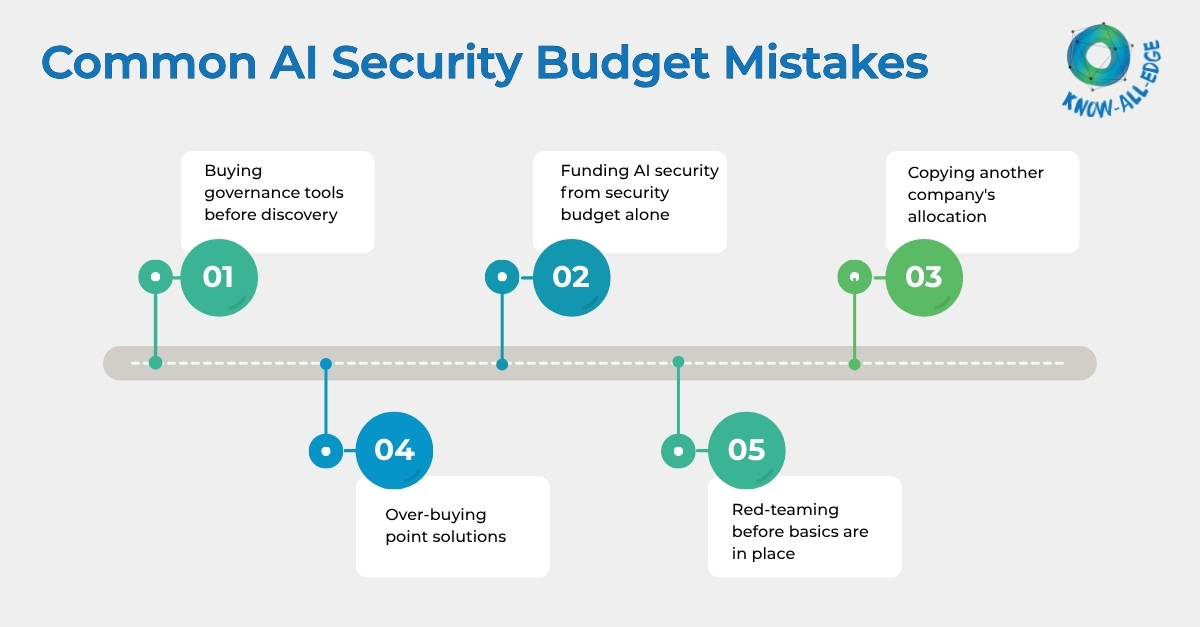
Copying someone else’s allocation percentages without adjusting for your own risk profile rarely ends well either. Neither does stacking up point solutions that each solve one narrow problem, leaving gaps in some areas and duplicate coverage in others. And red-teaming an AI product before basic input validation or access controls exist tends to produce a long list of findings and no real baseline to measure progress against.
Year One vs Year Two: Sequencing the Spend
Organizations just starting out should weight their first year heavily toward visibility and foundational governance, building a complete AI tool inventory, classifying tools by sensitivity, and putting basic policy and approval workflows in place.
By year two, with that baseline established, spending naturally shifts toward continuous monitoring, automated enforcement, and increasingly, agentic AI governance. Agent deployments tend to follow a year or so behind initial AI adoption, and they demand distinct controls: behavioural monitoring, auditing of tool calls, and human oversight for high-stakes actions.
Budget ownership also starts to spread out in year two, moving from a single centralised line to a shared model between security and the AI product teams themselves.
Wrapping It Up
An AI security budget isn’t something you can squeeze into an existing spreadsheet tab and call it done. It needs its own line, a clear-eyed framework for splitting that spend across discovery, governance, data protection, and threat defense, and a business case built in language the board already understands.
The organizations that come out ahead over the next couple of years will be the ones treating this seriously today, starting with visibility, building governance on a real inventory rather than guesswork, and scaling threat defense to match actual exposure rather than headlines.
Figuring out where to start, or how much of your AI footprint is actually flying under the radar, doesn’t have to be a guessing game. At Know All Edge, we help security teams move from planning to execution, implementing the right AI workforce security controls for your environment and staying on as an ongoing partner as your AI footprint keeps evolving. Reach out, and let’s map what your AI security budget should actually look like.
FAQs on AI Security Budget
How much of the security budget should go toward AI security?
It depends on maturity. Organizations early in their AI journey typically allocate a smaller single-digit percentage of their overall security budget, while those running mature, agentic AI deployments allocate a much larger share. There’s no universal number, it should track your actual AI footprint and risk exposure.
What should a CISO prioritize first when building an AI security budget?
Discovery and visibility. Without a clear inventory of what AI tools are actually in use, governance policies and threat defense investments end up protecting only a fraction of the real risk.
What’s the biggest mistake CISOs make with AI security budget planning?
Buying governance or threat detection tools before completing a proper AI discovery exercise. Policies and controls can only cover what you know exists, and most organizations underestimate how much AI activity is happening outside their visibility.
Does AI security budget planning change once agentic AI is introduced?
Yes. Agentic systems need distinct controls like behavioural monitoring, tool-call auditing, and human oversight for high-stakes actions. Most organizations shift budget toward these controls in their second year of AI adoption, once initial visibility work is complete.


