 Skip to content
Data is everywhere now, and Data Security Posture Management gives security teams continuous visibility into all the data present across cloud apps, endpoints, SaaS platforms, and even AI tools.
It tells where your sensitive data is present, who can access it, and what data is at risk.
According to Frost & Sullivan, the global DSPM market is projected to grow at a CAGR of 37.4% from 2025 to 2029.
Among this, two DSPM vendors that come up often in this space are Forcepoint and Fortra. Both offer DSPM solutions. Both address discovery, classification, and compliance. But they’re built differently, positioned differently, and they serve different types of security programs.
So, let’s break down Forcepoint DSPM vs. Fortra DSPM in detail.
What Forcepoint DSPM Brings to the Table
Forcepoint DSPM is built as part of a wider data security platform. It isn’t a standalone product, it’s inside the Forcepoint Data Security Cloud, which also includes DLP and Data Detection and Response (DDR).
The core technology here is something Forcepoint calls AI Mesh. It’s a classification system that combines a Small Language Model (SLM), deep neural network classifiers, and other predictive AI components. The goal is to move beyond basic pattern matching. Instead of flagging every 16-digit number as a potential credit card, it understands context:
- what kind of document it is,
- what the data means,
- and what the surrounding content looks like.
This reduces false positives significantly, which matters a lot when your analysts are already overloaded.
Forcepoint DSPM scans structured and unstructured data across cloud environments (AWS, Azure, GCP), on-premises file servers, SaaS applications like Microsoft 365, Salesforce, and Google Workspace, and even AI workflows.
That last point is worth paying attention to. Shadow AI usage is a growing risk. Employees sharing sensitive data with generative AI tools is becoming a real blind spot for organizations, and Forcepoint specifically addresses this.
Where Forcepoint Stands Out
- AI Mesh classification that learns your environment over time and trains on your specific data patterns
- Integrated DDR to monitor and respond when sensitive data is accessed or moved in unexpected ways
- ROT data management, helping you identify and clean up redundant, obsolete, and trivial data that creates unnecessary risk
- Least privilege enforcement, making it easy to see who has access to what and reduce permissions down to only what’s needed
- Air-gapped deployment support for highly regulated industries like defense or government, where no data leaves the customer network
- Free data risk assessments, which let organizations test before committing
What Fortra DSPM Offers
Fortra takes a slightly different angle. Their DSPM framework is focused on helping organizations discover and classify sensitive data. And then feeding that context into broader enforcement through other tools in the Fortra portfolio, primarily their DLP and Data Classification products.
The strength of the Fortra approach is how it brings different security layers together. Their platform connects data discovery and classification with actual DLP policy enforcement, giving organizations a path from “knowing where data is” to “actively protecting it.” This is an important distinction. Many DSPM vendors stop at visibility. Fortra tries to extend that into protection.
Where Fortra Stands Out
- Data Discovery that scans data at creation, in motion, and at rest across cloud apps and on-prem systems
- Data Classification using metadata to categorize data accurately, making compliance less complicated
- DLP integration that prevents actions like copying to thumb drives, uploading to unauthorized cloud storage, or pasting source code into AI tools like ChatGPT or Google Gemini
- Impersonation attack detection across communication platforms like Microsoft Teams and Slack
- Support for major compliance frameworks including GDPR, HIPAA, PCI DSS, CCPA, and NIS 2
Fortra’s platform is particularly well-suited for organizations that already have a Fortra footprint, or those looking for a straightforward endpoint-to-cloud coverage model.
The DLP component specifically is feature-rich. It can monitor file uploads to Box and Dropbox, restrict access to unauthorized AI tools, and block sensitive data from leaving via removable devices.
Forcepoint DSPM vs Fortra DSPM: A Direct Look
Here’s comparison of Forcepoint DSPM vs Fortra DSPM across key areas that matter most for security leaders:
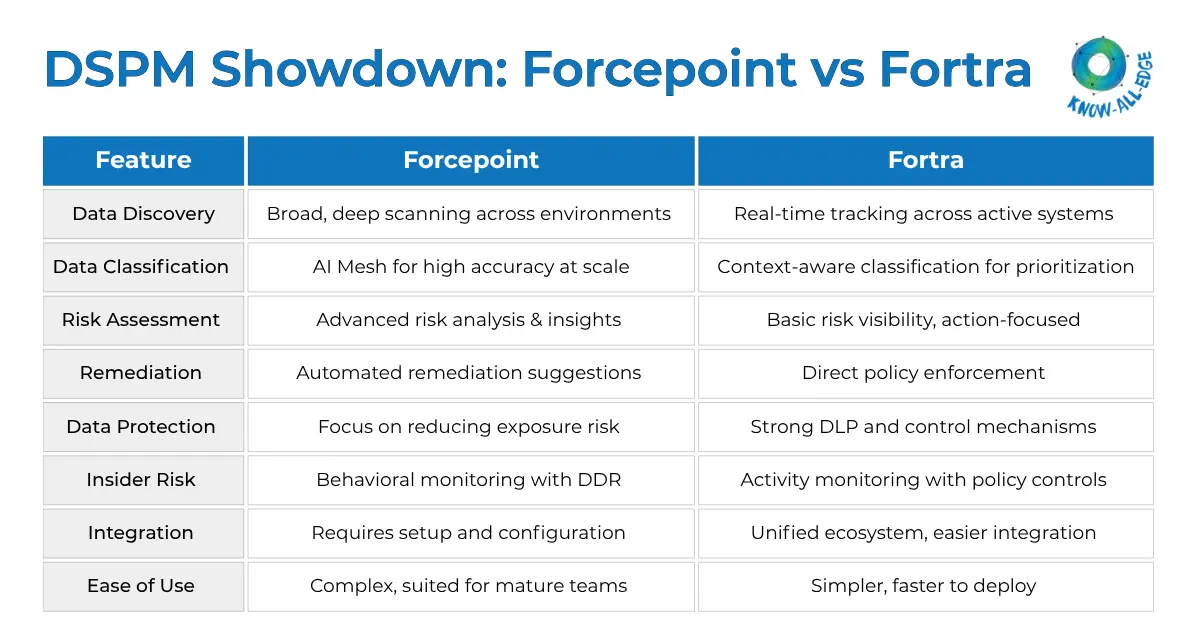
Classification Accuracy
- Forcepoint’s AI Mesh is the key differentiator here. It’s purpose-built for contextual understanding and adapts to your organization’s unique data patterns over time.
- Fortra’s classification is solid and uses metadata effectively, but it doesn’t have the same AI-native depth that Forcepoint brings.
Hybrid and On-Prem Coverage
Both products cover cloud and on-prem environments. Forcepoint goes a step further by supporting air-gapped deployments, which is critical for defense contractors, government agencies, and financial institutions with strict data residency requirements.
AI and GenAI Risk
- Forcepoint DSPM explicitly extends its controls to DSPM for AI, helping organizations monitor what data flows into AI tools and protect against data leakage through shadow AI.
- Fortra addresses AI-related risk through its DLP controls (blocking copy-paste into ChatGPT, for example), but the DSPM layer itself is less focused on AI-specific data flows.
Platform Integration
Both vendors offer integrated portfolios.
- Forcepoint connects DSPM with DDR and DLP in a unified dashboard, so your discovery, classification, and response capabilities share context.
- Fortra connects DSPM with DLP and Data Classification, offering a strong endpoint-to-cloud protection chain.
The difference is that Forcepoint’s integration happens at the data security layer natively, while Fortra, on the other hand, connects multiple tools within its own product portfolio.
Compliance
Both products cover major frameworks – GDPR, HIPAA, PCI DSS, CCPA. Forcepoint adds CMMC, which matters for organizations working with the U.S. Department of Defense.
Insider Risk
- Forcepoint includes Data Detection and Response to track unusual data access and movement by internal users, which gives it an edge in insider threat scenarios.
- Fortra’s DLP handles policy enforcement well, but the DDR-equivalent capability is less prominent.
Ease of Deployment
- Forcepoint’s integrated platform approach means teams get a more unified experience from the start, though it may require more upfront planning.
- Fortra’s model is more modular, which can make it easier to deploy specific components.
Which One Is Right for Your Organization: Forcepoint or Fortra?
The choice between Forcepoint DSPM vs. Fortra DSPM depends on your environment, not just features.
Choose Forcepoint DSPM if:
- You operate in a complex, hybrid environment
- You need deeper visibility, risk analysis, and strong compliance reporting
- Insider risk and data misuse are critical concerns for your organization
- You are looking for advanced AI capabilities with better control over shadow AI risks
- Your team is equipped to manage a more sophisticated, integrated platform
Choose Fortra DSPM if:
- You want faster deployment and quicker results
- You prefer integrated security with fewer tools
- You need strong enforcement controls, especially for cloud and AI use
- Your focus is on controlling data movement rather than deep risk analytics
- You already use Fortra products or want a simpler DSPM framework to start with
Conclusion
Both Forcepoint DSPM vs Fortra DSPM are capable products. Forcepoint leads in AI-powered classification, hybrid environment coverage, and integrated detection and response capabilities. Fortra is strong in endpoint-to-cloud DLP integration and suits organizations looking for modular deployment with clear policy enforcement paths.
Choosing between them isn’t just about features – it’s about alignment with your existing stack, your team’s capacity, and the specific data risks you’re trying to address.
We can evaluate, implement, and optimize the best DSPM solutions for your organization. Whether you’re starting with a data risk assessment or migrating from a legacy tool, we work with your team to make sure the deployment actually delivers value — not just a dashboard. If you’re ready to move from visibility to control, we’re here to help you get there.
Frequently Asked Questions
Can Forcepoint DSPM and Fortra DSPM both handle unstructured data like emails and documents?
Yes, both products handle unstructured data. Forcepoint uses AI Mesh to classify unstructured content with contextual accuracy, while Fortra relies on metadata-based classification. Both can scan documents, emails, and collaboration content across cloud and on-prem systems.
Do these DSPM solutions help with AI governance and controlling what data goes into GenAI tools?
Forcepoint DSPM specifically addresses DSPM for AI, helping organizations track data flows into GenAI workflows and prevent sensitive data from reaching unauthorized AI tools. Fortra handles this primarily through its DLP controls, which can block copy-paste actions into tools like ChatGPT and restrict access to unapproved AI platforms.
How does DSPM differ from traditional DLP, and do I need both?
DSPM focuses on discovering and classifying data at rest – it tells you where your sensitive data is and who can access it. DLP prevents data from moving in unauthorized ways. They work together: DSPM provides visibility and context, while DLP uses that context to enforce policies. Most security programs benefit from having both working in tandem.
What compliance standards do Forcepoint and Fortra DSPM support?
Both platforms cover major global frameworks including GDPR, HIPAA, PCI DSS, CCPA, and NIS 2. Forcepoint additionally supports CMMC, which is relevant for U.S. defense supply chain organizations. Both provide automated compliance reporting to reduce the manual effort involved in audits.
Is DSPM suitable for smaller organizations, or is it mainly for large enterprises?
DSPM is most commonly adopted by mid-to-large enterprises due to the complexity of their data environments. That said, any organization handling regulated data – healthcare, finance, legal, education, can benefit from DSPM regardless of size. Both Forcepoint and Fortra offer deployment options that scale to different organizational needs, and starting with a data risk assessment is a low-risk way to evaluate your current posture.


