 Skip to content
Every few years, security technology shifts from “being optional” to “necessary to operate”.
Zero Trust Network Access is at that moment right now. VPNs weren’t built for today’s hybrid and multi-cloud work environments, and attackers take advantage of their broad access to get in easily.
But now, ZTNA has taken over the VPNs to protect all tech environments, and its market is expected to grow from USD 1.34 billion in 2025 to USD 4.18 billion by 2030, at a CAGR of 25.5% as per MarketsandMarkets research.
Also, Gartner suggests that over 70% of new remote access deployments now use ZTNA instead of traditional VPNs – a number that seemed unimaginable just five years ago.
This is not a trend driven by marketing budgets. It is driven by necessity. So, before we jump into the ZTNA vendors directly, let’s have a short discussion about what is ZTNA and how it is better than VPN.
What Is ZTNA, and Why Does It Outperform VPN for Modern Teams?
Before getting into specific ZTNA vendors, it is worth grounding the concept clearly, because “zero trust” has been stretched to mean almost anything in vendor materials.
Zero Trust Network Access (ZTNA) operates on one foundational rule: no user, device, or connection is automatically trusted, regardless of where it originates. Every access request is verified in real time based on identity, device health, location, and behavioral context before a resource is made available.
And crucially, access is granted to a specific application, not to the entire network, which is exactly what VPNs do wrong.
- With a traditional VPN, an authenticated user walks into a wide-open floor of your network.
- With ZTNA, they walk into a sealed room with exactly the one resource they need.
That distinction matters enormously when credentials are compromised or an insider threat materializes.
ZTNA use cases now span well beyond remote access. Organizations are deploying it for:
- Third-party contractor access
- BYOD security enforcement
- Workload-to-workload protection in cloud environments, and
- Isolating their most sensitive applications from internet exposure entirely.
The Asia Pacific region, including India, is seeing some of the fastest adoption rates as India’s Digital Personal Data Protection Act pushes enterprises to modernize their access controls.
Why Choosing the Wrong ZTNA Vendor Is a Costly Mistake
Not all zero trust network access vendors deliver equally.
- Some platforms excel for large, globally distributed enterprises but become expensive and unwieldy for mid-market companies.
- Others offer excellent data protection but lack the network performance backbone to support real-time applications.
- A few look impressive on paper and fall apart during integration with existing identity or SIEM tools.
The Gartner SSE Magic Quadrant for 2025 named Zscaler, Netskope, and Palo Alto Networks as leaders.
What follows is a simple breakdown of the top ZTNA vendors in India and worldwide, along with honest notes on where each one shines and where it struggles.
Understanding how each solution fits into your overall ZTNA framework is critical when evaluating vendors.
Best ZTNA Vendors You Should Actually Evaluate in 2026
| Vendor | Core Strength | Best For |
| Zscaler ZPA | Scale & mature architecture | Large global enterprises |
| Palo Alto Prisma Access | Deep security + ecosystem | Enterprises with SecOps |
| Netskope One | Data protection (DLP/CASB) | Regulated, data-first orgs |
| Cloudflare Zero Trust | Speed & ease of deployment | SMBs & cloud-native teams |
| Cisco Secure Access | Strong ecosystem integration | Existing Cisco users |
| Fortinet FortiZTNA | Policy consistency & value | Hybrid environments |
Let us explore these in detail now.
1. Zscaler Private Access (ZPA)
Zscaler Private Access is one of the most widely adopted ZTNA platforms, trusted by a large share of Fortune 500 companies. It stands out for its scale, global infrastructure, and mature zero trust architecture.
Key Features
- Inside-out architecture (apps never exposed to the internet)
- Identity and device posture-based access
- AI-powered policy recommendations
- ZPA App Protection for detecting lateral movement
- Global cloud infrastructure with high scalability
Pricing
- Custom pricing
- Costs increase with DLP, CASB, and support tiers
Best Suited For: Large enterprises with global operations building toward a full SASE architecture
2. Palo Alto Networks Prisma Access
Prisma Access integrates ZTNA into Palo Alto’s broader SASE and security ecosystem, offering deep visibility and tightly connected threat detection capabilities.
Key Features
- ZTNA 2.0 with granular access controls
- Integration with Cortex for unified threat detection
- Multi-cloud and endpoint security integration
- Support for private 5G environments (via Ataya partnership)
Pricing
- Subscription-based (1, 3, or 5 years)
- Based on users or bandwidth
- Extra cost for add-ons (e.g., service connections)
- Custom pricing for SMBs to enterprises
Best Suited For: Enterprises with mature SecOps teams and multi-cloud environments
3. Netskope One
Netskope One takes a data-centric approach, combining ZTNA with strong DLP and CASB capabilities for organizations where data protection is critical.
Key Features
- Integrated ZTNA, CASB, SWG, DLP, and browser isolation
- UEBA-driven adaptive access policies
- NewEdge private backbone for low-latency inspection
- Single client for multiple security controls
Pricing
- Custom pricing (generally competitive with enterprise vendors)
- Total cost varies based on bundled services
Best Suited For: Regulated industries and data-first organizations needing strong DLP and CASB
4. Cloudflare Zero Trust
Cloudflare Zero Trust is known for its speed, ease of deployment, and cost-effectiveness, powered by Cloudflare’s global anycast network.
Key Features
- Identity-based access without VPN
- Device posture checks and secure web gateway
- Data loss prevention capabilities
- Infrastructure-level access (via BastionZero acquisition)
- Fast deployment and low latency
Pricing
- Tiered pricing available
- Free tier available for small teams
Best Suited For: Cloud-native organizations and growing businesses needing quick deployment and performance
5. Cisco Secure Access
Cisco Secure Access combines ZTNA with SSE and integrates deeply with Cisco’s ecosystem, making it a strong choice for existing Cisco customers.
Key Features
- Integration with Duo, Umbrella, and ISE
- Hybrid ZTNA + VPNaaS support
- Strong identity and endpoint trust controls
- Gradual migration from legacy environments
Pricing
- Subscription-based pricing (per user & features)
- Three tiers: DNS Defense, Essentials, Advantage
- Combines SIA & SPA in one dashboard
Best Suited For: Organizations already using Cisco infrastructure and seeking gradual ZTNA adoption
6. Fortinet FortiZTNA
Fortinet FortiZTNA stands out for its high customer satisfaction and consistent policy enforcement across both on-prem and remote environments.
Key Features
- Universal ZTNA (same policies on and off network)
- Integration with Fortinet Security Fabric
- AI-driven risk-based access (with CrowdStrike integration)
- Single FortiClient agent for multiple security functions
Pricing
- Subscription-based (per user/endpoint)
- Lower per-user cost at larger scale
Best Suited For: Organizations wanting consistent access policies and strong customer-validated performance
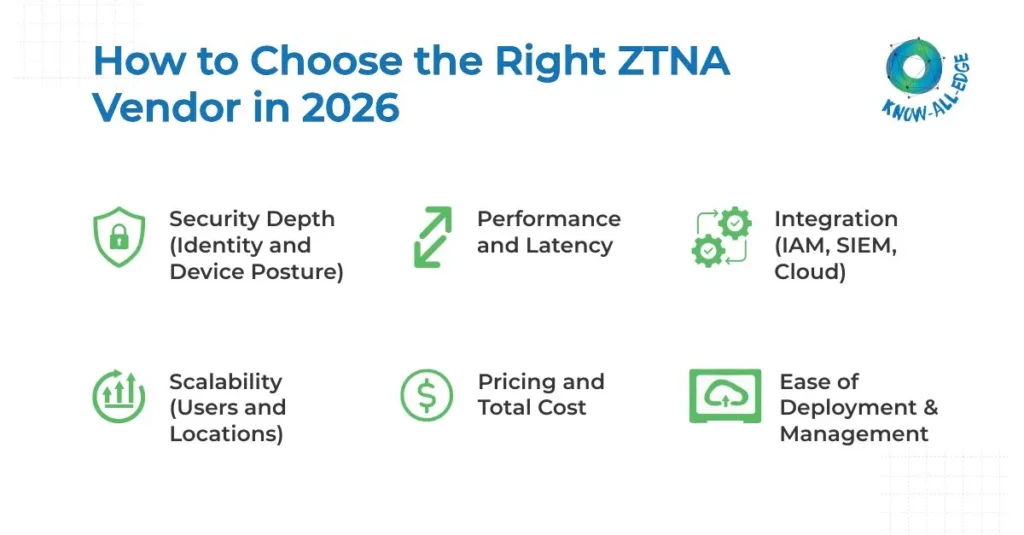
The Honest Summary
The practical truth about ZTNA vendors in 2026 is that the “best” platform depends entirely on your constraints.
- Zscaler wins on scale and proven enterprise deployments.
- Netskope wins on data protection and DLP depth.
- Palo Alto wins when you need ZTNA and threat intelligence tightly coupled.
- Cloudflare wins on performance, simplicity, and price.
- Cisco wins when you are deep in the Cisco ecosystem.
- Fortinet wins on customer satisfaction and policy consistency.
What unites all of them is a shift away from the network-centric, perimeter-trust model that VPNs represent. If your organization is still running VPN as its primary remote access mechanism, the question is no longer whether to move to ZTNA; it is which ZTNA solution fits your environment, your team’s capabilities, and your budget.
Ready to Choose the Right ZTNA Vendor for Your Business?
Evaluating ZTNA vendors is only half of the battle! Choosing, implementing, and optimizing the right solution for your environment is where the real impact happens.
We partner with leading zero trust network access vendors to help organizations like yours identify the best-fit solution, streamline deployment, and ensure long-term success. Whether you’re just starting your ZTNA journey or looking to replace an existing VPN setup, our team can guide you every step of the way.
Talk to our experts today and find the ZTNA solution that actually fits your business.
Frequently Asked Questions About ZTNA Vendors
Who is the vendor for a ZTNA solution?
There is no single dominant ZTNA vendor. Leaders include Zscaler, Netskope, and Palo Alto Networks, along with Cloudflare, Cisco, and Fortinet. The right choice depends on your architecture, scale, and whether you need standalone ZTNA or a broader SASE platform.
Is Zscaler a ZTNA solution?
Yes, Zscaler offers ZTNA through Zscaler Private Access (ZPA). It uses an inside-out architecture to connect users directly to applications without exposing the network. It is widely adopted and consistently ranked as a market leader.
What is the difference between ZTNA and a VPN?
VPNs grant broad network access once a user is authenticated, increasing lateral movement risk. ZTNA restricts access to specific applications and continuously verifies user and device context. This significantly reduces attack surface and improves security.
Check out the distinction here: ZTNA vs VPN: Why Modern Enterprises Are Moving Beyond Traditional Remote Access
What are the primary ZTNA use cases beyond remote work?
Beyond remote access, ZTNA is used for securing third-party access, enforcing BYOD policies, protecting cloud workloads, and isolating critical applications. It is also increasingly used for IoT security in industries like healthcare and manufacturing.
How do ZTNA vendors in India differ from global deployments?
ZTNA deployments in India must account for DPDPA and data residency requirements. Vendors with local data centers or regional support help ensure compliance. This is especially critical for regulated sectors like BFSI, healthcare, and government.


