 Skip to content
How confident are you that your organization could survive a Data Protection Board audit tomorrow?
With penalties under the DPDP Act reaching up to ₹250 crore (roughly $30 million) for the most serious violations, such as failing to implement reasonable security safeguards, the DPDPA has turned privacy from a legal footnote into a boardroom priority. And the clock is ticking: all substantive provisions of the Act become enforceable from May 13, 2027, which means 2026 is the year businesses need to actually get ready.
Organizations are now expected to know exactly what personal data they collect, why they collect it, how it is protected, and who has access to it. This means, you now have to look beyond policies and ensure that the right processes, technologies, and governance are already in place before regulatory scrutiny begins.
The good news is that becoming DPDPA-ready doesn’t happen overnight, nor does it require rebuilding your entire security framework. It starts with understanding your current data environment and addressing the areas that matter most.
If you’re just beginning your compliance journey or reviewing your existing privacy practices, this checklist can help you identify where to focus your efforts.
DPDPA Checklist for Compliance
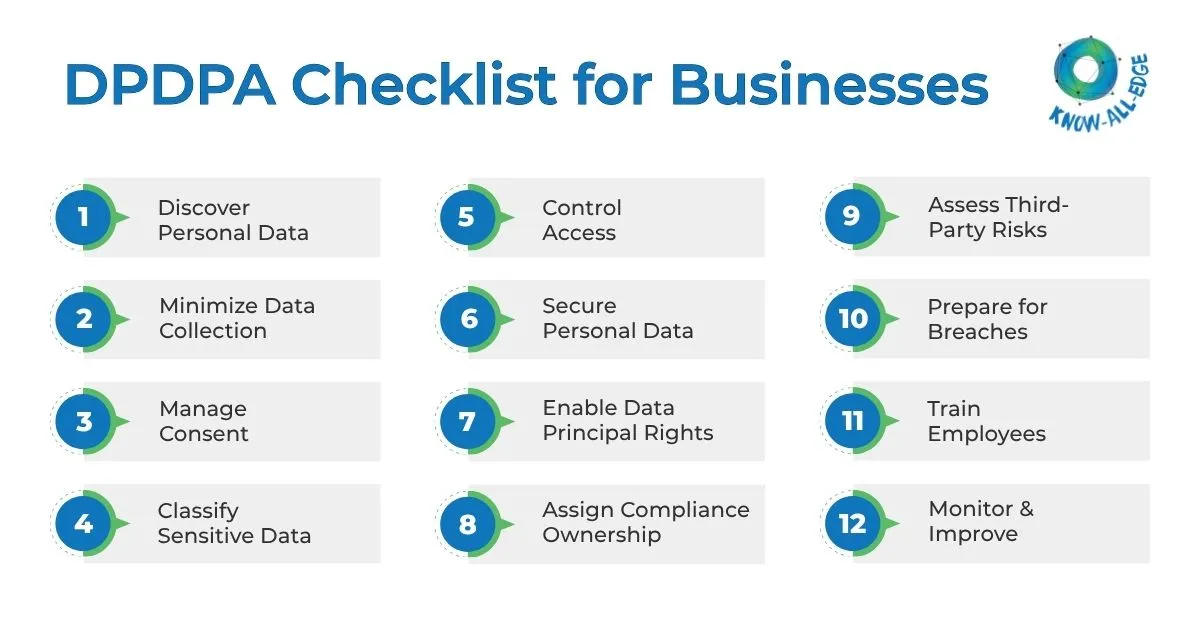
(1) Know What Personal Data You Have
You first need to know your data presence if you want to protect it.
You must identify every location where the personal data of your organization is stored, processed, or shared. This includes customer records, employee information, vendor data, cloud applications, endpoints, email systems, databases, and even spreadsheets maintained by different departments.
A complete data inventory helps you understand:
- What personal data do your organization collect
- Where it is stored
- Who has access to it
- Why it is being processed
- How long should it be retained
You’ll often find data that is outdated, duplicated, or no longer required. Cleaning it up not only supports DPDPA compliance but also reduces security and storage risks.
(2) Collect Only the Data You Actually Need
One of the core principles of DPDPA is data minimization.
Instead of collecting every piece of information “just in case,” organizations should gather only the personal data required for a clearly defined business purpose.
Reducing unnecessary data offers several benefits:
- Lower privacy risk
- Smaller attack surface
- Easier compliance management
- Reduced storage costs
This is also a good opportunity to review existing forms, applications, and onboarding processes to eliminate fields that no longer serve a legitimate purpose.
(3) Review How You Collect Consent
Consent sits at the center of the DPDPA framework.
Individuals should clearly understand:
- What data is being collected
- Why it is needed
- How it will be used
- Whether it will be shared with third parties
Consent requests should be written in simple language instead of lengthy legal statements. Equally important, individuals must have an easy way to withdraw their consent whenever they choose.
Maintaining proper records of consent is equally critical, as organizations may need to demonstrate compliance during audits or regulatory reviews.
(4) Classify Your Data Based on Risk
Not every dataset carries the same level of sensitivity.
Once personal information has been identified, classify it according to its business value and risk level. Information such as financial records, identity documents, health information, and employee records typically require stronger protection than general business information.
Proper data classification helps organizations:
- Apply appropriate security controls
- Define retention policies
- Restrict unnecessary access
- Prioritize monitoring efforts
Many businesses also use Data Security Posture Management solutions to continuously discover, classify, and monitor sensitive information across cloud and on-premises environments.
(5) Strengthen Access Controls
One of the simplest ways to reduce privacy risk is to ensure that employees only have access to the data they genuinely need.
Role-based access controls should be regularly reviewed, especially when employees change departments, receive promotions, or leave the organization.
Adding stronger authentication measures significantly improves protection against unauthorized access. Combining least privilege access with Multi-Factor Authentication (MFA) and Identity and Access Management (IAM) creates multiple layers of security around sensitive information.
Organizations should also periodically review privileged accounts to ensure administrative access remains tightly controlled.
(6) Prepare for Data Principal Requests
DPDPA gives individuals greater control over their personal information.
Organizations should establish clear processes to handle requests related to:
- Accessing personal data
- Correcting inaccurate information
- Deleting personal data when applicable
- Withdrawing consent
- Registering grievances
If these requests rely entirely on manual processes, response times can become inconsistent and increase compliance risk.
Documented workflows, defined responsibilities, and response timelines help ensure requests are handled efficiently and consistently.
(7) Secure Personal Data Across Its Entire Lifecycle
Privacy cannot exist without strong security.
While DPDPA focuses on responsible data handling, organizations are expected to implement reasonable safeguards that reduce the likelihood of unauthorized access, data leaks, or cyberattacks.
Some fundamental security measures include:
- Data encryption
- Regular vulnerability assessments
- Continuous monitoring
- Secure backup practices
- Endpoint protection
- Data loss prevention controls
Together, these controls help protect personal information whether it is stored, transmitted, or actively being processed.
(8) Establish Clear Ownership for Data Protection
Technology alone cannot ensure DPDPA compliance. Every organization also needs accountability.
Businesses that process significant volumes of personal data may be required to appoint a Data Protection Officer (DPO). Even where it is not mandatory, assigning ownership to a dedicated individual or privacy team helps ensure compliance activities remain consistent.
The responsibility goes beyond handling audits. It includes monitoring regulatory changes, reviewing internal processes, coordinating with different departments, managing data principal requests, and driving awareness across the organization.
Privacy should become part of everyday business operations rather than a one-time compliance exercise.
(9) Review Third-Party Data Sharing Practices
Very few organizations operate in isolation. Customer data is often shared with cloud providers, payment gateways, HR software, marketing platforms, and other business partners.
Under DPDPA, your responsibility does not end when data leaves your environment. If a third-party processes personal data on your behalf, you must ensure they follow appropriate security and privacy practices.
When reviewing vendors, verify that they:
- Have adequate security controls to protect personal data
- Clearly define responsibilities in contractual agreements
- Can report security incidents within agreed timelines
- Follow appropriate data retention and deletion practices
A structured vendor assessment process helps reduce compliance risks across your ecosystem.
(10) Be Ready Before a Data Breach Happens
No organization expects to experience a security incident, but preparation makes all the difference when one occurs.
Instead of creating an incident response plan after a breach, businesses should establish one well in advance. Everyone involved should understand their role, whether it is identifying the incident, containing the impact, investigating the root cause, or notifying the relevant authorities.
Regular testing is equally important. Tabletop exercises and simulation drills help identify weaknesses in response procedures before they become real problems.
Reliable backup systems also play a critical role in maintaining business continuity. Alongside strong security controls, a well-planned Backup and Disaster Recovery strategy helps organizations recover quickly while minimizing operational disruption.
(11) Build a Privacy-Aware Workforce
Technology can only do so much. Employees remain one of the most important lines of defense against accidental data exposure.
An effective awareness program should include:
- Regular training on DPDPA requirements
- Guidance on identifying phishing and social engineering attacks
- Secure handling of personal and sensitive information
- Password hygiene and authentication best practices
- Reporting procedures for suspicious activities or potential incidents
When employees understand their role in protecting personal data, compliance becomes much easier to sustain.
(12) Review, Monitor, and Improve Continuously
DPDPA compliance is not something organizations complete once and forget about.
Business operations evolve continuously. New applications are introduced, vendors change, employees join and leave, and data moves across different environments. Every change can introduce new privacy risks.
Conducting regular assessments helps organizations identify compliance gaps before they become larger issues. Reviewing data inventories, access permissions, privacy notices, retention policies, and security controls on a scheduled basis keeps the compliance program aligned with changing business needs.
Organizations that treat privacy as an ongoing process are far better prepared for regulatory audits and future amendments to the law.
The Road Ahead
“DPDPA Compliance Is an Ongoing Commitment”
DPDPA compliance is not a one-time milestone but an ongoing commitment to protecting personal data. While meeting regulatory requirements is important, organizations that invest in strong data governance, robust security controls, and transparent privacy practices are better equipped to reduce cyber risks and build lasting customer trust.
At Know All Edge, we help businesses turn compliance goals into practical security strategies. From implementing identity and access management, data protection, encryption, endpoint security, and other cybersecurity solutions to providing continuous support, our experts work closely with organizations to build a secure and scalable environment.
Whether you’re starting your DPDPA compliance journey or enhancing your existing security posture, Know All Edge can help you stay compliant while keeping your data protected. Let’s connect to know more.
DPDPA Checklist FAQs
Who should follow a DPDPA compliance checklist?
Any organization that collects, stores, or processes the digital personal data of individuals in India should follow a DPDPA compliance checklist. This includes businesses of all sizes across industries such as finance, healthcare, retail, manufacturing, IT, and e-commerce.
How do I know if my organization is DPDPA compliant?
You can evaluate your readiness by reviewing your data collection practices, consent mechanisms, privacy policies, security controls, vendor agreements, and incident response processes. A compliance assessment or gap analysis can help identify areas that need improvement.
How often should organizations review their DPDPA compliance?
DPDPA compliance should be reviewed regularly rather than treated as a one-time project. Organizations should reassess their privacy practices whenever they introduce new applications, onboard new vendors, change business processes, or update their security infrastructure.
What happens if an organization fails to comply with DPDPA?
Failure to comply with DPDPA may result in regulatory action, financial penalties, and reputational damage. More importantly, weak privacy practices can increase the risk of data breaches and loss of customer trust.


