 Skip to content
As per reports, 83% of enterprises already use AI- yet only 13% report strong visibility into how it touches their data. More than half of office workers admit to using unauthorized AI to summarize meeting notes or calls. Numbers like these aren’t a warning sign anymore, they’re already the current state of most workplaces.
That’s shadow AI in a nutshell: AI tools employees pick up without IT’s knowledge, quietly touching company data along the way. This article is about what comes next, once you’ve accepted that shadow AI probably exists in your environment and you need a structured way to actually find it.
That is where an AI Risk Assessment becomes important.
A structured assessment can bring hidden AI usage into view, identify data exposure, evaluate AI security and compliance risks, and help organizations establish practical controls without blocking legitimate productivity.
Why You Need an AI Risk Assessment?
Running a single automated scan and calling it done sounds efficient, but it rarely tells the full story. Shadow AI isn’t just about which tools show up on a network log. It’s about understanding which teams use them, what data flows through them, and how much appetite the business has for locking things down versus enabling safer alternatives. That’s exactly what a proper AI risk assessment is meant to capture.
A workshop format solves that by pulling in the right people alongside the right tooling. Security, IT, department leads, and sometimes compliance all sit at the table, so the technical findings get paired with real context about how each team actually works. That combination is what turns a list of discovered tools into a usable AI risk assessment, not just a spreadsheet of app names.
How an AI Risk Assessment Discovers Shadow AI
As discussed above, the right assessment must look beyond application inventories.
Shadow AI can exist across browsers, endpoints, cloud applications, identity systems, network traffic, APIs, and employee workflows. Let’s breakdown this into 6 phases.
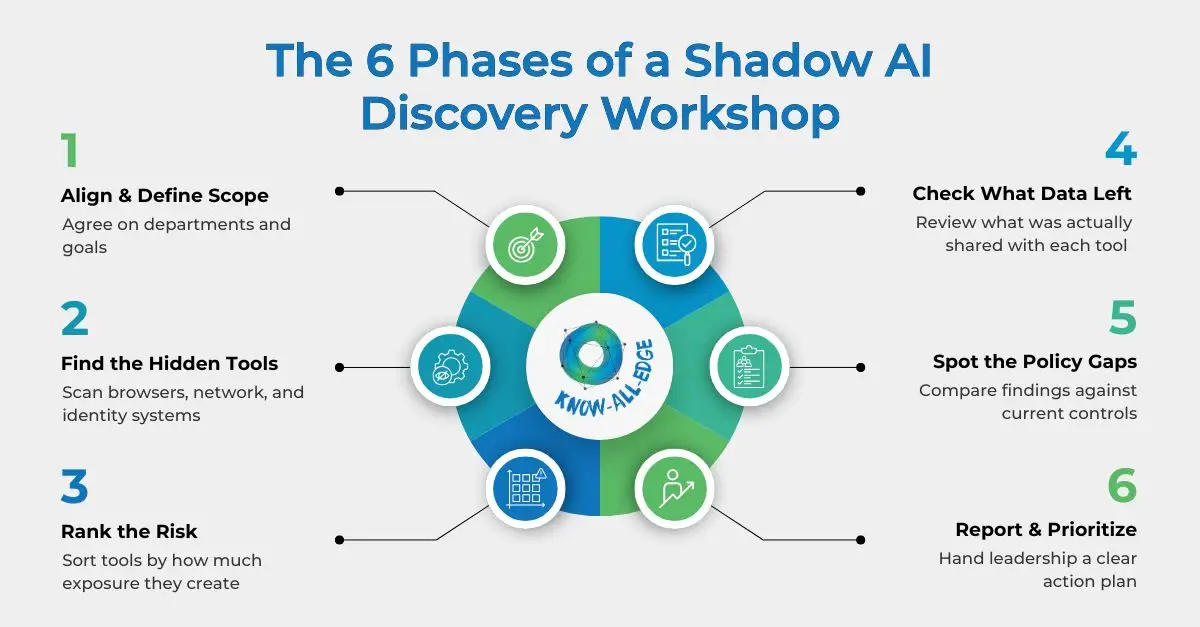
Phase 1: Kickoff and Scope
Every workshop starts with a short kickoff. This is where stakeholders align on scope: which departments to focus on first, what systems are in play, and what “success” looks like for the engagement. Skipping this step is tempting when everyone wants to jump straight to scanning, but a rushed scope almost always means blind spots later in the AI risk assessment.
What comes out of this phase: a documented scope and engagement plan that everyone signs off on before discovery begins.
Phase 2: Discovery and Visibility
This is where the actual hunting happens. The workshop deploys multiple discovery techniques at once rather than relying on a single method, since no single approach catches everything.
- Browser-level telemetry picks up AI tools accessed through personal profiles, free tiers, and browser extensions, catching what nothing else can.
- Identity and API monitoring flags OAuth grants and SSO connections tied to AI services nobody approved.
- Network traffic analysis surfaces connections to known AI domains across managed devices.
- SaaS management data ties AI app usage back to specific employees and departments.
Layering these together produces a far more complete inventory than any one method alone, and it’s the foundation the rest of the AI risk assessment builds on. The output at this stage is usually eye-opening: dozens of tools nobody in security knew existed, spread across nearly every department.
What comes out of this phase: a full inventory of detected AI tools, mapped to the teams and individuals using them.
Phase 3: AI Risk Assessment and Classification
Not every discovered tool deserves the same level of concern. A marketing intern using an AI tool for blog title ideas is a very different risk than a finance employee uploading payroll data into a free chatbot. This phase is the core of the AI risk assessment, ranking every discovered tool against factors like data sensitivity, user role, business process, and regulatory exposure.
The goal is a working risk matrix, something the security team can actually act on instead of a flat list that treats every tool as equally dangerous.
What comes out of this phase: an AI risk assessment matrix with tools sorted into risk tiers.
Phase 4: Data Exposure and Leakage
This phase digs into what’s actually being shared, and it’s where the AI risk assessment gets its sharpest teeth. Prompts, uploads, pasted text, exported files, meeting transcripts, source code snippets, it all gets reviewed to understand whether sensitive or regulated data has already left the building through an unapproved AI tool.
This is often the phase that shifts leadership’s attitude the fastest. Discovering that a tool exists is one thing. Discovering that client contracts or proprietary code have already passed through it tends to get budget approved a lot quicker.
What comes out of this phase: a sensitive data exposure report showing exactly what’s at risk and where.
Phase 5: Governance Gap Analysis
With visibility and risk data from the AI risk assessment in hand, the workshop turns to the gaps in current policy and controls. Where does the existing AI usage policy fall short? Which teams have no guardrails at all? Are there approved AI alternatives already available that could reduce the pull toward risky free tools?
This phase also looks at practical controls worth introducing, such as data loss prevention rules, access restrictions, or cloud app visibility, matched to the risk tiers identified earlier rather than applied as a blanket policy.
What comes out of this phase: a governance framework with specific, prioritized recommendations.
Phase 6: Reporting and Roadmap
The workshop wraps with a report built for leadership, not just the security team. It covers what the AI risk assessment found, how risky each finding is, what compliance exposure exists, and a tiered action plan based on the organization’s current maturity level.
Most organizations land somewhere between “we have no visibility at all” and “we have partial controls that aren’t enforced technically.” Wherever you land, the roadmap should tell you exactly what to fix first and why.
What comes out of this phase: a final report and executive briefing with a clear, prioritized action plan.
What You Walk Away With
By the end, a well-run AI risk assessment leaves you with more than a list of scary findings. You get a live inventory of AI tools in use, a risk-tiered view of where the real exposure sits, a clear picture of what sensitive data has already been exposed, and a governance roadmap that tells you exactly what to fix first.
That’s a very different starting point than guessing at policy from a place of zero visibility, which is unfortunately how most AI governance programs still get built today.
Not a One-Time Exercise
New AI tools show up weekly. Existing platforms add AI features through routine updates without anyone announcing it. Employees pick up and drop tools constantly. An AI risk assessment run once and filed away goes stale within months.
The organizations getting this right treat the AI risk assessment as a recurring habit built into their security calendar, not a project they check off once. Revisiting discovery, risk tiers, and controls on a regular cadence is what keeps governance from falling behind the pace at which AI actually spreads through a workforce.
Ready to Run Your Own AI Risk Assessment?
Discovery only pays off when it turns into action. At Know All Edge, we don’t stop at handing you a findings report. Once your shadow AI footprint is mapped, we work with your team to implement the right controls and provide ongoing support as your AI usage keeps evolving, so the governance actually holds up over time. If you’re ready to see where your blind spots are, our team can help you secure how your workforce actually uses AI, before a shortcut turns into an incident.
FAQs on Shadow AI Discovery Workshop
How long does a Shadow AI Discovery Workshop usually take?
Timelines vary with company size and how many departments are in scope, but most engagements run somewhere between two and six weeks from kickoff to final reporting. Discovery and data exposure review tend to take the longest, since they involve pulling data from multiple sources like browsers, identity systems, and network logs before anything can be classified or reported on.
What’s the difference between a shadow AI scan and a full discovery workshop?
A scan is purely technical, it tells you which AI tools showed up in your logs or network traffic. A workshop goes several steps further by adding risk classification, a review of what data has actually been exposed, and a governance roadmap built around your organization’s specific gaps. In short, a scan gives you a list, while a workshop gives you a plan.
How often should we repeat this AI Risk Assessment?
It’s better treated as a recurring practice than a one-time project, since new AI tools and features appear on a near constant basis. Many organizations revisit discovery and risk tiers on a quarterly or biannual cadence, though the right frequency depends on how fast your AI landscape is changing and how much risk appetite leadership is comfortable with.


