 Skip to content
A security dashboard can look completely clean and still be lying to you. Every login checks out, every app is approved, every policy shows green, and yet an AI agent has already pulled customer data through an API your team never logged. That gap between “looks safe” and “is safe” is exactly what has pushed CASB vs AI Workforce Security out of niche IT forums and straight into boardroom conversations.
For years, Cloud Access Security Brokers were treated as the final word in cloud protection. Gartner even crowned CASB a must-have back in 2017, and for a while, that reputation was well earned. But the ground has shifted. Artificial intelligence tools now sit inside apps, run through APIs, and act with a level of autonomy that older frameworks simply weren’t designed to watch over.
So the real question isn’t which one should win the CASB vs AI Workforce Security argument. It’s whether your organization can survive with only one of them standing guard.
Do read our in-depth article: What Is AI Security? Threats, Risks, and Best Practices Explained
What Exactly Is CASB, and What Was It Built For?
A Cloud Access Security Broker sits between your users and the cloud services they rely on daily, think Salesforce, Google Workspace, or Dropbox. Its job is fairly straightforward on paper: watch traffic, flag risky behavior, enforce policy, and keep compliance officers happy.
CASBs were designed for a human-centric world. A person logs in, opens an app, downloads a file, and the broker watches that entire sequence. It’s built around sessions, endpoints, and predictable patterns of behavior. For traditional SaaS sprawl, this model worked brilliantly, and honestly, it still does for a large chunk of enterprise traffic.
The trouble starts when the “user” isn’t quite human anymore, or when the application quietly has an AI engine humming away inside it.
What Is AI Workforce Security, and Why Is It Suddenly Everywhere?
AI Workforce Security refers to the practices, tools, and governance layers built specifically to monitor how artificial intelligence tools, copilots, and autonomous agents interact with company data. This includes everything from an employee using a free AI writing assistant to a fully autonomous agent making dozens of API calls a minute without a human ever clicking a button.
Unlike a person browsing a SaaS dashboard, an AI agent can reason, plan, and act on its own. It might pull data from three different systems, transform it, and pass it along, all within seconds, and often through encrypted, dynamic API endpoints that don’t resemble typical application traffic at all. That’s precisely the blind spot older security tools weren’t engineered to see.
Where CASB Starts to Struggle With AI
This is where the CASB vs AI Workforce Security comparison gets genuinely interesting, because it isn’t that CASB is a bad tool. It’s that it’s answering a completely different question than the one AI adoption is now asking.
AI usage often hides inside everyday apps.
Natural language processing and computer vision features are frequently embedded within tools your team already uses. A CASB sees “app usage.” It doesn’t necessarily see “AI usage.”
Data context gets lost.
CASBs are good at controlling access, not at inspecting what kind of data is flowing through an AI model or whether that data includes sensitive, proprietary, or personal information.
Shadow AI is nearly invisible.
Just as shadow IT once haunted security teams, shadow AI is now the sequel nobody asked for. Employees quietly use freemium AI tools, or AI features get switched on inside approved software without anyone formally signing off. CASBs simply don’t have the markers to flag this behavior.
Policies are too broad.
CASBs typically allow or block entire applications. AI governance, on the other hand, needs finer control, permitting some data types while restricting others within the very same tool.
Machine-speed decisions outpace static rules.
Agentic AI doesn’t wait for a session to end. It acts continuously, often server-side, in environments that were never part of the traditional CASB blueprint.
Compliance reporting falls short.
Regulations like GDPR, HIPAA, and CCPA increasingly expect organizations to show exactly how AI systems process personal data. CASBs weren’t built to generate that kind of AI-specific audit trail.
So, Is It CASB vs AI Workforce Security, or CASB and AI Workforce Security?
Here’s the honest answer: framing this as a rivalry misses the point entirely. CASB and AI-focused governance aren’t competitors fighting for the same job, they’re colleagues covering different shifts. One watches your traditional cloud perimeter. The other watches the fast-moving, often invisible world of AI-driven data exchange.
Dropping CASB leaves your SaaS environment exposed. Ignoring AI workforce security leaves the fastest-growing risk category in your organization completely unmonitored. Choosing just one is a bit like locking your front door while leaving every window wide open, technically you did something, but the house still isn’t safe.
If you’re weighing priorities for your security roadmap, our detailed breakdown on AI Security digs deeper into how these gaps show up in real environments and what modern teams are doing about it.
Building a Security Posture That Actually Covers Both
Organizations that are thinking clearly about this shift are moving toward a layered approach rather than a single silver-bullet tool.
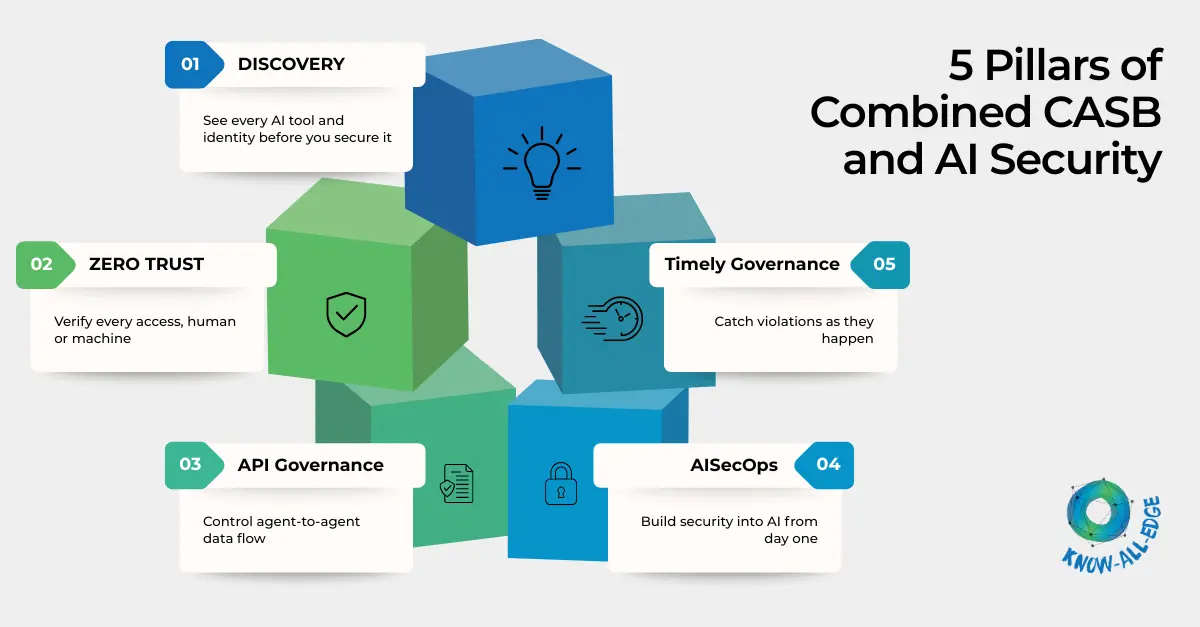
- Dynamic discovery first. You can’t govern what you can’t see. Continuous discovery of identities, assets, and AI-driven processes gives you the visibility CASBs were never designed to provide.
- Modern Zero Trust, upgraded for AI. This means micro segmentation, non-human identity management, and posture management tools that cover both cloud (CSPM) and data (DSPM) angles.
- API and agent governance. As agent-to-agent communication becomes routine, having a governance layer that can apply agent-specific controls prevents sprawl before it turns into chaos.
- Real-time compliance monitoring. Feedback loops that catch policy violations as they happen, not weeks later during an audit, are no longer optional extras.
- A shift from DevSecOps to AISecOps. Security by design has to extend into how AI systems are built, trained, and deployed, not bolted on afterward.
The Bottom Line
Treating this as a straight-up CASB vs AI Workforce Security contest sets organizations up to make the wrong call.
The companies that will come out ahead aren’t the ones picking a side, they’re the ones building a security posture flexible enough to hold both. CASB still matters for the SaaS backbone of your business. AI workforce security matters for the part of your business that’s moving faster than any policy document can keep up with.
The businesses that get this balance right won’t just avoid a breach headline, they’ll build the kind of resilient, adaptable posture that lets them adopt AI confidently instead of nervously.
Ready to Close the Gap in Your Security Stack?
Understanding the difference is one thing. Actually closing that gap across your existing systems, without disrupting daily operations, is where most teams get stuck.
At Know All Edge, we work alongside security teams to design, implement, and provide ongoing support for the kind of layered protection this new landscape demands, so nothing slips through the cracks while your workforce keeps moving fast.
If your current setup was built before AI became part of daily workflows, it’s worth exploring what proper workforce-focused AI protection actually looks like in practice, and how our team can help you get there.
Frequently Asked Questions
Is AI workforce security meant to replace CASB entirely?
No. AI workforce security is meant to fill the gaps CASB was never designed to cover, particularly around AI-specific data flows and non-human activity. Most organizations need both working together.
Why can’t a CASB simply be updated to monitor AI tools?
CASBs are architected around session-based, human-centric traffic. AI agents often act server-side, through encrypted and dynamic API calls, which falls outside the core design of how a CASB inspects traffic.
Does this apply to smaller companies, or only large enterprises?
Any organization using AI tools, even something as simple as an AI writing assistant, is exposed to some level of this risk. The scale of the response should match company size, but the underlying gap applies broadly.
How does this connect to compliance requirements like GDPR or HIPAA?
Regulators increasingly expect organizations to demonstrate how AI systems handle personal or sensitive data. Since CASBs don’t provide AI-specific reporting, organizations need additional tools to meet these evolving compliance expectations.
Where should a company start if it wants to strengthen both areas – CASB and AI Workforce Security?
Start with visibility. Map out where AI tools are being used across the organization, including shadow AI, before layering in policy controls, monitoring, and governance frameworks tailored to both cloud and AI activity.


