 Skip to content
Introduction
When a lawsuit hits, legal points at IT team. Not because IT broke the law, but because IT owns the data. And if that data wasn’t preserved correctly, wasn’t collected properly, or was accidentally deleted before anyone issued a hold notice, IT is the one left explaining what went wrong.
Most IT teams don’t find out about their eDiscovery obligations until they’re already in the middle of one. By then, the damage is either done or expensive to fix.
This blog exists to change that. Whether you’re a CISO, CTO, or IT leader facing a legal matter, here’s what you need to know about eDiscovery before a legal notice arrives.
What is eDiscovery?
eDiscovery, short for electronic discovery, is the legal process of identifying, collecting, preserving, reviewing, and producing electronically stored information (ESI). It is mainly for use in litigation, regulatory investigations, government audits, or internal inquiries.
Before everything went digital, discovery mainly involved paper documents and physical records. Today, business data is all over – emails, cloud storage, collaboration tools, SaaS applications, and mobile devices.
Even a single legal matter can require data from multiple systems.
What makes electronic discovery different is that digital data can be easily changed, deleted, or lost. Details such as timestamps, edit history, and communication records can be just as important as the content itself.
Once legal action is reasonably expected, organizations must start preserving relevant data immediately. Waiting until a lawsuit is filed may be too late.
The Data Reality Most IT Teams Underestimate
Here’s a number worth sitting with: by recent estimates, nearly 463 exabytes of data are created globally every single day. That’s emails, WhatsApp messages, Teams chats, cloud uploads, database transactions, the full torrent of enterprise digital life. On average, 294 billion emails alone are sent daily.
Every piece of that, when relevant to a legal matter, becomes potentially discoverable.
The rise of remote work has made eDiscovery more complex. Employees now use personal devices, personal accounts, and a growing number of cloud applications for work. When legal matters arise, data from these sources may also need to be reviewed.
Courts generally do not accept “it was on a personal device” or “it was sent from a personal account” as a reason to exclude relevant business communications.
In practice, digital discovery goes beyond corporate servers. It includes data from anywhere work-related information was created, shared, or stored.
What is ESI and Why Does it Go Beyond Just Emails?
Electronically Stored Information (ESI) includes much more than email. It can include text messages, Teams and Slack conversations, cloud storage platforms like SharePoint and OneDrive, CRM records, social media content, voicemails, audio files, and videos.
Each of these sources contains metadata details such as who created the data, when it was created, and whether it was modified. In many cases, this metadata is just as important as the content itself.
That’s why eDiscovery requires proper collection methods. Simply exporting emails or files can alter or remove important metadata, creating legal and compliance risks.
The EDRM: The Framework That Governs Every eDiscovery Engagement
The Electronic Discovery Reference Model (EDRM) is the industry-standard framework for managing the eDiscovery process.
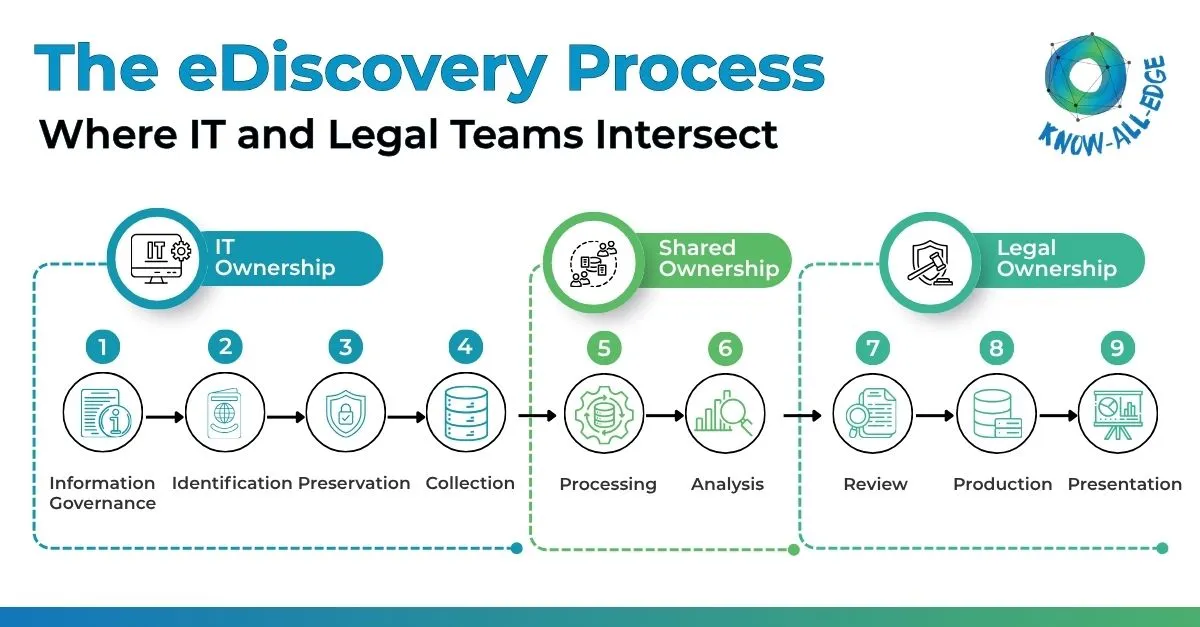
It breaks the workflow into nine stages that, while not always perfectly linear, provide the structural backbone for any defensible discovery effort.
- Information Governance is where it all starts, and notably, it happens before any litigation. Organizations that already know where their data lives, who owns it, and what their retention policies say start every eDiscovery engagement ahead of the curve. Those that don’t scramble every time.
- Identification maps the landscape. Which custodians are relevant? Which systems did they use? What time period matters? Poorly negotiated ESI protocols at this stage create expensive disputes downstream.
- Preservation is where IT becomes central. Legal hold notices go to relevant custodians, automatic deletion schedules are suspended, backup overwrites are halted. This is not just an administrative action, the documentation of the preservation process is as legally important as the preservation itself.
- Collection requires forensic discipline. Proper eDiscovery tools collect from email servers, cloud platforms, mobile devices, and endpoint systems while maintaining metadata integrity and establishing a clear chain of custody. Every collection action is logged. Every transfer is documented.
- Processing takes the raw collected data and shapes it into something reviewable- deduplication, filtering by date range, culling by keyword, removing system files that aren’t responsive. This is where a bloated collection becomes a focused, manageable review population.
- Review is traditionally the most expensive phase. Attorneys assess documents for relevance, privilege, and responsiveness. Modern platforms use Technology-Assisted Review (TAR), also called predictive coding, which applies machine learning to prioritize documents by predicted relevance. Courts have accepted TAR as legally defensible when properly validated, and it cuts review costs substantially.
- Analysis goes deeper into email threading, near-duplicate detection, communication mapping to surface patterns that straight linear review misses.
- Production delivers non-privileged relevant documents to opposing counsel in agreed formats, with metadata handling specified in advance.
- Presentation is trial. A clean, documented process means evidence authenticates easily and opposing counsel has fewer grounds to challenge admissibility.
Legal Hold and Chain of Custody: The Two Things IT Teams Get Wrong Most
If there are two concepts IT leaders need to internalize before any legal notice arrives, these are them.
Legal Hold (Litigation Hold)
A legal hold is the requirement to preserve potentially relevant data once litigation is reasonably expected, not when a lawsuit is officially filed. This can be triggered by contract disputes, regulatory investigations, or internal complaints that may lead to legal action.
For IT teams, this means pausing deletion, retention, and overwrite policies for relevant data and custodians. While legal teams issue hold notices, IT must ensure the necessary technical controls are in place.
It’s also important to track custodian compliance. Sending a hold notice alone is not enough. Organizations need proof that custodians understood and followed preservation requirements.
Chain of Custody
Chain of custody is the record of where data came from, who accessed it, and what actions were taken throughout the eDiscovery process.
Maintaining this record helps preserve the integrity and admissibility of evidence. Informal collection methods can create gaps, while dedicated eDiscovery tools automatically generate audit trails that support defensible investigations.
The Four Dimensions of Modern ESI
The challenge in eDiscovery is not just the amount of data; it’s the complexity of managing it. IT teams often deal with four key issues: volume, velocity, variety, and veracity.
- Volume refers to the sheer amount of data organizations generate, often including multiple versions and copies of the same files across different systems.
- Velocity reflects the speed at which data is created through email, collaboration tools, mobile devices, and increasingly, AI-powered applications.
- Variety means data exists in many formats and platforms, making collection and review more difficult.
- Veracity focuses on data accuracy and integrity. Metadata helps verify authenticity, while deleted or altered data can create legal risks. Once a legal hold is in place, improper deletion of relevant data can lead to serious consequences.
eDiscovery Compliance India: What’s Different for Organizations Here
For organizations operating in India, eDiscovery comes with additional compliance considerations. Indian courts recognize electronic records as admissible evidence when they are properly collected, preserved, and certified under applicable laws.
The bigger challenge often arises in cross-border investigations and litigation. Organizations with operations in multiple countries may need to balance discovery obligations with data privacy, localization, and transfer requirements.
From an IT perspective, this means that decisions about:
- Where data is stored
- Which jurisdiction governs the data
- How data is classified and protected
- How data can be transferred across borders
can directly affect how eDiscovery is handled.
As regulations continue to evolve, organizations need close coordination between legal, compliance, and IT teams to ensure they can meet discovery requirements while maintaining compliance with applicable data protection laws.
What Happens to Organizations That Aren’t Ready
The consequences of weak eDiscovery preparedness are serious and well-established in courts.
- Courts can impose case-terminating sanctions, effectively causing a party to lose the case due to preservation failures.
- Juries may receive adverse inference instructions, allowing them to assume deleted evidence was unfavorable.
- Monetary penalties in complex litigation can reach millions of dollars.
The impact is not limited to court outcomes; operational disruption is often just as damaging.
- Organizations face high costs from outside counsel, forensic experts, and litigation support teams.
- Internal IT and business teams are pulled away from core work to handle urgent data collection and review.
- The overall cost of unprepared eDiscovery response is frequently measured in the seven-figure range.
Data privacy obligations add another layer of risk during discovery.
- Laws such as GDPR, CCPA, and India’s DPDPA still apply even during legal production.
- Sensitive or personal data must be protected while being reviewed and shared for litigation.
- Mishandling data during discovery can create separate regulatory liability, even if done under a court order.
Also read: eDiscovery in Office 365: How to Search, Preserve, and Investigate Microsoft 365 Data Effectively
What Effective eDiscovery Infrastructure Actually Looks Like
For IT and security leaders, an effective eDiscovery solution needs to cover more than basic data search. It should include:
- Integration with enterprise systems such as cloud email security solutions, cloud storage, collaboration tools, and endpoints. This is critical since most business data sits in platforms like Exchange, Teams, SharePoint, and OneDrive.
- Endpoint coverage to collect data from laptops and mobile devices, especially in remote and BYOD environments.
- Legal hold management, including automated notifications, tracking acknowledgments, and monitoring compliance.
- Chain of custody tracking to log every action on data and maintain a defensible audit trail.
- Advanced review capabilities (TAR/AI) to help identify relevant data faster and improve accuracy during large-scale reviews.
- Privacy-aware redaction and production to ensure sensitive or personal data is properly protected before sharing.
- Early Case Assessment tools to quickly understand data before deciding legal strategy and scope.
Together, these capabilities help ensure eDiscovery is defensible, efficient, and compliant rather than manual and risky.
AI and the Future of eDiscovery: What IT Teams Should Track
- AI in eDiscovery has evolved from basic keyword search to advanced predictive systems (TAR 1.0 → TAR 2.0 with continuous learning).
- RAG and LLMs now enable document summarization, relevance detection, and early case analysis at scale.
- Human review is shifting from full manual processing to AI-assisted first-pass review and prioritization.
- Courts are starting to require disclosure of AI use, making governance and transparency important for IT and legal teams.
- Cloud-based eDiscovery is becoming standard, offering scalability, lower costs, and better support for distributed teams, with hybrid options for regulated environments.
Final Thought: eDiscovery Is an IT Problem Whether IT Knows It or Not
The legal team may own the process and outside counsel may drive the strategy, but the data sits in systems controlled by IT. Legal holds impact backups, email servers, endpoint devices, cloud platforms, and SaaS configurations. Chain of custody depends on the tools IT deploys, and metadata integrity depends on how data is collected, not just what is requested.
When eDiscovery fails, IT is often asked to explain why. When it succeeds, IT is a key reason it worked.
Organizations that treat eDiscovery as an IT and security responsibility stay prepared and avoid last-minute scrambling.
At Know All Edge we help businesses ensure compliance driven eDiscovery with vendor-neutral guidance on backup & DR so you are ready before legal notices arrive.
Not sure where your organization stands, let’s connect!
Frequently Asked Questions About eDiscovery
What is eDiscovery in cybersecurity?
In cybersecurity, eDiscovery is the process of finding, preserving, and collecting digital data for legal cases, regulatory investigations, or internal security incidents. It directly overlaps with incident response, especially when a data breach leads to litigation.
Security teams need to collect logs, emails, and endpoint data while keeping it intact and tamper-proof. This is where DSPM plays a key role, helping teams know where sensitive data lives so it can be retrieved in a legally sound way when required.
What is eDiscovery used for?
eDiscovery is used whenever an organization needs to find and hand over digital information for legal or compliance purposes.
Common scenarios include civil litigation, regulatory investigations, internal fraud or HR inquiries, government audits, and due diligence during mergers and acquisitions. It’s also increasingly used for responding to data subject access requests (DSARs) under privacy laws like GDPR, which follow very similar workflows.
What is an example of eDiscovery?
Two companies are in a contract dispute. One side believes the other knew about a product problem before it caused damage. Both sides must share all relevant emails, messages, and documents.
IT and legal teams work together to stop data from being deleted, collect it safely, and review it to find important information.
Even one internal email showing that the issue was known and ignored can decide the case. eDiscovery is what helps find that email.
What are the steps in the eDiscovery process?
The eDiscovery process follows the Electronic Discovery Reference Model (EDRM):
- Information Governance: Knowing where your data lives before any legal matter arises.
- Identification: Mapping which data sources, people, and time periods are relevant.
- Preservation: Issuing legal hold notices and stopping any automatic deletion.
- Collection: Gathering data using methods that protect metadata and chain of custody.
- Processing: Removing duplicates and filtering down to a reviewable set.
- Review: Assessing documents for relevance and privilege.
- Analysis: Finding patterns and key evidence within the data.
- Production: Delivering non-privileged documents to the opposing party.
- Presentation: Using the evidence in court or regulatory proceedings.
What happens if a company fails to preserve data after a legal hold is issued?
This is called spoliation, when evidence is lost or destroyed even though it should have been preserved. Courts take it very seriously.
The consequences can include:
- Financial penalties and paying the other side’s legal costs
- An adverse inference, where the court tells the jury to assume the missing evidence would have been harmful
- In severe cases, the court may even rule against the party that destroyed the evidence
This is why legal hold management is not just an administrative task; it directly affects legal risk.
How is eDiscovery different from a regular IT data backup?
A backup is for restoring systems after a failure. eDiscovery is for finding and producing data like emails, messages, and documents for legal cases.
Backups can overwrite old data and are not designed to preserve legal evidence or metadata.
Both are needed: backups for recovery, and eDiscovery for legal holds and legal requests.


