 Skip to content
Organizations have spent years securing networks, devices, applications, and data. Yet attackers continue to find their way in because modern cyberattacks increasingly focus on identity.
More than 90% of Fortune 1000 companies rely on Active Directory (AD) to manage authentication and access, making it one of the most valuable targets in the enterprise.
This is where identity resilience comes in.
Unlike traditional security, which focuses on preventing unauthorized access, identity resilience focuses on maintaining access and recovering quickly when identities are compromised. As ransomware and identity-based attacks continue to rise, organizations need more than protection. They need the ability to recover.
In this article, we’ll explore what identity resilience means, why Active Directory remains a top attack target, and what organizations can do to strengthen identity protection and recovery.
Identity Is the New Security Perimeter
Not long ago, cybersecurity was all about protecting a well-defined network perimeter. Organizations secured data centers, deployed firewalls, segmented networks, and monitored traffic entering and leaving corporate environments.
Now, there is a change in that model and identity security has become crucial.
Today, employees work remotely, applications run in the cloud, data is distributed across multiple platforms, and organizations depend on SaaS services for critical business functions. At the same time, machine identities, service accounts, APIs, and automated workflows have become essential components of daily operations.
As a result, the traditional perimeter has largely disappeared.
What remains constant is identity.
Every user, device, service, and application requires some form of authentication before accessing resources. This is precisely why attackers have shifted their focus. Without a Zero Trust model in place, a compromised identity can easily be exploited.
A compromised identity allows attackers to:
- Access business applications
- Move laterally across systems
- Escalate privileges
- Gain administrative control
- Evade traditional security defenses
In many cases, the attacker doesn’t need to exploit a vulnerability at all. They simply use valid credentials and trusted relationships that already exist within the environment.
What Is Identity Resilience?
As identity has become the new security perimeter, traditional Identity and Access Management (IAM) is no longer enough. While IAM focuses on controlling who gets access to what, identity resilience focuses on maintaining trusted access during and after an identity-based attack.
In simple terms, identity resilience is an organization’s ability to detect, contain, and recover from attacks targeting identities, credentials, and authentication systems while keeping business operations running.
This includes:
- Detecting identity threats quickly
- Limiting unauthorized access
- Recovering compromised accounts and permissions
- Restoring trusted identities
- Maintaining business continuity
In essence, identity resilience combines prevention, detection, response, and recovery into a unified strategy.
This becomes especially important during ransomware attacks, as ransomware recovery involves more than restoring data and systems; it also requires restoring trusted identities and access.
Identity resilience helps organizations recover trust in their identities, not just recover their data.
Why Active Directory Is the #1 Target in Modern Cyberattacks
When discussing identity resilience, one platform consistently sits at the center of the conversation: Active Directory.
Often described as the “keys to the kingdom,” Active Directory serves as the foundation of identity and access management in most enterprise environments.
It controls authentication, permissions, privileged access, applications, and security policies across the organization.
Because Active Directory determines who can access what, compromising it gives attackers far more than access to a single system. It can give them control over large parts of the environment.
Active Directory Controls Access
Organizations rely on Active Directory to verify users, manage permissions, and establish trust between systems and applications. Once attackers gain control of AD, they can often move through the network as legitimate users.
Active Directory Is Everywhere
Many organizations still depend on Active Directory and Microsoft Entra ID to manage identities across on-premises and cloud environments. This widespread use makes AD a highly attractive target.
Complexity Creates Risk
Most Active Directory environments have evolved over many years. As a result, unused accounts, outdated permissions, service accounts, and forgotten privileges often accumulate. These weaknesses can create opportunities for attackers.
Attackers Want Control
Modern attackers are not just looking for access. They want control. By compromising Active Directory, they can escalate privileges, move across systems, establish persistence, and support ransomware attacks.
This is why Active Directory remains one of the most targeted components in modern cyberattacks.
How Active Directory Attacks Unfold
Many people assume Active Directory attacks rely on advanced exploits or zero-day vulnerabilities. In reality, most attacks begin with something much simpler, such as a phishing email, stolen credentials, or a compromised endpoint.
What makes these attacks dangerous is how quickly they can escalate once attackers gain an initial foothold.
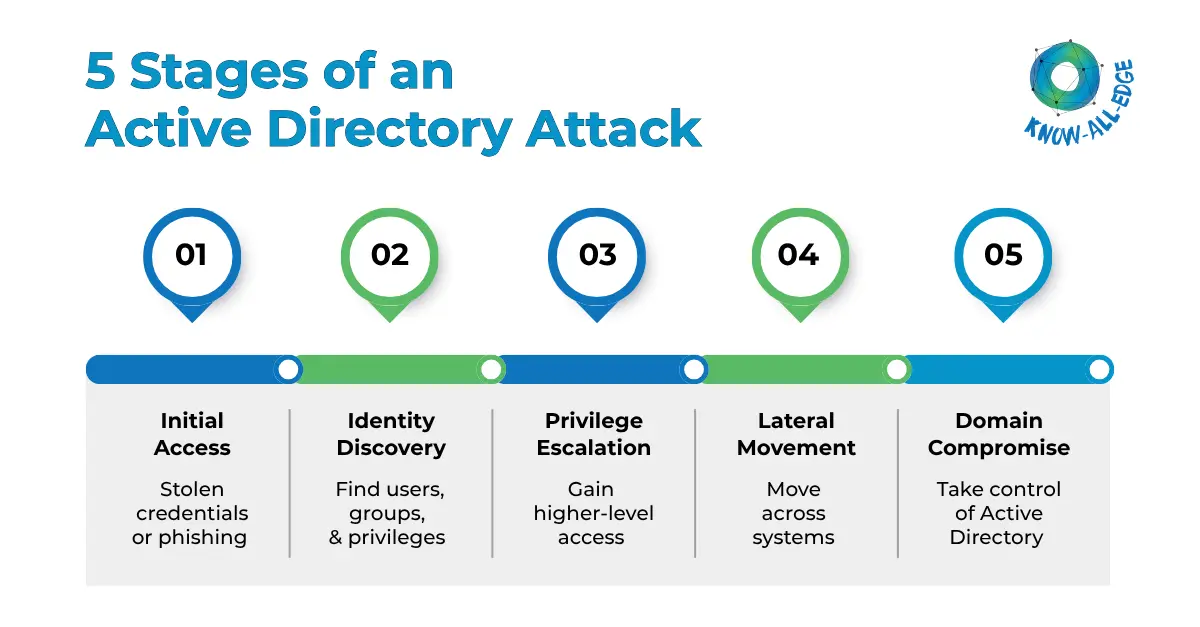
Stage 1: Initial Access
Attackers typically gain access through phishing, malware, password spraying, or stolen credentials.
Even a standard user account can provide valuable information about the environment. At this stage, attackers usually remain quiet and focus on understanding the network.
Stage 2: Identity Discovery
Once inside, attackers start gathering information about users, groups, service accounts, systems, and privileged identities.
Their goal is to identify high-value accounts and find the quickest path to elevated privileges. Because they often use legitimate Active Directory tools and protocols, this activity can be difficult to detect.
Stage 3: Privilege Escalation
After identifying potential targets, attackers attempt to gain higher privileges.
They may exploit weak passwords, over-privileged accounts, service accounts, misconfigured permissions, or outdated Group Policies.
In many cases, privilege escalation happens because access rights have not been reviewed for years.
Stage 4: Lateral Movement
With elevated privileges, attackers move across the environment to expand their control. They often target file servers, critical applications, backup systems, security platforms, and domain controllers.
The objective is to gain access to as many critical systems as possible before launching the final attack.
Stage 5: Domain Compromise
The final goal is often complete control of Active Directory. Attackers may steal directory secrets, create backdoor accounts, modify permissions, or abuse Group Policies to spread ransomware.
Once identity is compromised, attackers can operate as trusted users and gain control over large parts of the environment.
This is why Active Directory attacks are so dangerous. A single compromised account can quickly turn into a domain-wide compromise if the attack goes undetected.
Why Backup Alone Cannot Solve an Identity Attack
Backup and disaster recovery remain essential for restoring data, applications, and systems after an attack. However, modern cyberattacks increasingly target identity, not just data.
If attackers compromise Active Directory, create unauthorized administrative accounts, modify permissions, or establish persistent access, restoring servers from backup does not eliminate the threat. The systems may be back online, but the attacker may still have access.
This is why data recovery and identity recovery are not the same.
- Traditional backup focuses on restoring information.
- Identity recovery focuses on restoring trust across accounts, permissions, authentication systems, and administrative access.
Without a clean and trusted identity environment, organizations risk bringing compromised access back into production during recovery.
As ransomware and identity-based attacks continue to grow, identity recovery has become a critical component of cyber resilience.
Recovering data gets the business running again. Recovering trusted identities ensures it stays secure.
What Complete Identity Recovery Looks Like
Recovering from an identity attack involves much more than restoring a domain controller backup. The goal is to restore a trusted identity environment.
Recovering Active Directory and Entra ID
Organizations need to recover not only Active Directory but also Microsoft Entra ID in hybrid environments. This includes restoring user accounts, security groups, permissions, policies, administrative roles, and authentication settings.
A compromise in either environment can allow attackers to maintain access even after systems and data have been restored.
Removing Malicious Changes
Recovery is not just about restoring identities. It also requires identifying and removing unauthorized accounts, excessive permissions, malicious group memberships, and other changes introduced during the attack.
Validating Before Production
Before returning to production, organizations must verify that the recovered environment is clean and trustworthy. Many organizations now use isolated recovery or cleanroom environments to validate identity services and reduce the risk of reinfection.
Ultimately, identity recovery is not just about bringing systems back online. It is about restoring trust in the identities that control access to those systems.
Building an Identity Resilience Strategy
Identity resilience is not just about preventing attacks. It’s about detecting threats quickly, limiting their impact, and recovering trusted access when identities are compromised.
A strong identity resilience strategy should focus on:
Reduce Excessive Privileges
Many Active Directory attacks succeed because users, service accounts, or administrators have more access than they need. Regularly reviewing permissions and applying least-privilege access can significantly reduce risk.
Strengthen Authentication
Passwords alone are no longer enough. Organizations should use multi-factor authentication (MFA), conditional access policies, and stronger protection for privileged accounts to reduce the risk of credential theft.
Improve Identity Visibility
Monitoring authentication activity, privilege changes, and unusual behavior across Active Directory and Entra ID can help security teams identify attacks before they escalate.
Prepare for Recovery
Identity recovery should be planned and tested before an incident occurs. This includes maintaining secure AD backups, documenting recovery procedures, and regularly testing recovery processes.
Use the Right Technologies
Solutions such as Commvault, Microsoft Defender for Identity, CrowdStrike Identity Protection, and Semperis can help organizations strengthen identity protection, improve threat detection, and accelerate Active Directory and Entra ID recovery.
Identity resilience is ultimately about ensuring that even if identities are compromised, the organization can recover quickly and continue operating securely. Also, strong identity resilience starts with stronger identity security. Explore our approach to securing identities and access to see how we can help build a more resilient identity foundation for your organization.
Conclusion
As organizations continue to adopt hybrid infrastructure, cloud services, AI-powered applications, and machine identities, the number of identities requiring protection will continue to grow. This will make identity security and recovery even more critical in the years ahead.
The question is no longer whether attackers will target identity. The question is how quickly organizations can detect, contain, and recover from identity-based attacks when they occur.
At Know All Edge, we help organizations strengthen cyber resilience through the implementation and ongoing support of identity security, backup and disaster recovery, ransomware recovery, and data protection solutions. By combining the right technologies with proven implementation expertise, we help businesses improve recovery readiness and build a more resilient security posture.
Identity Resilience FAQs
What is identity resilience?
Identity resilience is an organization’s ability to maintain trusted access, detect identity-based threats, recover compromised identities, and continue business operations during and after an identity-related cyberattack.
What is an identity resilience strategy?
An identity resilience strategy helps your organization keep access to critical systems secure, even during a cyberattack. It combines identity protection, monitoring, and identity recovery so that if attackers compromise accounts, credentials, or Active Directory, your business can recover quickly and continue operating with minimal disruption.
Why do attackers target Active Directory?
Attackers target Active Directory because it controls access to users, devices, applications, and data across the organization. If they gain control of Active Directory, they can often move through the network, increase their privileges, and access critical systems without raising immediate suspicion. Following Active Directory best practices around account management, permissions, privileged access, and monitoring can help reduce these risks.
What is the difference between a Domain Controller (DC) and Active Directory (AD)?
Active Directory is the service that stores and manages user identities, permissions, and access policies. A Domain Controller (DC) is the server that runs Active Directory and handles authentication requests. Simply put, Active Directory is the system, while the Domain Controller is the server that powers it.
What is Active Directory and why is it important?
Active Directory is Microsoft’s identity and access management service that helps organizations manage users, devices, and permissions from a central location. It is important because it controls who can access business resources, making it one of the most critical components of an organization’s IT and security infrastructure.


