 Skip to content
We can all see how cybersecurity is day by day evolving. The sub-part of security, ‘Backup and Recovery’ has also evolved significantly in recent years. Just keeping backup of data is not enough now.
You must think: Can your backups survive a cyberattack (in case it happens to you)?
Cyber attackers are increasingly targeting backup environments before encrypting production systems. If backups can be deleted, modified, or corrupted, recovery options become limited and organizations are more likely to face costly disruptions.
No one wants that to happen. Right?
This growing risk has pushed regulators and cybersecurity authorities to focus on backup integrity and resilience. In India, initiatives around RBI backup compliance and SEBI immutable storage are driving organizations to strengthen their data protection strategies. Globally, immutable storage is becoming a key component of modern cyber resilience frameworks.
This is where immutable backups come in. By preventing backup data from being altered, deleted, or tampered with for a defined period, they provide a trusted recovery point, even if attackers gain privileged access.
This blog post will explain what immutable backups are, how they work, and why regulators increasingly expect organizations to adopt immutable storage practices.
Let’s begin with.
Why Traditional Backups Are No Longer Enough
For decades, organizations relied on conventional backup systems to recover from hardware failures, accidental deletions, software corruption, and natural disasters.
While these backups served their purpose, they were built for an era when the primary concern was system failure, not deliberate attacks by sophisticated cybercriminals.
Modern ransomware operators have changed the game.
Before encrypting production systems, attackers often spend days or weeks moving through networks, identifying backup repositories, stealing credentials, disabling security controls, and deleting recovery points. Their objective is simple: eliminate recovery options before launching the attack.
This means an organization may technically have backups, yet still be unable to recover because those backups were altered or destroyed before the attack became visible.
The result is a growing realization that backup copies themselves need protection.
Organizations now require backup architectures that can withstand:
- Ransomware attacks
- Insider threats
- Accidental deletion
- Privileged account compromise
- Data tampering
- Regulatory investigations
- Compliance audits
Immutable backups address these challenges by ensuring that once backup data is written, it cannot be changed or removed until a predefined retention period expires.
What Is an Immutable Backup?
Let’s explain this in a little detail.
An immutable backup is a backup copy that cannot be modified, overwritten, deleted, or encrypted after it has been created.
The word “immutable” literally means unchangeable.
Once data is written into an immutable backup repository, it remains locked for a specified retention period. During this period, nobody, not even backup administrators, storage administrators, or attackers with elevated privileges can alter the stored data.
Think of an immutable backup as a “golden copy” of your information.
Even if production systems are compromised, malicious actors gain administrator privileges, or backup software is attacked, the protected backup remains intact and available for recovery.
This creates a trustworthy recovery point that organizations can rely on during a cybersecurity incident.
Immutable Backup vs Traditional Backup
Traditional backups and immutable backups provide very different levels of security.
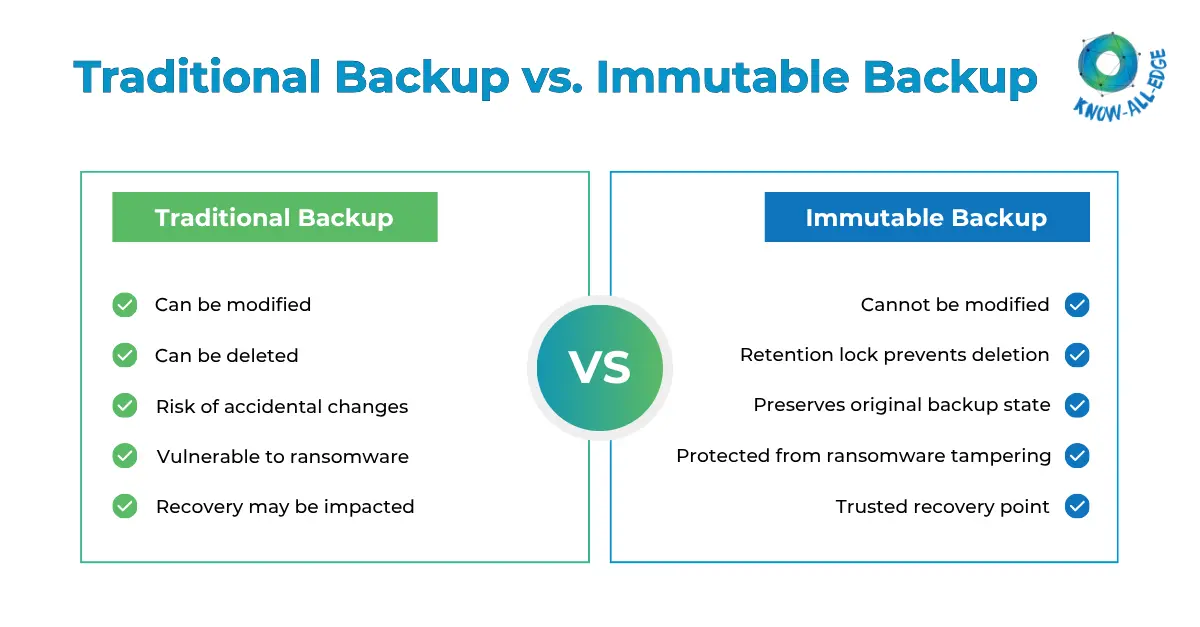
Traditional backups are typically mutable. This means authorized users or systems can modify, overwrite, or delete backup data.
This flexibility is useful for everyday backup operations, but it also creates risk.
If an attacker gains access to privileged credentials, they may be able to:
- Delete backup sets
- Shorten retention periods
- Encrypt backup repositories
- Modify recovery data
- Corrupt backup catalogs
An immutable backup removes these possibilities.
Once written, the backup remains unchanged until the retention lock expires. This significantly strengthens an organization’s ability to recover from ransomware and other cyber incidents.
Rather than replacing traditional backups entirely, immutable backups often complement them as part of a broader backup and disaster recovery strategy.
To understand how immutable backups remain protected from deletion or modification, it’s important to look at the storage technologies that make immutability possible.
Understanding WORM Storage
When discussing immutable backups, you will frequently encounter the term WORM storage.
WORM stands for Write Once, Read Many.
As the name suggests, data can be written once and read multiple times, but it cannot be modified after it has been stored.
WORM technology forms the foundation of many immutable storage solutions.
Historically, WORM capabilities were associated with optical media, specialized disks, and tape systems. Today, modern cloud platforms and enterprise storage solutions offer software-based WORM functionality that provides the same protection at significantly greater scale.
When WORM storage is enabled:
- Data can be written normally.
- Retention periods are enforced automatically.
- Deletion requests are rejected.
- Modification attempts are blocked.
- Audit records can be maintained.
This makes WORM storage particularly valuable for regulatory compliance, digital evidence preservation, legal record retention, and cybersecurity recovery.
How Immutable Backups Actually Work
Although implementation varies across vendors, most immutable backup solutions rely on several core mechanisms.
- The first is retention locking. When backup data is created, administrators define a retention period. During this period, the data remains protected from deletion or modification.
- The second mechanism is access control. Strong authentication, role-based permissions, and administrative separation prevent unauthorized changes to backup policies.
- The third mechanism is storage-level enforcement. Rather than relying solely on backup software, many solutions enforce immutability directly at the storage layer. This means protection remains active even if backup management systems are compromised.
- Some modern platforms also incorporate multi-factor authentication (MFA), object locking, versioning, encryption, audit trails, and chain-of-custody tracking.
Together, these controls create multiple layers of protection around critical backup data.
Logical Immutability vs Air-Gapped Backup: Understanding the Difference
One of the most common misconceptions in backup security is that immutability and air-gapping are the same thing.
They are related concepts, but they solve different problems.
What Is Logical Immutability?
Logical immutability uses software and storage controls to prevent modification or deletion of backup data.
The backup repository remains connected to the network, but protective mechanisms enforce retention locks and immutability policies.
Examples include:
- Amazon S3 Object Lock
- Microsoft Azure Immutable Blob Storage
- Google Cloud Object Lock
- Commvault Immutable Storage
- Rubrik Immutable File System
- Cohesity DataLock
- Veeam Immutable Repositories
Logical immutability offers strong protection while maintaining accessibility and operational efficiency.
Many organizations choose this approach because it integrates seamlessly into modern hybrid and cloud environments.
What Is an Air-Gapped Backup?
An air-gapped backup is physically or logically isolated from production systems and networks.
The defining characteristic is separation.
The backup copy is stored in a location that attackers cannot directly access from the production environment.
Historically, tape backups stored offsite represented the most common form of air-gapping.
Modern air-gapped approaches may include:
- Offline tape storage
- Isolated backup networks
- Vaulted cloud repositories
- Physically disconnected storage systems
Because the backup is isolated, attackers have a much harder time reaching it.
Which Approach Is Better?
The answer is neither.
The strongest cyber resilience strategies often combine both.
An organization may maintain immutable backup copies while also preserving an air-gapped backup for additional protection.
This layered approach aligns closely with modern cybersecurity recommendations and significantly improves ransomware recovery capabilities.
Why Regulators Are Increasingly Demanding Immutability
The growing focus on immutable storage is not driven solely by ransomware concerns.
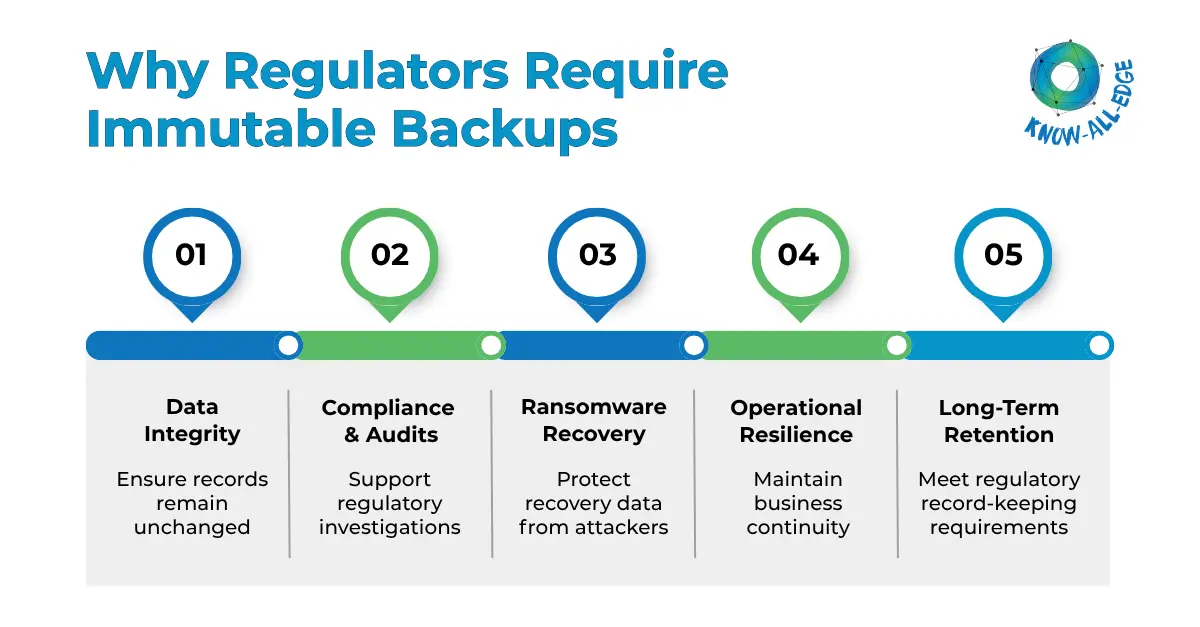
Regulators are increasingly concerned with data integrity, operational resilience, financial stability, and the ability of organizations to recover from disruptive incidents.
Across financial services, healthcare, government, critical infrastructure, and other regulated sectors, backup systems are no longer viewed as simple IT tools. They are now considered essential components of risk management.
Authorities want assurance that organizations can preserve records accurately, prevent unauthorized modifications, recover from cyber incidents, and maintain compliance and operational continuity.
Immutable storage directly supports these objectives.
RBI Backup Compliance and the Growing Focus on Cyber Resilience
The financial sector faces some of the strictest expectations around resilience and recoverability.
The Reserve Bank of India has consistently emphasized cybersecurity preparedness, operational resilience, business continuity, and effective recovery mechanisms for regulated entities.
While organizations should always review the latest regulatory guidance applicable to their industry, the broader direction is clear: backup systems must be capable of supporting recovery even during severe cyber incidents.
This has made RBI backup compliance discussions increasingly focused on:
- Data integrity
- Secure retention
- Recovery assurance
- Cyber resilience
- Ransomware preparedness
Immutable backup technologies help organizations demonstrate that critical recovery data remains protected from unauthorized changes and cyber threats.
As cyber regulations continue evolving, immutable storage is becoming an increasingly important part of compliance strategies.
SEBI and the Push Toward Immutable Storage
The securities and capital markets sector faces similar challenges.
Trading records, transaction histories, communication records, compliance documents, and audit data must remain accurate and available for extended periods.
This is one reason why discussions around SEBI immutable storage have gained momentum.
From a regulatory perspective, preserving data is not enough.
Organizations must also demonstrate that records have not been altered after creation.
Immutable storage provides this assurance by creating verifiable records that remain unchanged throughout the retention period.
This supports audit readiness, record authenticity, regulatory investigations, data governance initiatives, and long-term retention requirements.
For financial institutions, brokers, exchanges, and market participants, immutable storage is increasingly viewed as a foundational control rather than an optional enhancement.
Global Regulatory Trends Supporting Immutable Storage
India is not alone in this shift.
Across the world, regulators and cybersecurity authorities are emphasizing immutable storage and resilient recovery practices.
Frameworks from government agencies, financial regulators, and cybersecurity bodies frequently recommend immutable backups as part of ransomware defense strategies.
The message is becoming consistent globally: organizations must not only back up data but also ensure that backup copies remain trustworthy during a cyber crisis.
Best Practices for Implementing Immutable Backups
Implementing an immutable backup strategy requires more than simply enabling immutability. To ensure effective protection and recovery, organizations should:
- Enable multi-factor authentication (MFA) for backup administrators.
- Apply strict access controls and role-based permissions.
- Define retention policies based on business and compliance requirements.
- Regularly validate backup integrity and completion status.
- Encrypt backup data and securely manage encryption keys.
- Maintain offsite or cloud-based backup copies.
- Consider air-gapped backup copies for critical data.
- Test recovery processes regularly to ensure backups can be restored when needed.
Remember, an immutable backup only delivers value if it can be recovered successfully during a cyber incident or disaster.
The Future of Immutable Storage
As ransomware attacks become more sophisticated and regulatory expectations continue to evolve, immutable storage is quickly moving from a recommended best practice to a core requirement for modern data protection.
Organizations are increasingly investing in technologies such as cyber recovery vaults, AI-driven threat detection, automated recovery validation, and zero-trust security models to strengthen resilience.
Looking ahead, immutability will become more deeply integrated into enterprise storage, cloud platforms, and backup solutions. The focus will go beyond protecting data to ensuring organizations can recover quickly, maintain business continuity, and operate confidently in the face of cyber threats.
Conclusion
It’s no longer enough to simply have backup copies of your data, you need to know those backups will still be available when you need them most.
As ransomware attacks become more common and regulators place greater emphasis on resilience, immutable backups, WORM storage, and air-gapped backups are becoming essential parts of a strong data protection strategy.
From RBI and SEBI compliance to cyber resilience, immutable backups are now a key part of modern data protection.
At Know All Edge, we help organizations build resilient backup and disaster recovery strategies through immutable storage solutions, ransomware recovery planning, and ongoing support, ensuring critical data remains protected and recoverable when it matters most.
Because nowadays having a backup is actually not enough. You need a backup that attackers can’t change.
FAQs on Immutable Backups
What is an immutable backup?
An immutable backup is a backup copy that cannot be changed or deleted for a set period of time. Once it’s created, the data remains locked, giving organizations a clean and reliable copy to recover from if something goes wrong.
What is an example of an immutable backup?
A backup stored in Amazon S3 with Object Lock enabled is a common example. Even if an attacker gains administrative access, they cannot delete or alter the protected backup until the retention period ends.
What is the difference between immutable and mutable backup?
The difference comes down to whether the backup can be changed after it’s created.
A mutable backup can be edited, overwritten, or deleted. That’s useful for day-to-day backup operations, but it also means the backup could be affected by ransomware, human error, or malicious activity.
An immutable backup is locked. Nobody, not even administrators can modify or delete it during the retention period. That’s why it’s often considered a safer recovery option.
What is the difference between immutable and offline backups?
People often confuse these two, but they’re not the same.
An immutable backup stays protected because it cannot be changed or deleted. An offline backup stays protected because it is disconnected from the network.
Think of immutability as a lock on the data and offline storage as putting the data in a separate room. Many organizations use both approaches together for stronger protection against ransomware.
What is immutable WORM storage?
WORM stands for Write Once, Read Many.
Once data is written to WORM storage, it can be viewed whenever needed but cannot be modified. This makes it ideal for compliance, audits, long-term record retention, and immutable backup strategies.
Are immutable backups required for compliance?
It depends on the industry and regulatory requirements. However, financial regulators, cybersecurity frameworks, and compliance standards increasingly expect organizations to protect backup data from unauthorized changes.
As a result, immutable storage is becoming an important part of meeting data retention, audit, and cyber resilience requirements.
Can ransomware affect immutable backups?
In most cases, no.
Ransomware may be able to encrypt production systems and even target backup environments, but it cannot modify or delete a properly configured immutable backup. This allows organizations to restore data from a trusted recovery point instead of relying on attackers for recovery.


