 Skip to content
A ransomware never thinks about the time before attacking. It could be 2 AM or 2 PM. Imagine it happens to your organization! The first question out of everyone’s mouth is the same:
“We have backups, right?”
The answer, tragically, is often yes. You run the backups and status said “Success.” And yet, the organization still spent the next three weeks trying to piece itself back together. Some never fully did.
This is the gap between backup and cyber resilience. And right now, in 2026, that gap is costing organizations billions of dollars, months of recovery time, and in the case of hospitals and critical infrastructure, actual human lives. This is exactly why is cyber resilience important today.
If you are anyone responsible for keeping an organization operational through a cyber event, this article is for you. Not because you don’t know what backup is. You do. But because the threat landscape has shifted in ways that make yesterday’s strategy dangerously insufficient for today’s attacks, and the conversation in most boardrooms hasn’t caught up.
Let’s change that.
The Illusion of the Green Checkmark
Think about how most organizations treat backup. A job runs every night. The monitoring dashboard shows “completed.” An automated report confirms that backups are done and there’s a green checkmark.
That workflow made perfect sense in 2010. It doesn’t anymore.
Modern ransomware groups aren’t kicking in the front door and demanding money. They’re patient. They infiltrate systems weeks or even months before they strike. They move laterally through networks, mapping out your infrastructure, identifying your backup systems, and quietly compromising your backup data before you even know they’re in your environment.
“By the time the encryption event triggers and you see that ransom note on your screen, your backups may already be corrupted, exfiltrated, or locked behind the attacker’s own encryption. The green checkmark from last night means nothing now.”
The FBI and CISA have both issued explicit warnings about ransomware groups like Ghost that specifically target backup infrastructure as part of their attack chain. This isn’t a theoretical threat model. It’s happening to government agencies, healthcare networks, financial institutions, and manufacturers right now.
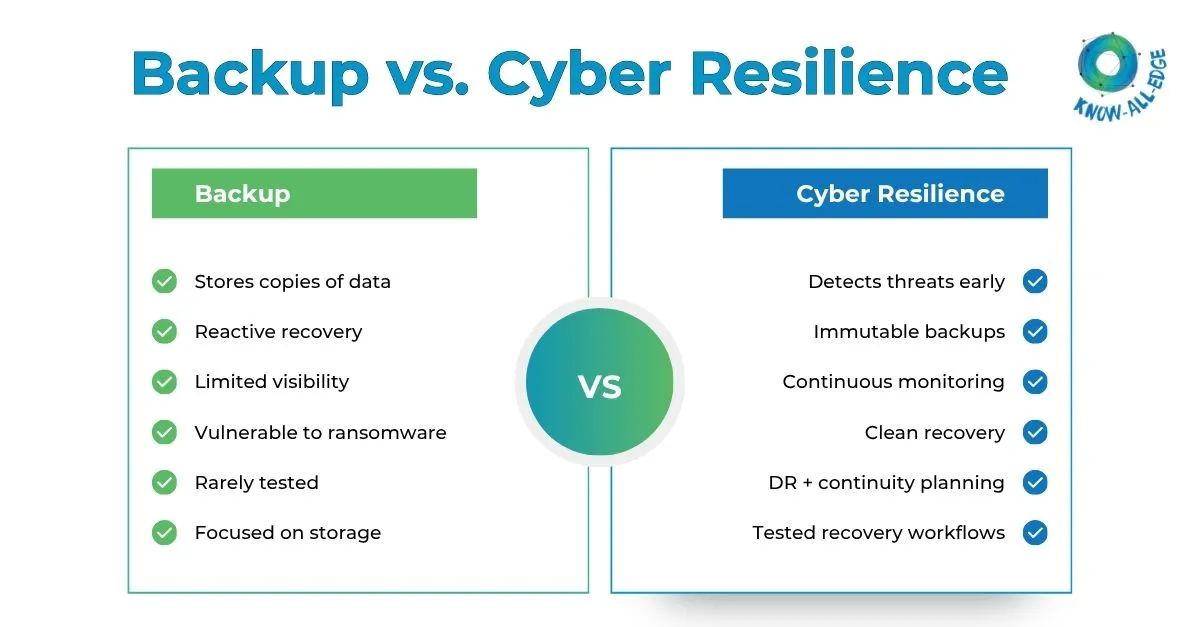
So the first thing to understand is this: backup is a component of cyber resilience. It is not a substitute for it.
What is Cyber Resilience?
Cyber resilience gets thrown around a lot without enough precision. So let’s be specific.
Cyber resilience is your organization’s ability to anticipate, withstand, detect, respond to, and recover from cyber incidents, while maintaining continuous operations.
Here’s what each pillar of cyber resilience actually demands in practice:
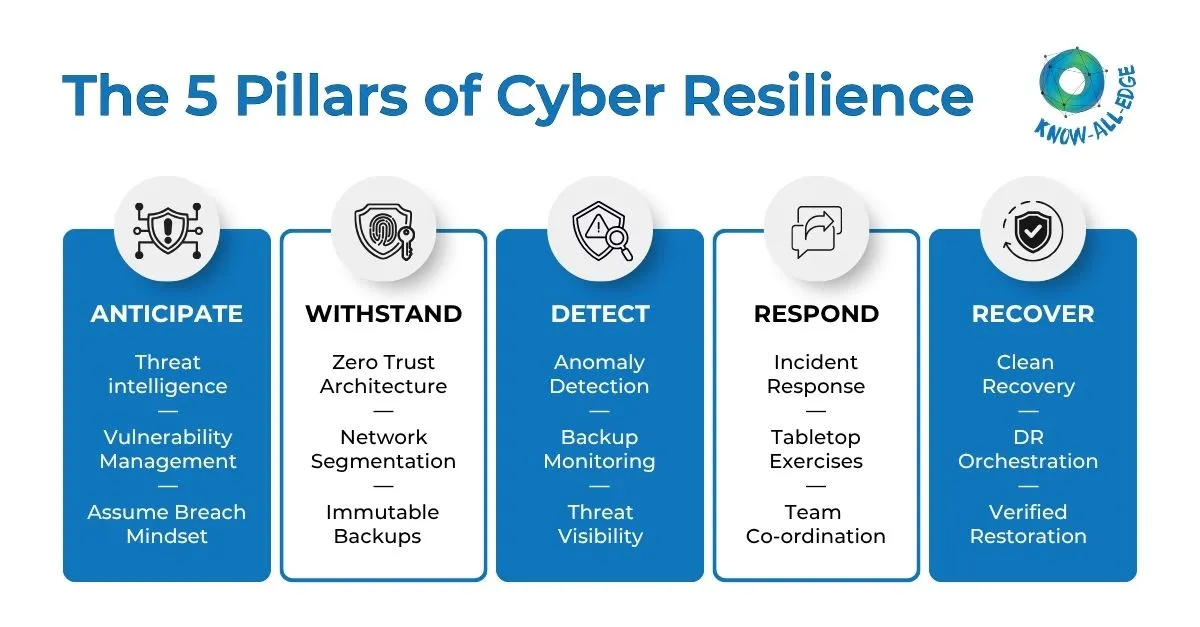
- Anticipate: You need threat intelligence, vulnerability management, and an architecture that treats compromise as a matter of when, not if.
- Withstand: Systems and data must be designed to survive attacks, not just recover from them. Immutability, network segmentation, zero-trust access, these aren’t trending words. They are architectural decisions that determine whether an attacker who gets into one part of your environment can reach everything else.
- Detect: You have to know an attack is happening, ideally long before it reaches its target. That means behavioral analytics, anomaly detection across your data estate, and the ability to identify threats in your backup environment, not just your production environment.
- Respond: Having a plan documented in a PDF is not the same as having a tested, practiced response capability. Who makes the call to isolate systems? In what order do you restore? Who communicates to the board? These decisions cannot be made for the first time in the middle of an incident.
- Recover: And not just “get the data back.” Recover cleanly, without reinfecting production with compromised backup data. Recover fast enough to matter for operations. Recover to a known-good state with verifiable integrity.
That’s cyber resilience. Backup is only one small part of recovery. Most organizations are still not fully prepared for everything else a modern cyberattack can impact.
The Organizational Problem Nobody Talks About Enough
Here’s something that rarely makes it into vendor whitepapers but is absolutely critical to understand: most organizations have a fundamental structural gap that makes cyber resilience nearly impossible to achieve.
Backup administrators and cybersecurity teams operate in silos.
The security team is focused on perimeter defenses, endpoint detection, threat hunting, and incident response. The backup team is focused on data protection, recovery time objectives, and storage optimization. In most organizations, these two groups barely talk to each other outside of a major incident.
The result is predictable and dangerous:
- Security teams often don’t know what backup solution is running in their environment, or what its security posture looks like
- Backup teams rarely think in terms of attack vectors, lateral movement, or privilege escalation
- An attacker with domain admin credentials can potentially reach backup infrastructure just as easily as production systems
- Legacy backup tools were simply never designed with today’s threat actors in mind
And the main part is that threat actors know this all. They exploit it deliberately.
Closing this organizational gap isn’t a technology problem, it’s a people and process problem. It requires:
- Shared threat-hunting protocols that cover the backup environment, not just production
- Joint tabletop exercises simulating ransomware scenarios from initial access all the way through recovery
- A common definition of what “secure backup” means in the context of modern threats
- An “assume breach” mindset embedded across both teams, not just the security side
“This collaboration needs to happen before an incident. Not during one.”
RTO and RPO
Ask most IT teams if they have a backup strategy and the answer is yes. Ask them what their Recovery Time Objective (RTO) and Recovery Point Objective (RPO) are, and you’ll get varying degrees of confidence. Ask them when they last tested against those objectives, actually stood up systems from backups in an isolated environment, and you’ll often get a much longer pause.
RTO and RPO aren’t just technical parameters. They’re business commitments.
Metric | What it tells? |
RTO (Recovery Time Objective) | The maximum amount of downtime your business can tolerate before operations, revenue, customer trust, or critical services are seriously impacted. |
RPO (Recovery Point Objective) | The maximum amount of data loss your organization can accept, measured as the time between the last clean recovery point and the disruption itself. |
How long can a financial institution operate without core banking systems? How much transaction data can you afford to lose? These answers should be driving your data protection architecture.
But in many organizations, it works the other way around, the technology they already have ends up deciding their actual recovery time and data loss limits, whether they realize it or not. And when a cyberattack happens, they discover their real recovery capability for the first time, during the worst possible moment.
The modern approach demands that you:
- Define RTO and RPO requirements based on genuine business impact
- Design your architecture specifically to meet those requirements
- Prove through regular, documented testing that you can actually hit them
At Know All Edge, we help organizations bridge that gap by assessing real recovery readiness, validating resilience strategies, and ensuring backup environments are designed for modern cyber threats, not just routine IT failures.
Where Organizations Fail Most Often
The patterns of failure are remarkably consistent across industries and geographies. These aren’t edge cases:
- Recovery is defined in a policy document but never actually tested
- All backup copies are stored in the same location as production
- The organization doesn’t know its RPO or RTO, or hasn’t revisited them in years
- Backups are not protected against ransomware, no immutability, no isolation
- No one is clearly responsible for the DR plan when things go wrong
- Security and backup teams have never run a joint exercise
If two or more of those describe your current state, you’re not alone, but you are at significant risk. And the risk is not theoretical.
The Hybrid IT Complexity Nobody Prepared For
If your infrastructure were simple, a single data center, a single set of workloads, a single backup target, cyber resilience would still be hard enough. But that’s not the reality any modern organization operates in.
Today’s typical enterprise combines:
- On-premises infrastructure with its own backup tooling
- One or more public cloud environments with native (often workload-specific) backup options
- SaaS platforms like Microsoft 365, Google Workspace, and Salesforce
- Private cloud instances with separate SLAs and management requirements
- Edge or remote computing environments with inconsistent coverage
Each of these has different security controls, backup methods, and recovery processes. Most organizations built their backup strategy when infrastructure was simpler, then kept adding cloud, SaaS, and hybrid environments without rethinking the bigger picture.
The result is fragmented protection: one solution for cloud workloads, another for on-prem systems, another for SaaS, with visibility and recovery gaps in between.
In such environments, saying “we have backups” often only means some systems are protected, not that the organization has a unified and tested recovery strategy.
True cyber resilience requires consistent protection, visibility, and recovery across every environment because attackers don’t care where your data lives.
What Actually Happens When Ransomware Hits
Let’s walk through a realistic scenario, because the specifics matter.
A threat actor gains initial access through a phishing email, still the most common initial access vector, and establishes persistence. Over the next several weeks, they:
- Conduct reconnaissance across the network
- Move laterally, escalating privileges at each step
- Map out the infrastructure, identifying backup systems and schedules
- Identify the backup retention period, and wait long enough that compromised data propagates into the backup chain
- Finally trigger the encryption event
This is exactly why modern cyber resilience strategies must focus equally on ransomware recovery and prevention, not just perimeter security.
By the time that ransom note appears, you’re not just dealing with encrypted production data. Your most recent backups may already contain compromised files. Restore from them without proper analysis, and you reintroduce the malware into production. If your backup infrastructure wasn’t logically isolated, it may itself be encrypted or corrupted.
This is why three things matter so much:
- Logical air-gapping: Your backup data must be isolated from the same attack paths that reach production. An attacker with valid credentials should not be able to reach your backups through those same credentials.
- Immutability: If backup data cannot be modified or deleted by anyone, including administrators, then even if an attacker reaches the backup environment, they can’t corrupt the data. The backups survive the attack.
- Continuous threat monitoring: If you can detect anomalous activity, like unexpected access patterns, encryption events in backup repositories, exfiltration attempts, you can potentially catch an attack in progress rather than discovering it at detonation.
The Leading Solutions Redefining Cyber Resilience
The market has responded to the shift from backup to resilience. A handful of platforms have emerged as genuine leaders, not because of their marketing, but because of the design principles that underpin them.
(1) Commvault
Commvault focuses on cyber resilience, not just backup. The idea is simple: your backup environment should be protected with the same level of security as your production systems.
Key capabilities include:
- Clean recovery with malware-verified restoration
- Threat intelligence scanning built directly into backup workflows
- Anomaly detection to identify suspicious activity early
- Unified management across on-prem, cloud, and SaaS environments
- Strong focus on reducing recovery complexity in hybrid IT environments
Instead of treating backup as passive storage, Commvault positions it as an active part of the organization’s security posture.
(2) Zerto
Zerto approaches cyber resilience through continuous data protection and disaster recovery. Unlike traditional backup systems that capture data at scheduled intervals, Zerto continuously records changes in real time.
Key capabilities include:
- Continuous data replication instead of periodic snapshots
- Recovery points measured in seconds rather than hours
- Faster recovery after ransomware or outages
- Ability to restore systems to a clean point just before an attack
- Integrated backup and disaster recovery capabilities
This approach helps organizations reduce downtime and minimize data loss during critical incidents.
(3) Cohesity
Cohesity treats backup infrastructure as a security layer rather than just a storage function. The platform focuses heavily on threat detection, monitoring, and secure recovery.
Key capabilities include:
- AI-driven anomaly detection for suspicious backup activity
- Ransomware detection within backup environments
- Clean-room recovery for isolated forensic analysis
- Continuous monitoring across backup infrastructure
- Secure recovery workflows to avoid reinfection
The platform is designed to help organizations detect threats early and recover safely without reintroducing compromised data into production.
Disaster Recovery Is Not the Same as Backup
This distinction gets blurred constantly, and it has real consequences when an incident occurs.
| What It Protects | What It Doesn’t Cover |
Backup | Your data and file copies | Full business operations, applications, and infrastructure recovery |
Disaster Recovery | Your entire operational environment | Includes systems, applications, infrastructure, and backup recovery |
You need backup to have DR. But having backup does not mean you have DR. So, you need both.
A common problem is that organizations successfully back up their data but still struggle to recover operations after a ransomware attack. The data may be safe, but restoring applications, configurations, and infrastructure in the correct order can take days or even weeks if there’s no proper recovery plan in place.
This is where Disaster Recovery as a Service (DRaaS) helps. Instead of maintaining an expensive secondary data center, organizations can replicate critical workloads to a cloud-based DR environment and quickly restore operations when needed.
But technology alone is not enough. A DR plan that has never been tested is just documentation. A tested and regularly practiced DR plan is what actually helps organizations recover during a real incident.
Compliance Is Not Resilience, But Resilience Makes Compliance Easier
For organizations in regulated industries, like healthcare, financial services, government, there’s often an implicit assumption that meeting compliance requirements equals being protected. This is one of the most dangerous misconceptions in the industry.
Compliance frameworks like HIPAA, PCI-DSS, DPDPA, and government security standards define minimum requirements. They’re backward-looking by design, they codify what was considered adequate at the time they were written. They cannot keep pace with the evolution of threat actor tactics.
What resilience does is get you ahead of compliance rather than chasing it:
- Immutable backups, zero-trust access controls, continuous monitoring, and regular recovery testing don’t just meet regulatory minimums, they exceed them
- When auditors ask, you have documented, tested evidence of your capabilities, not just policies
- Data governance becomes a strength rather than an audit liability: you know where sensitive data lives, who has access, how it’s controlled, and you can prove it quickly
This is also where DSPM (Data Security Posture Management) is becoming increasingly important for identifying sensitive data exposure risks across hybrid environments.
The organizations that treat data protection as a pure IT function, disconnected from governance and compliance, are setting themselves up for painful surprises during both security incidents and regulatory examinations.
Building Toward Cyber Resilience: Where to Start
The first step toward cyber resilience is recognizing that backup alone is not enough. Here’s a practical six-step approach organizations can follow:
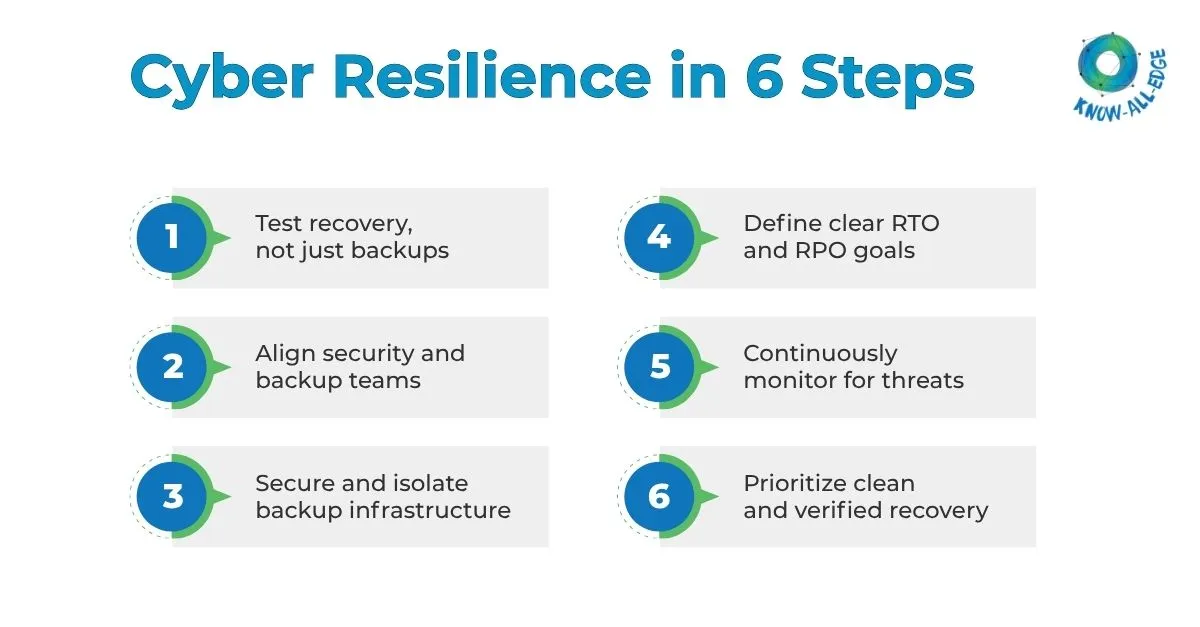
(1) Start with an Honest Assessment
Don’t rely only on compliance reports or backup success notifications. Evaluate your real recovery capability.
Question yourself:
- When was the last time recovery was actually tested?
- Can you truly meet your RTO and RPO targets?
- Do security and backup teams work together effectively?
(2) Break the Silos Between Security and Backup Teams
Cyber resilience is not just a technology issue; it’s also a people and process issue.
Security and backup teams should:
- Share visibility into threats and recovery environments
- Run joint tabletop exercises
- Build coordinated incident response plans
This collaboration becomes critical during a real attack.
(3) Secure the Backup Environment
Your backup infrastructure should be treated like a critical security asset, not just storage.
Key questions to evaluate:
- Who has access to backup systems?
- Can attackers reach backups using compromised credentials?
- Are backups immutable and isolated from production systems?
(4) Define Recovery Goals Based on Business Impact
Recovery objectives should come from business requirements, not technology limitations.
Understand:
- How much downtime the business can tolerate
- How much data loss is acceptable
- Which systems are most critical to operations
Then regularly test whether your recovery strategy can actually meet those targets.
(5) Continuously Monitor for Threats
Monitoring should extend beyond production systems into the backup environment itself.
Organizations should watch for:
- Unusual backup activity
- Unexpected encryption behavior
- Suspicious access patterns
- Early signs of ransomware activity
Early detection can significantly reduce recovery impact.
(6) Focus on Clean Recovery, Not Just Fast Recovery
Recovering quickly is important, but recovering infected data back into production can make things worse.
Recovery processes should include:
- Malware scanning of backup data
- Isolated recovery environments for verification
- Integrity checks before systems go live again
The goal is not just to restore operations quickly, but to restore them safely.
The Bottom Line
The numbers are stark:
- $4.44 million: The global average cost of a data breach reached in 2025 as per IBM report
- Weeks to months: Typical attacker dwell time before ransomware detonates, during which backup infrastructure is at risk
- Days to weeks: Average recovery time for organizations without a tested DR capability
In critical sectors, like healthcare, finance, government, the cost of downtime is measured not just in dollars but in patient outcomes, economic stability, and public trust.
In this environment, backup is the floor, not the ceiling. It’s necessary, but it’s nowhere near sufficient.
True cyber resilience is the integration of:
- Secure, immutable, logically isolated backup architecture
- Continuous detection across both production and backup environments
- Tested, practiced response procedures, not documentation that’s never been exercised
- Verified recovery capability with clean, malware-free restoration
- Organizational alignment between security and backup teams
The organizations that will navigate the next generation of cyber threats aren’t those with the most sophisticated perimeter defenses. They’re the ones that have built genuine resilience into the fabric of how they operate, and who know, because they’ve tested it, that when the attack comes, they can get back up.
Ready to Move Beyond Traditional Backup?
At Know All Edge, we work with organizations across sectors to assess, design, and implement complete cyber resilience strategies that combine secure backup and disaster recovery, not just isolated point solutions. As system integrators, we bring a vendor-neutral approach to help enterprises choose the right technologies, strengthen recovery readiness, and build resilience across complex hybrid environments.
If you’re ready to have an honest conversation about the gap between your current backup posture and true cyber resilience, where your organizational gaps are, what your real recovery capability looks like, and what it would take to close that gap, we’d like to talk.
FAQs on Cyber Resilience
What is cyber resilience and why is there a need for it?
Cyber resilience is an organization’s ability to anticipate, withstand, detect, respond to, and recover from cyberattacks, while keeping operations running. It goes beyond traditional security, which assumes you can block every threat. You can’t. Ransomware groups are patient, sophisticated, and specifically designed to bypass perimeter defenses. The need for cyber resilience comes from a simple reality: breaches are inevitable. What separates organizations that survive from those that don’t isn’t just whether they were attacked, it’s whether they were built to recover.
What is resilience in backup?
Resilience in backup means your backup data can survive an attack, not just exist. A resilient backup is immutable (can’t be altered or deleted), logically isolated from production attack paths, continuously monitored for anomalies, and regularly tested for actual recoverability.
It’s the difference between a backup that says “completed” and a backup you can genuinely restore from under pressure. Most traditional backup systems weren’t designed with today’s ransomware tactics in mind. Resilient backup is backup built to withstand an adversary who’s specifically trying to reach it.
What are the 5 pillars of cyber resilience?
The five pillars expand on the core framework:
- Anticipate: Identify risks and vulnerabilities before attackers exploit them
- Withstand: Design systems to survive compromise without total failure
- Detect: Identify threats early, including inside backup environments
- Respond: Act decisively with pre-tested, clearly owned procedures
- Recover: Restore operations to a clean, verified state with minimal downtime
Each pillar is interdependent. Strong detection without recovery capability still leaves you exposed, and fast recovery without early detection means you risk restoring compromised data.
Is backup enough in cyber resilience?
No, and this is the most dangerous assumption in enterprise IT today. Backup protects your data. Cyber resilience protects your business. Modern ransomware groups routinely target backup infrastructure specifically, corrupting or encrypting it weeks before detonating an attack. If your backups aren’t immutable, isolated, and continuously monitored, they’re part of the attack surface, not the safety net. Backup is the foundation. But without detection, tested recovery, disaster recovery planning, and organizational readiness, backup alone will not save you when it matters most.


