 Skip to content
Quick Summary
- Prevention lowers the chances of an attack; recovery keeps your business running when prevention fails.
- Ransomware attackers now target and delete backups before launching attacks.
- Immutable backups are the only reliable way to recover after accounts or admin access are compromised.
- Recovery goals like RTO and RPO are meaningless if they are never tested.
- Companies that ignore recovery planning realize the problem only during a real cyber incident.
Introduction
Most organizations believe ransomware protection is about prevention. They invest in firewalls, endpoint security, email protection, and MFA, assuming that if the defenses are strong enough, recovery will never become a problem.
But modern ransomware attacks do not stop at bypassing security controls. Attackers now spend weeks inside environments identifying backup systems, stealing data, and disabling recovery options before launching the attack.
Ransomware is no longer just a malware problem. It is an operational resilience problem. As per reports, 89% of organizations hit by ransomware had their backup repositories targeted by attackers. In many cases, the recovery systems were attacked first.
The reality is simple: prevention reduces risk, but recovery determines whether the business survives the incident. The debate is no longer Ransomware Recovery vs Ransomware Prevention. Organizations need both, and most still have critical gaps in one or the other.
Let’s discuss this in detail.
Why Ransomware Keeps Getting Worse
Before we talk about prevention and recovery, it helps to be clear about the reality security teams are dealing with today.
Ransomware has now turned into a business.
With Ransomware-as-a-Service (RaaS), attackers can simply rent tools, buy access, and run full-scale operations, complete with negotiation teams and leak sites. Another report says, in 2025, more than 7,500 organizations were publicly named on ransomware leak sites, a 58% jump from the previous year.
The impact is massive. Globally, ransomware is now estimated to cost around $57 billion every year, according to a report. Another TOI report says, in India alone, 2025 saw over 265 million cyberattack attempts, with ransomware affecting hospitals, factories, government offices, and schools, and losses crossing ₹20,000 crore.
What’s more concerning is how the attacks themselves have changed. Most of them now include double extortion, where attackers steal data before encryption and threatened for public release. Many groups also use AI-driven phishing and credential theft, making attacks faster and harder to detect.
The reality is simple: the threat is not reducing, and security programs must be built for this level of sophistication.
Below image gives you a gist of ransomware recovery vs prevention.
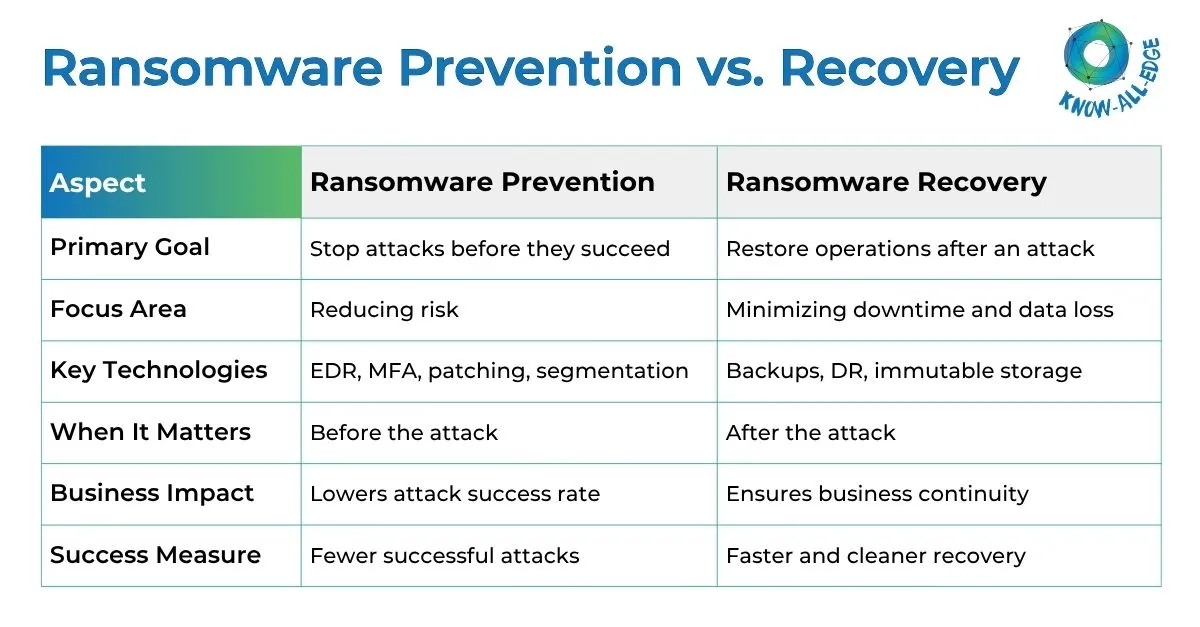
Let’s now discuss this in detail.
Ransomware Prevention: What It Is and What It Requires
Prevention is everything your organization does to stop a ransomware attack before it succeeds. It is where most security budgets go because stopping an attack is always easier and cheaper than dealing with the fallout.
But prevention is not just installing an endpoint tool and calling it done. Modern ransomware has multiple stages:
- Attackers break in
- Move across systems
- Escalate access
- Then launch the attack
How Attackers Usually Get In
Most ransomware still starts with phishing emails. But another major cause is unpatched systems, especially older vulnerabilities that attackers already know how to exploit.
The third big entry point is stolen credentials. In many cases, attackers don’t “break in” at all; they simply log in. This is why MFA has become essential.
What Genuine Prevention Looks Like
Effective prevention works in layers, not in isolation:
- Strong identity controls: Use MFA everywhere, especially for admin and remote access. Combine it with strict access limits so that even if one account is compromised, it can’t be used to move freely across systems or access everything.
- Endpoint detection (EDR/XDR): Tools like CrowdStrike Falcon Microsoft Defender for Endpoint, and SentinelOne Singularity help. They detect unusual behavior early, before encryption begins across endpoints, cloud workloads, and identity systems, giving teams a chance to stop attacks in progress.
- Patch management: Keep systems consistently updated so attackers can’t exploit known vulnerabilities that already have fixes available.
- Network segmentation: Separate systems so that if one device is compromised, the attack can’t easily spread to critical systems or backup infrastructure.
- Security awareness: Train people to recognize phishing and other threats, but design systems with the assumption that mistakes will still happen, so one wrong click doesn’t turn into a full-scale incident.
The key point
Prevention reduces the chances of an attack succeeding, but it doesn’t eliminate the risk entirely. And that’s why recovery matters just as much.
Ransomware Recovery: The Part Most Enterprises Get Wrong
Recovery is what gets your business back up and running after a ransomware attack. It decides how long you stay down, how much data you actually lose, and in many cases, whether you end up paying the ransom.
But here’s the part most teams miss: recovery can’t be “figured out” during an incident. By the time an attack hits, it’s already too late. It has to be planned, tested, and proven in advance. In fact, organizations that regularly tested their backups recovered up to 3x faster than those that never validated their restore process.
And the gap is still wide. IBM’s Report shows that most organizations that reported recovery took more than 100 days to fully recover from a breach. Even a “successful” ransomware recovery still means an average of 24 days of downtime – weeks of disruption, lost revenue, and operational chaos.
The Backup Problem Nobody Talks About Enough
Backups are essential for ransomware recovery. But if your backup strategy was designed before attackers started targeting backups themselves, it is no longer a real recovery strategy, it is just a false sense of security. Effective cyber resilience depends on ensuring backup systems remain recoverable even when production environments are compromised.
Today’s ransomware groups don’t stop at encrypting data. They actively look for backup systems first and try to delete or corrupt them before launching the attack. The goal is simple, if you cannot restore, you are more likely to pay.
That changes how backups need to be designed.
- Immutable backups have become a baseline requirement. They cannot be altered or deleted for a set period, even if attackers get admin access. This is typically achieved using WORM (Write Once, Read Many) storage, available in platforms like Amazon S3 Object Lock and Azure Immutable Blob. CISA also recommends immutable backups as a core defense against ransomware.
- The 3-2-1 rule is no longer enough. It has evolved into 3-2-1-1-0, three copies of data, two different media types, one offsite copy, one immutable or air-gapped copy, and zero unverified restores. That last part matters, backups are only useful if recovery is actually tested.
- Just as important, backups must be isolated from production systems. If they sit on the same network and use the same credentials, attackers who compromise the environment can usually reach them too.
What RTO and RPO Actually Mean for Security Leaders
- Recovery Time Objective (RTO) is how long your organization can afford to be down.
- Recovery Point Objective (RPO) is how much data loss is acceptable, measured in time, for example, losing up to four hours of data but not more.
These are not just IT metrics. They are business decisions with real cost behind them. An RTO of 72 hours and an RPO of 24 hours may look fine in a slide deck, but during a ransomware attack, 72 hours of downtime feels like an eternity. Customers are impacted, revenue stops, and pressure on leadership escalates quickly.
The real question is whether your recovery setup can actually meet the RTO and RPO targets you have defined. In many cases, organizations discover that they cannot meet those targets at all during an incident only.
This is why recovery architecture matters as much as backup solutions. Platforms like Commvault, Veeam, and IBM, help organizations reduce recovery time by enabling faster backup restoration, clean recovery points, and better visibility into usable data.
But tools alone are not enough. RTO and RPO only become meaningful when they are regularly tested through real recovery drills, not just documented in policy.
The Hidden Cost of Treating Recovery as an Afterthought
Most organizations that invest only in prevention and neglect recovery face a specific and painful failure mode. The attack gets through, backups are compromised or unavailable, and there are only two options left:
- pay the ransom or
- rebuild everything from scratch
And yes, organizations do pay, but hardly they can recover the whole data. Many find that decryption keys provided by attackers are unreliable, corrupted, or incomplete. Paying also signals to attackers that the organization is willing to pay, which can increase the risk of future attacks.
Even after these scenarios, cyber insurers may also deny coverage if required security controls, validation, or incident response conditions are not met.
The real cost goes far beyond the ransom itself. It includes:
- downtime, which often exceeds the ransom amount by more than 100 percent, along with legal fees,
- forensic investigations,
- regulatory penalties,
- reputational damage,
- and lost productivity across the business.
But good news! Organizations with offline or immutable backups reduced recovery costs significantly compared to those that ended up paying ransom demands.
What a Mature Ransomware Resilience Program Actually Looks Like
Let’s bring this down to ground level. A strong ransomware resilience program is not one thing, it is a mix of prevention and recovery working together.
On the Prevention Side
- Endpoint and Extended Detection: Use EDR/XDR tools that can spot suspicious behavior across endpoints, cloud, and identity systems. The goal is simple, catch attackers before they can deploy ransomware.
- Identity Security: Turn on MFA everywhere, limit admin access, and use privileged access management. Most ransomware attacks start with stolen credentials.
- Vulnerability Management: Focus first on internet-facing systems and older infrastructure. During high-risk periods, patch faster than usual.
- Network Segmentation: Segment critical systems, backup environments, and operational technology so attackers cannot move freely if they get in.
- Security Awareness: Go beyond annual training. Run phishing simulations and make awareness part of daily behavior, not a checkbox.
On the Recovery Side
- Immutable Backup Infrastructure: Use immutable backups with defined retention so attackers cannot delete or encrypt them. Separate backup access from production credentials. And most importantly, test restores regularly, not just backup success.
- Cyber Recovery Solutions: Disaster recovery solutions like Commvault Cloud, Rubrik, and Veeam help organizations find clean recovery points, isolate recovery environments, and validate data before it goes back into production.
- Defined RTO and RPO by System Tier: Not every system needs the same recovery speed. Set clear targets for each system and actually test if you can meet them.
- Incident Response Plan: Document who does what, how decisions are made, and how systems come back online. Run tabletop exercises so teams are not figuring it out during an attack.
- Involve Law Enforcement: Organizations that involve law enforcement often reduce breach costs and improve recovery outcomes. It is a low-effort step with real impact.
The Sectors With the Most to Lose
Ransomware exposure is not evenly distributed. The sectors facing the highest impact in India and globally are:
Ransomware does not hit everyone equally.
- Manufacturing – Highest attack volume, often due to legacy systems and operational downtime pressure
- Healthcare – Very high cost per breach, and limited tolerance for downtime
- Financial services – Constant targeting due to high-value data and strict regulations
- IT and ITeS – Heavy targeting in India, often through supply chain attacks
- Government – Large-scale exposure, with very low recovery rates once systems are encrypted
- Education and edtech – Increasing attacks, sensitive data, but limited security budgets
The Cyber Insurance Reality Check
Cyber insurers no longer treat ransomware protection as optional. Before they issue or renew a policy, they expect organizations to show that both prevention and recovery controls are actually in place and working.
On the prevention side, this usually means MFA for remote access, endpoint detection tools, regular patching, and security awareness training. On the recovery side, it is about having a real incident response plan, tested backups, offline or immutable copies, and proper network segmentation.
If these basics are missing or unproven, insurers may deny claims, reduce payouts, or set premiums so high that coverage becomes impractical. In today’s environment, it is not enough to document resilience – organizations need to prove it through testing and evidence.
The Bottom Line
Ransomware is not just a prevention problem with recovery as a fallback. It is a resilience problem that requires both to work together, continuously tested and maintained.
For security leaders, the real question is whether ransomware recovery and prevention are equally strong, or if recovery has been underinvested because it is less visible.
Organizations that handle ransomware better in 2026 treat recovery as a core capability. They rely on immutable backups, tested response plans, clear RTO and RPO targets, and recovery systems isolated from production environments.
Prevention reduces how often you are hit. Recovery determines how bad it gets when you are. You need both.
And building that level of resilience requires the right recovery architecture. We help organizations evaluate, design, and implement backup and disaster recovery solutions aligned with their infrastructure, recovery goals, and ransomware resilience requirements. Get in touch with our experts to know more about our services.
Frequently Asked Questions
What is the prevention of ransomware?
Ransomware prevention includes all security measures that stop an attack before it executes. This covers:
- deploying endpoint protection,
- enforcing multi-factor authentication,
- patching vulnerabilities regularly,
- segmenting networks, and
- training employees to recognize phishing attempts.
The goal is to eliminate entry points and detect malicious behavior early, before the ransomware payload is ever delivered.
What is ransomware data recovery?
Ransomware data recovery is the process of restoring systems, applications, and data to a clean state after a successful attack. It relies on having tested backups, a documented incident response plan, and isolated recovery environments that attackers have not compromised.
What is a key step in recovery from a ransomware attack?
Identifying a clean, pre-attack recovery point is the most critical step. Without knowing exactly when the attacker established persistence, you risk restoring already-infected data.
Can ransomware be reversed?
In most cases, no. Once ransomware encrypts your data, decryption without the attacker’s key is rarely possible. Some older ransomware variants have had decryption tools released publicly, but modern ransomware uses strong encryption that cannot be broken. Your best path to recovery is always clean, immutable backups, not decryption.
What are the two main defenses against ransomware?
Prevention and recovery. Prevention stops attacks from succeeding through controls like EDR, MFA, and patch management. Recovery ensures that when an attack does succeed, your organization can restore operations quickly without paying the ransom. Neither works as a standalone strategy, you need both operating in parallel.
What is the best method to recover from a ransomware attack?
The most reliable way to recover from ransomware is to restore from immutable, offline backups into a clean, isolated environment. This helps ensure no compromised data is reintroduced into production.
Modern recovery approaches also focus on validating backups before restoration using isolated environments, so only clean data is brought back online.
What is the 3 2 1 backup rule for ransomware?
The 3-2-1 rule means maintaining three copies of your data, across two different storage media types, with one copy stored offsite. In 2025, this has evolved into the 3-2-1-1-0 rule, adding one air-gapped or immutable copy, and zero unverified restores. The additional steps directly address how modern ransomware targets and destroys conventional backup infrastructure.
What are the tools to prevent ransomware?
Core prevention tools include EDR and XDR platforms like CrowdStrike Falcon and Microsoft Defender for Endpoint for behavioral threat detection, MFA solutions for identity protection, email security gateways to block phishing, and network segmentation tools to contain lateral movement. Palo Alto Networks Cortex XDR is also widely deployed for network-level prevention.
What are the tools to recover from ransomware?
Leading recovery tools include Commvault Cloud for clean recovery point identification and isolated restoration environments, and Veeam Data Platform for immutable backups across hybrid and cloud infrastructure. For forensic investigation, Splunk SIEM helps security teams trace the attack timeline and confirm systems are fully remediated before restoration begins.
Is it possible to recover from ransomware?
Yes, but the outcome depends entirely on your preparation before the attack. Organizations with immutable backups, tested recovery plans, and isolated recovery environments can restore operations with minimal data loss. Without these in place, recovery becomes a choice between paying the ransom or rebuilding from scratch, both costly and unreliable.


