 Skip to content
Three years ago, most security leaders were asking a fairly simple question: should our people even be using ChatGPT? Today, that question feels almost quaint. Employees across every department are already relying on generative AI tools, sanctioned or not, and the real challenge has shifted to something far trickier.
How do you keep an eye on something that moves this quickly, touches this much sensitive information, and refuses to sit neatly inside any control you’ve already built?
That’s the reality of generative AI risk. It’s not about futuristic AI threats. It’s about employees unintentionally sharing sensitive business data with AI tools that organizations can’t fully see or control.
This piece breaks down:
- what generative AI risk really looks like inside a modern enterprise
- why your existing defenses were never built for it, and
- what a workable, level-headed approach to managing it actually involves.
Let’s begin.
What Do We Mean by Generative AI Risk?
At its core, generative AI risk refers to the exposure organizations face when employees interact with large language models and AI-powered applications built on top of them. It covers everything from leaked intellectual property to compliance violations that surface only after the damage is done.
Unlike AI safety, which addresses model behavior, bias, and societal impact, generative AI risk focuses on the security of enterprise data. For security teams, the priority is preventing data exposure, leakage, and misuse as employees use AI tools, making AI security a critical part of everyday operations.
Traditional data loss prevention (DLP) programs were designed for a predictable world: data moved through known channels like email, USB drives, or file uploads, and you simply watched those doors. Generative AI doesn’t play by those rules.
Consider what’s actually happening on the ground. Staff members paste contracts, source code, and customer records into chatbots just to save time on summarizing or rewriting. That data now flows through a channel most legacy tools never even glance at.
Worse, AI-generated responses can reconstruct sensitive details in the output itself, even when the original file never technically “left” the building. And because employees are adopting these tools faster than IT can review them, plenty of this activity happens on personal accounts nobody in security has ever heard of.
Put together, this creates a gap that’s wide, growing quickly, and mostly invisible to organizations still running yesterday’s playbook.
Why DLP and CASB Weren’t Built for This
Here’s an uncomfortable truth: even approved, enterprise-grade AI tools carry serious risk.
Tools like Microsoft Copilot or ChatGPT Enterprise can connect directly into your ERP, HR, and CRM systems the moment they’re implemented. If permissions haven’t been tightened beforehand, the AI can retrieve and summarize whatever it has access to, no hacking required, no malicious intent needed. Just a governance gap that AI happens to amplify at scale.
This is where legacy tools start showing their age.
DLP was designed to flag known patterns, like a social security number or a “confidential” watermark. But generative AI operates on meaning, not keywords. Someone can rephrase a prompt in another language, or restructure it entirely, and slide right past a filter that’s only looking for exact matches.
Related Reading: AI DLP vs Traditional DLP: Why Legacy Data Protection Falls Short for Generative AI
CASB solutions were built to monitor SaaS activity at runtime, essentially watching the handshake between a user and a service. The trouble is, a lot of the danger tied to generative AI risk doesn’t happen at runtime at all. It’s baked into misconfigurations within the AI platform itself, activity a CASB was never positioned to catch in the first place.
Related Reading: CASB vs AI Workforce Security: Why Betting on Just One Could Cost You Everything
AI tools also don’t always respond the same way. The same prompt can produce different answers each time. That makes it difficult for traditional security tools to monitor and control AI activity effectively.
The Risk Categories Security Teams Actually Deal With
Generative AI risk isn’t one single threat sitting in a corner. It’s a cluster of overlapping problems, and it helps to separate them out.
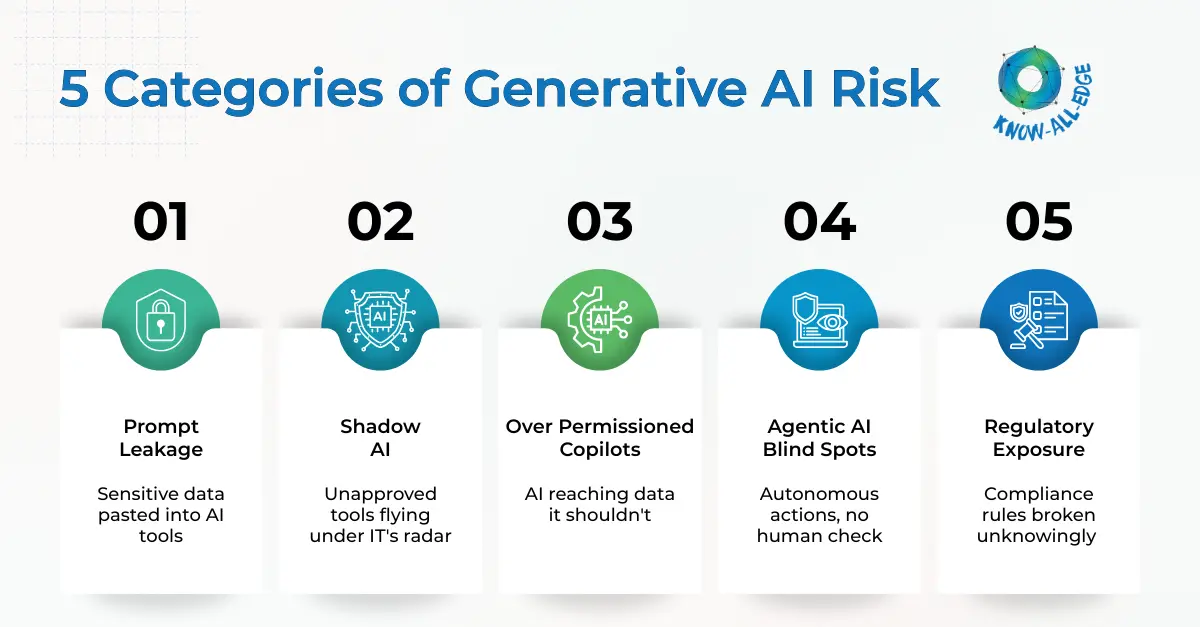
Prompt-Based Data Leakage
Prompt Injection is the most common issue by far. Employees paste financial data, legal documents, or proprietary code into AI tools hoping for a quick answer, often without realizing the provider may store or learn from that input.
Shadow AI
Browser extensions, personal accounts, and embedded AI features nobody approved are all part of the growing Shadow AI problem. These hidden data flows often go unnoticed by traditional monitoring tools. You can’t govern what you can’t see, and this particular blind spot has become the norm rather than the exception.
Over Permissioned Access
Enterprise copilots often get broad access to internal repositories so they can function well. If that data was never properly classified or scoped beforehand, the AI can surface it to anyone who phrases a prompt cleverly enough.
Agentic AI
Unlike a static chatbot, agentic AI systems take action on their own, browsing, writing code, calling APIs. A DLP rule built to catch a human uploading a file won’t necessarily catch an AI agent quietly pulling the same data through an automated workflow.
Regulatory Exposure
Regulations such as the Digital Personal Data Protection (DPDP) Act, along with global frameworks like GDPR and HIPAA, require organizations to protect sensitive data wherever it’s used. As generative AI becomes part of everyday work, limited visibility into AI data flows can quickly turn into a compliance risk.
Building a Program That Actually Addresses Generative AI Risk
The good news is that fixing this doesn’t require reinventing your entire security strategy from the ground up. It requires extending what already works.
- Start with visibility. Map where AI tools are actually being used, not just the ones on your approved list. Assume shadow AI exists before you’ve even confirmed it, because odds are, it does.
- Classify before you connect. Enterprise AI will inevitably touch your data. The real question is whether that data was properly scoped and governed beforehand. Getting classification right upstream protects everything downstream.
- Enforce at the point of use. Treat AI prompts and outputs as monitored channels, just like email or file transfers. Block regulated data before it enters a prompt. Flag outputs that reconstruct sensitive content. Log everything for audit purposes.
- Let your controls adapt to context. A first-time interaction with a new AI tool might just need a gentle warning. A pattern of repeated uploads to unsanctioned platforms deserves a much firmer response.
- Frameworks like the NIST AI Risk Management Framework and the OWASP Top 10 for LLM Applications offer useful structure here, organizing governance around discovery, classification, and enforcement rather than one-off fixes.
The Bottom Line
Generative AI risk isn’t going anywhere, and pretending it will settle down on its own isn’t a strategy. The organizations getting ahead of it aren’t building brand-new security programs from scratch. They’re extending what they already have, classification intelligence, policy frameworks, enforcement logic, to cover a new, faster-moving surface.
What’s changed is the speed, the scale, and the sheer invisibility of the exposure. Data that once moved through a single monitored channel now flows through dozens of AI applications, many of them completely unsanctioned, across every device your people use.
At Know All Edge, we work with security teams to close exactly this kind of gap, implementing the right controls and providing the ongoing support needed to keep pace as AI adoption grows. If you’re ready to build a stronger foundation for AI workforce security, our team is ready to help you get there.
FAQs on Generative AI Risk
Can’t our existing DLP tools handle generative AI risk?
Only partly, and that’s the tricky part. DLP was built to catch specific patterns, like a credit card number or a “confidential” tag. AI doesn’t work that way. Someone can rephrase a sensitive request in plain English, or a different language altogether, and it sails right past a filter that’s only trained to spot exact matches.
How do I know if my company has a generative AI risk problem?
A quick way to check is to ask how many AI tools your employees actually use versus how many IT has approved. If there’s a gap between those two numbers, and there usually is, you already have some level of exposure worth looking into.
Where should a company start when addressing generative AI risk?
Start by simply finding out what’s already happening. Most organizations are surprised by how many AI tools their employees are using without anyone signing off on it. Once you know where the data is flowing, classifying and enforcing policy becomes a lot more manageable, and a lot less guesswork.


