 Skip to content
Artificial intelligence is changing cybersecurity faster than most organizations anticipated. While businesses are adopting AI to improve productivity and automate operations, cybercriminals are using the same technology to launch attacks that are more convincing, scalable, and difficult to detect. This has created a new reality where both defenders and attackers are operating at machine speed.
According to IBM’s Cost of a Data Breach Report 2025, 97% of organizations that experienced an AI-related security incident reported not having proper AI access controls in place. AI is now becoming a core part of modern cyber defense.
For security leaders, this presents both an opportunity and a challenge. AI can help security teams detect threats faster, automate repetitive investigations, and improve incident response. But it also raises new questions about governance, transparency, and how to defend against AI-powered attacks.
In this blog, we’ll explore the role of AI in cyber security, where it delivers the greatest value, how attackers are taking advantage of it, and what organizations should consider before integrating AI into their security operations.
Understanding the Role of AI in Cyber Security
The role of AI in cyber security extends far beyond automation. AI acts as an intelligent layer that helps security teams process information, prioritize risks, identify hidden threats, and respond more efficiently.
Think of AI as a force multiplier rather than a replacement for cybersecurity professionals. It handles repetitive and data-intensive tasks while allowing analysts to focus on complex investigations, strategic decisions, and incident response.
Today, AI supports cybersecurity in several ways:
- Continuously monitoring user, device, and network behavior.
- Detecting anomalies that may indicate malicious activity.
- Prioritizing alerts based on actual risk.
- Automating repetitive security workflows.
- Accelerating threat investigation and incident response.
- Improving vulnerability prioritization.
- Supporting identity verification and adaptive authentication.
This combination of intelligence and automation allows organizations to strengthen their security posture without proportionally increasing security staff.
Related Article: What Is AI Security? Threats, Risks, and Best Practices Explained
How AI is Transforming Threat Detection and Incident Response
One of the biggest advantages of AI in cybersecurity is its ability to detect threats in real time.
Security Operations Centers (SOCs) receive thousands, and sometimes millions, of alerts every day. Many of these alerts are duplicates or false positives, making it difficult for analysts to identify incidents that truly require immediate attention.
AI changes this process dramatically.
Instead of treating every alert equally, AI correlates information from multiple security tools, analyzes historical attack patterns, evaluates contextual information, and identifies which incidents present the highest risk.
For example, imagine an employee logs in from India at 10:00 AM. Ten minutes later, the same account attempts to access sensitive financial systems from another country using an unfamiliar device while downloading unusually large amounts of data.
- A traditional system may generate multiple unrelated alerts.
- An AI-powered security platform, however, can connect these seemingly separate activities into a single high-risk incident. It recognizes that the combination of unusual login behavior, new device usage, and abnormal data access may indicate account compromise, allowing security teams to investigate before significant damage occurs.
This ability to correlate data across different systems significantly reduces investigation time and improves response accuracy.
AI also helps automate common response actions such as isolating compromised endpoints, blocking malicious IP addresses, disabling suspicious user sessions, or escalating critical incidents to analysts. As a result, organizations can reduce response times while minimizing the impact of cyberattacks.
Key Areas Where AI is Strengthening Cybersecurity
Artificial intelligence is no longer limited to a single security product. It now supports multiple layers of enterprise security, making defense more proactive and adaptive.
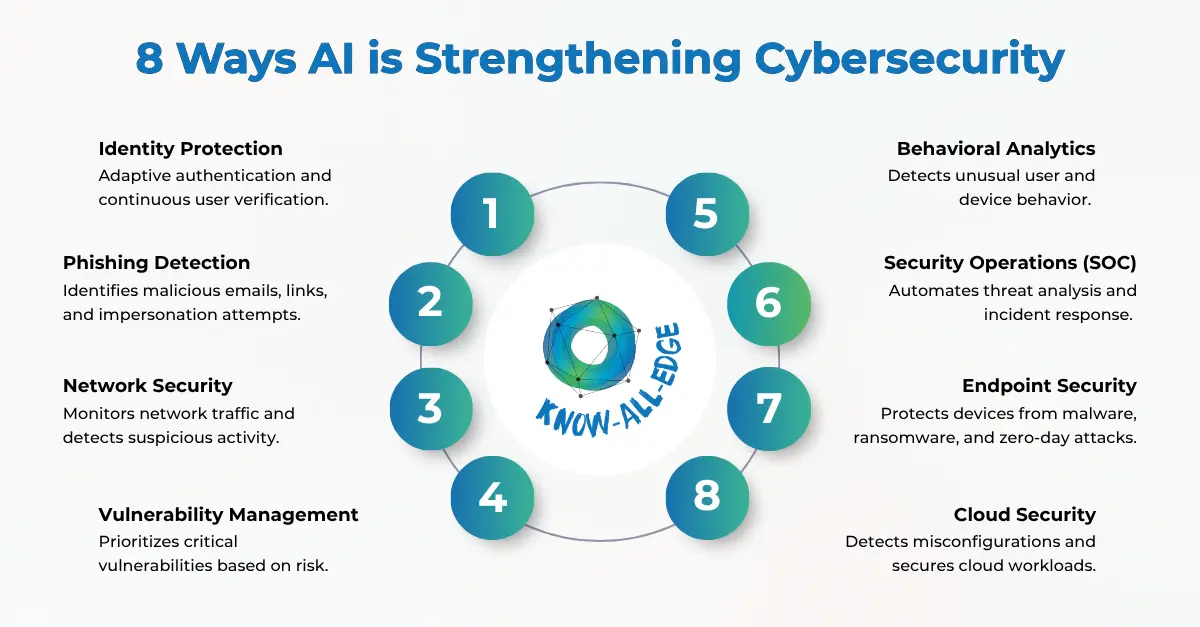
Identity Protection and Intelligent Authentication
Identity has become one of the most targeted attack vectors. Stolen credentials remain a leading cause of data breaches, making stronger authentication essential.
AI improves identity security by analyzing behavioral signals rather than relying solely on passwords. It evaluates factors such as login location, device reputation, typing behavior, access time, user habits, and authentication history to determine whether a login attempt appears legitimate.
If something seems unusual, AI can trigger additional authentication methods such as multi-factor authentication (MFA) instead of immediately granting access.
Smarter Phishing Detection
Phishing continues to be one of the easiest ways for attackers to gain initial access.
Modern email security platforms use AI to analyze not only email content but also writing style, sender reputation, domain characteristics, attachments, embedded links, and communication patterns.
Unlike traditional spam filters that rely on fixed rules, AI continuously learns from emerging phishing campaigns. It can detect subtle indicators such as spoofed domains, unusual language patterns, impersonation attempts, and business email compromise attacks before users interact with malicious messages.
As attackers increasingly use generative AI to create highly convincing phishing emails, AI-powered email protection is becoming increasingly important for organizations.
AI in Network Security
One of the most impactful applications of AI is AI in network security.
Enterprise networks have become highly distributed, connecting offices, cloud platforms, remote workers, SaaS applications, branch locations, and connected devices. Monitoring all this traffic manually is no longer practical.
AI analyzes network traffic continuously, establishing a baseline for normal communication patterns. When unusual behavior occurs, such as unexpected lateral movement, abnormal bandwidth usage, unauthorized connections, or suspicious communication between systems, AI can immediately identify and prioritize those events.
This makes artificial intelligence for network security particularly valuable for detecting threats that bypass traditional perimeter defenses.
Over time, AI also helps organizations refine network policies by learning how applications and workloads normally communicate, supporting more effective Zero Trust implementations.
Vulnerability Management
Organizations face thousands of newly disclosed vulnerabilities every year, making it impossible to remediate everything immediately.
AI helps security teams focus on vulnerabilities that present the greatest business risk.
Instead of relying only on severity scores, AI evaluates multiple factors, including exploit availability, asset criticality, exposure, threat intelligence, and attack likelihood. This allows organizations to prioritize remediation efforts where they matter most rather than simply patching vulnerabilities based on published CVSS scores.
The result is a more risk-driven approach to vulnerability management.
Behavioral Analytics
Traditional security tools primarily identify threats based on known attack signatures. However, many modern attacks intentionally avoid known indicators to remain undetected.
Behavioral analytics takes a different approach.
AI continuously builds profiles of normal user, device, and application behavior. Whenever activity significantly deviates from these baselines, AI identifies it as potentially suspicious.
For example, if an employee who typically accesses HR applications suddenly begins downloading engineering documents late at night from an unmanaged device, AI recognizes this as abnormal behavior even if no known malware signature exists.
This makes behavioral analytics particularly effective against insider threats, compromised accounts, and previously unseen attack techniques.
AI-Powered Security Operations
Security analysts spend a considerable amount of time reviewing alerts, gathering evidence, and performing repetitive investigations.
AI is transforming Security Operations Centers by helping analysts work more efficiently.
Modern AI-powered SIEM, XDR, and security analytics platforms automatically correlate events across endpoints, identities, cloud environments, networks, and applications. They summarize incidents, identify affected assets, recommend investigation steps, and prioritize response based on business impact.
How Cybercriminals Are Using AI to Their Advantage
While organizations are investing in AI to strengthen their security, cybercriminals are using the same technology to make attacks faster, cheaper, and more effective. To truly understand the role of AI in cyber security, it’s important to recognize that AI is not only helping defenders. It is also changing the way attackers operate.
So, what is the use of artificial intelligence by attackers? Instead of spending days crafting phishing emails or manually searching for vulnerabilities, attackers can now automate much of the process. AI enables them to create highly personalized phishing campaigns, generate malware code, analyze stolen data, identify weak points in networks, and even develop convincing deepfake audio or video to impersonate executives.
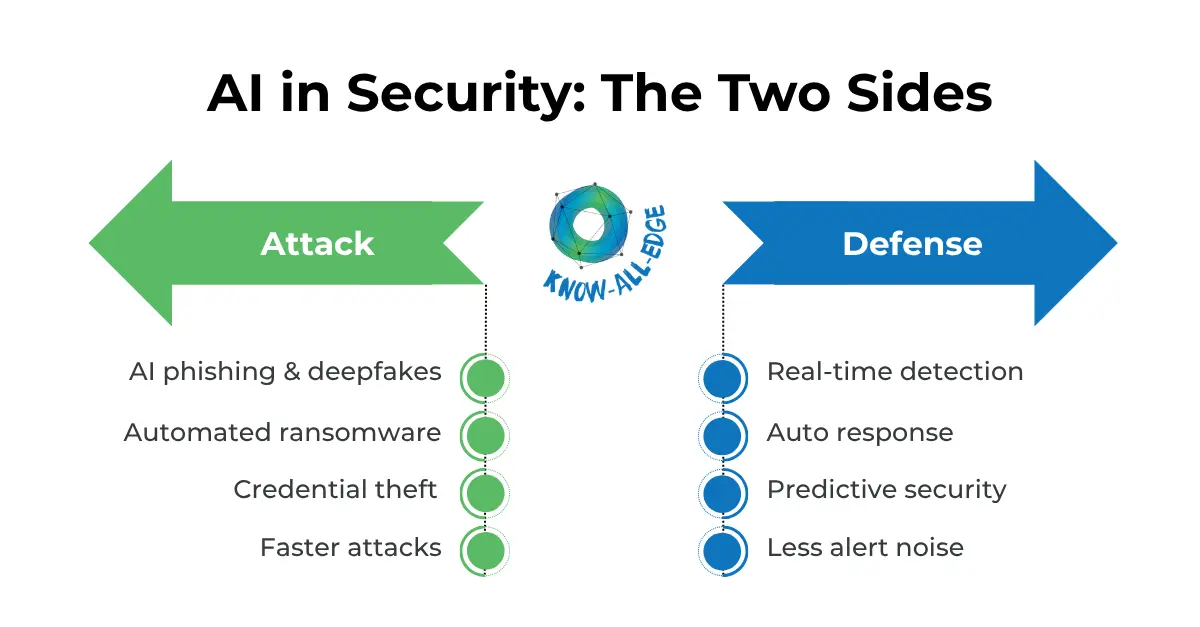
For example, an attacker can use publicly available information from social media, company websites, and professional networking platforms to generate a highly convincing phishing email that appears to come from a trusted colleague. Because AI understands language and writing styles, these emails often contain fewer grammatical errors and are more difficult for employees to identify.
- AI also allows attackers to launch campaigns at a much larger scale. Instead of targeting a handful of individuals, they can generate thousands of customized phishing emails within minutes. This increases the chances of someone clicking a malicious link or sharing sensitive information.
- Another growing concern is AI-assisted malware. Rather than relying on static malware that is easily detected by traditional antivirus tools, attackers are increasingly experimenting with malware that can modify its behavior or adapt its techniques to avoid detection.
- Deepfake technology is another emerging risk. Fraudsters can generate realistic voice recordings or videos that appear to come from senior executives, making social engineering attacks far more convincing. Combined with business email compromise (BEC), these techniques can lead to unauthorized payments, credential theft, or exposure of sensitive business information.
AI has undoubtedly lowered the barrier to entry for cybercrime. Activities that once required advanced technical skills can now be automated, allowing less experienced attackers to launch increasingly sophisticated attacks.
This doesn’t mean AI is making attackers unbeatable. It simply means organizations need to strengthen their defenses with technologies that can detect and respond at the same speed.
Benefits of AI in Cybersecurity
Despite the growing risks, the advantages of artificial intelligence and cybersecurity working together are significant. When implemented correctly, AI helps organizations improve efficiency, reduce response times, and strengthen overall security without replacing human expertise.
- One of the biggest benefits is the ability to analyze enormous volumes of security data in real time. Modern enterprises generate millions of events every day across endpoints, cloud environments, applications, and networks. AI can process this information in seconds, identifying suspicious patterns that would otherwise be impossible to detect manually.
- AI also reduces alert fatigue. Security analysts often spend valuable time reviewing alerts that turn out to be false positives. AI helps prioritize alerts based on risk, allowing security teams to focus on incidents that require immediate attention.
- Another major advantage is faster incident response. AI can automatically isolate compromised devices, block malicious connections, suspend suspicious user sessions, or trigger predefined response workflows before attackers move deeper into the environment.
- AI also supports better vulnerability management by helping organizations prioritize remediation based on business risk rather than simply relying on vulnerability severity scores. This enables security teams to focus their efforts where they can make the greatest impact.
- As organizations continue adopting cloud services, remote work, and digital transformation initiatives, AI provides the visibility and automation needed to manage increasingly complex security environments.
- Most importantly, AI enables security teams to spend less time on repetitive tasks and more time on strategic initiatives such as threat hunting, security architecture, and improving overall cyber resilience.
Challenges and Risks of AI in Cybersecurity
While AI offers tremendous potential, it is not a complete solution to cybersecurity challenges. Like any technology, it has limitations and must be implemented carefully.
- One of the biggest concerns is data quality. AI models learn from the data they receive. If training data is incomplete, outdated, or biased, the system may produce inaccurate results, overlook genuine threats, or generate excessive false positives.
- Another growing challenge is adversarial AI. Attackers are actively researching ways to manipulate AI-powered security systems by feeding them misleading inputs or designing attacks that evade machine learning models. As these techniques evolve, security teams must continuously improve and retrain their AI systems.
- Organizations also need to guard against data poisoning, where attackers intentionally manipulate training data to influence AI decision-making. If successful, this can reduce detection accuracy and create blind spots within security operations.
- Over-reliance on automation presents another risk. AI excels at identifying patterns and processing data, but it cannot fully understand business context, organizational priorities, or unusual situations that require human judgment. Security decisions involving legal implications, business continuity, or regulatory requirements should always involve experienced professionals.
- Transparency is equally important. Many AI systems function as “black boxes,” making it difficult to understand why certain decisions were made. As AI becomes more integrated into cybersecurity operations, organizations should prioritize solutions that provide explainable results and support audit requirements.
- Finally, governance cannot be overlooked. As businesses adopt AI across multiple departments, they must establish clear policies covering responsible AI usage, monitoring, accountability, data protection, and vendor risk management.
Best Practices for Implementing AI in Cybersecurity
Successfully adopting AI requires more than deploying new tools. Organizations need a structured approach that combines technology, people, and governance.
- Start with high-quality, well-maintained data. Since AI relies on accurate information, regularly updating training datasets and validating data sources helps improve detection accuracy.
- Keep humans involved in critical decisions. AI should support analysts rather than replace them. Human expertise remains essential for investigating complex incidents, validating AI-generated recommendations, and making informed business decisions.
- Regularly update AI models to reflect the latest attack techniques. Threat actors continuously adapt their methods, and outdated AI models quickly lose effectiveness.
- Integrate AI across your broader security ecosystem instead of deploying isolated solutions. When AI has visibility across endpoints, identities, networks, cloud environments, and security operations, it can correlate events more effectively and provide stronger protection.
- Organizations should also conduct continuous testing through threat simulations, red teaming, and adversarial exercises to identify weaknesses before attackers exploit them.
- Finally, establish strong AI governance. Define how AI systems are monitored, audited, and maintained, while ensuring compliance with regulatory requirements and internal security policies.
The Future of AI and Cybersecurity
The relationship between AI and cybersecurity will continue to evolve over the coming years. AI will become deeply embedded across security platforms, helping organizations detect threats earlier, automate investigations, improve threat intelligence, and accelerate incident response.
At the same time, attackers will continue using AI to create more sophisticated phishing campaigns, automate reconnaissance, generate malware, and exploit vulnerabilities faster than ever before.
This means organizations cannot rely on AI alone. Success will depend on combining intelligent automation with experienced security professionals, strong governance, continuous monitoring, and well-defined security processes.
Rather than replacing security teams, AI will increasingly act as a trusted assistant, enabling analysts to make faster and more informed decisions while focusing on strategic security initiatives.
Conclusion
The role of AI in cyber security is expanding rapidly. From detecting sophisticated threats and improving vulnerability management to strengthening identity protection and accelerating incident response, AI has become an essential capability for modern security operations.
However, AI is not a silver bullet. As defenders embrace AI, attackers are doing the same. Organizations must therefore balance innovation with governance, combine AI-driven automation with human expertise, and continuously adapt their security strategies to stay ahead of evolving threats.
At Know All Edge, we help organizations strengthen their cybersecurity through the right combination of technology, strategy, and expertise. Whether you’re looking to implement AI-powered security solutions, improve your AI security posture, modernize your SOC, enhance AI in network security, or build long-term cyber resilience, our team works with you to integrate the right solutions into your existing environment and provide ongoing support to keep your defenses ready for tomorrow’s threats.
FAQs on Role of AI in Cybersecurity
What is the role of AI in cyber security?
The role of AI in cyber security is to help organizations detect threats faster, automate repetitive security tasks, identify unusual behavior, prioritize risks, and improve incident response. AI complements security teams by analyzing large volumes of security data that would be difficult to process manually.
What are the biggest risks of using AI in cybersecurity?
While AI strengthens cyber defenses, it also introduces risks such as adversarial AI, data poisoning, model bias, and over-reliance on automation. Organizations should combine AI with strong governance, regular model updates, continuous monitoring, and human oversight to ensure AI-driven decisions remain accurate and trustworthy.
How does AI improve Security Operations Center (SOC) efficiency?
AI helps SOC teams by automating alert correlation, reducing false positives, prioritizing incidents based on risk, and assisting with threat investigations. Instead of spending hours reviewing thousands of alerts, analysts can focus on high-priority incidents and strategic threat hunting. This improves response times while reducing analyst fatigue.
How can organizations securely implement AI in cybersecurity?
Organizations should implement AI with high-quality data, strong governance, continuous model testing, and human oversight. AI should also integrate seamlessly with the existing security ecosystem to deliver maximum value. Know All Edge helps organizations implement and integrate AI-powered cybersecurity solutions while providing ongoing support to ensure they remain secure, effective, and aligned with business needs.


