 Skip to content
You cannot rely on traditional idea of protecting a single perimeter in this modern tech world.
Today, your users, applications, devices, and workloads are spread across on-premises infrastructure, multiple clouds, remote locations, and third-party environments. While this flexibility helps businesses grow, it also creates more opportunities for attackers.
At the same time, cyber threats have come a long way and will get smarter day by day. Ransomware groups, phishing campaigns, zero-day attacks, and advanced persistent threats (APTs) are evolving faster than ever. Security teams are expected to defend increasingly complex environments while dealing with alert overload and a shortage of skilled professionals.
This is where Artificial Intelligence in network security is changing the game.
AI is helping organizations move beyond traditional, reactive defenses. Instead of simply looking for known threats, AI can analyze huge amounts of data, identify unusual behavior, and respond much faster than manual processes.
It gives security teams better visibility, faster response times, and the ability to defend against threats that traditional tools often miss. Let’s learn this in detail.
Why Modern Network Security Is Facing New Challenges
To understand why AI matters, it’s important to understand what has changed. The problem isn’t just that there are more attacks. The entire environment that security teams are protecting has become much more complex.
Expanding Attack Surfaces Across Hybrid and Multi-Cloud Environments
Your employees work remotely. Applications run across public and private clouds. SaaS platforms, IoT devices, and third-party integrations are all connected to your network. Every connection and every device adds another potential entry point for attackers.
As organizations continue to adopt hybrid and multi-cloud environments, maintaining visibility and enforcing consistent security policies becomes increasingly difficult. A single misconfigured cloud resource, exposed API, or forgotten endpoint can provide attackers with everything they need.
Modern networks have become larger and more dynamic, and that means traditional approaches are being stretched beyond their limits.
Sophisticated Threats Are Outpacing Traditional Defenses
Attackers are using advanced techniques designed specifically to bypass signature-based security tools. Some of the most challenging threats include:
- Advanced Persistent Threats (APTs) infiltrate networks and stay quiet for months, moving slowly to avoid triggering alerts
- Polymorphic malware rewrites its own code continuously to avoid matching any known signature
- Living Off the Land (LOTL) attacks use legitimate system tools like PowerShell and WMI, making them nearly indistinguishable from normal admin activity
- Zero-day exploits target vulnerabilities that have no existing patch or detection signature
Traditional security tools are good at recognizing threats they already know. But they struggle when dealing with unknown or constantly evolving attacks.
That’s one of the biggest reasons why organizations are looking at AI-powered security technologies.
Attackers Are Using AI Too
There is another reality that organizations cannot ignore – cybercriminals are using AI as well.
Attackers are leveraging artificial intelligence to create more convincing phishing emails, automate vulnerability discovery, and improve malware capabilities. Generative AI is making social engineering attacks more personalized and harder to detect.
This creates an uneven playing field.
If attackers are using intelligent tools while defenders rely only on static rules and manual analysis, security teams will always be reacting instead of staying ahead.
Artificial Intelligence in network security helps restore that balance by giving defenders the speed and intelligence needed to fight back.
Why Organizations Need AI in Network Security
Modern security isn’t just about stopping attacks. It’s about responding fast, reducing damage, and maintaining business continuity.
That’s exactly why organizations are turning to Artificial Intelligence in network security.
Moving From Reactive Security to Proactive Defense
Traditional security often works in a reactive way.
A threat enters the environment, an alert gets generated, and then someone investigates it. By the time analysts understand what’s happening, attackers may have already moved deeper into the network.
AI changes this approach.
Instead of waiting for damage to happen, AI continuously learns what normal behavior looks like across users, devices, applications, and systems. When something unusual appears, it can quickly identify the anomaly and raise alerts before the threat escalates.
This allows your organization to become proactive instead of constantly playing catch-up.
The Need for Real-Time Visibility and Faster Response
AI makes continuous monitoring possible. It processes large volumes of information instantly and identifies suspicious activities that would otherwise go unnoticed.
More importantly, AI-driven systems can automate certain response actions, helping security teams contain threats before they spread.
Faster detection means faster remediation, which directly reduces the impact of security incidents.
How AI Helps Security Teams Scale Operations
One of the biggest challenges facing cybersecurity today is the talent shortage.
Security teams are expected to protect more assets, investigate more alerts, and defend against more sophisticated attacks, often without additional staff.
AI helps close that gap.
It doesn’t replace analysts, but it helps them work smarter.
Routine tasks like:
- Alert triage
- Threat classification
- Anomaly detection
- Initial incident response
- Log analysis
can be automated, allowing security professionals to focus on higher-value activities like threat hunting, security strategy, and complex investigations.
This makes security operations more scalable without requiring a proportional increase in headcount.
Also read:
What Is AI Security? Threats, Risks, and Best Practices Explained
The Role of AI in Cybersecurity: How AI is Changing Modern Defense
Importance of Artificial Intelligence in Network Security
The importance of Artificial Intelligence in network security goes far beyond automation. It helps organizations strengthen their overall security posture and improve their ability to deal with constantly changing threats.
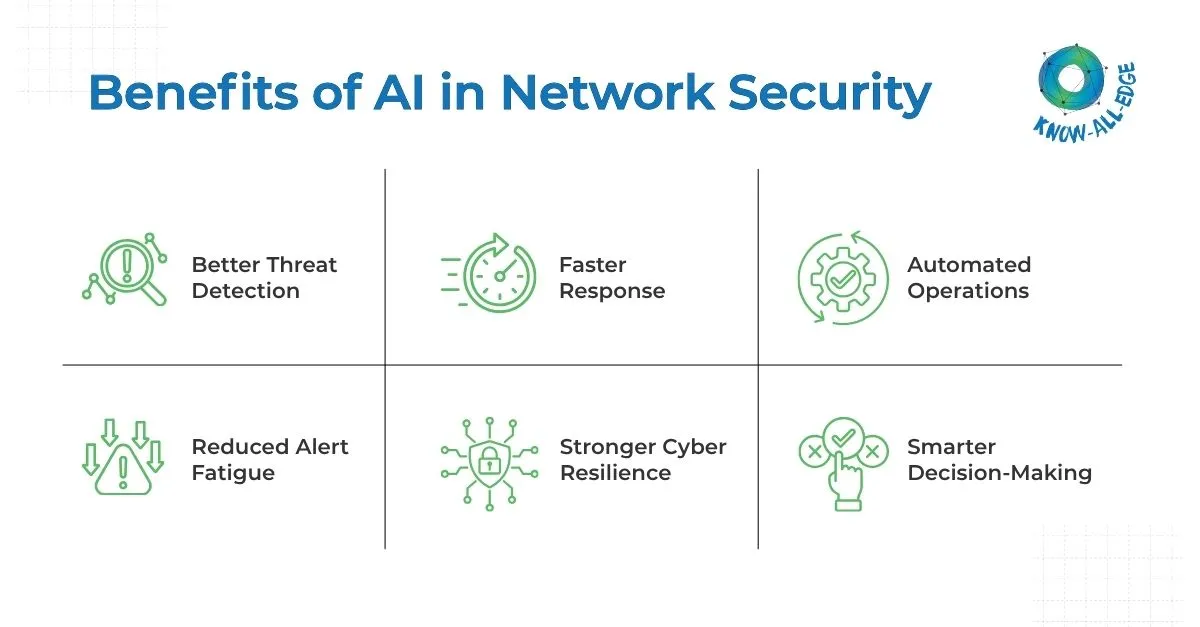
Better Threat Detection
Traditional tools rely heavily on known attack signatures. AI takes a different approach.
It analyzes user behavior, network traffic, endpoint activity, and other data sources to understand what “normal” looks like. When something falls outside those patterns, AI can quickly recognize that something may be wrong.
This makes it much more effective against unknown threats and advanced attacks.
Faster Response and Fewer Human Errors
Manual investigations take time, and under pressure, mistakes can happen.
AI-powered systems can automatically isolate compromised devices, block malicious traffic, or revoke suspicious access privileges within seconds.
Automation reduces response times while minimizing the risk of human error during critical situations.
Improved Efficiency and Lower Costs
Security teams are often overwhelmed by thousands of alerts every day.
AI helps prioritize genuine threats and filters out noise, reducing alert fatigue and improving operational efficiency.
By preventing incidents and speeding up response, organizations can also reduce the financial impact associated with cyberattacks.
Stronger Cyber Resilience
No security system can guarantee that attacks will never happen.
That’s why cyber resilience is becoming just as important as prevention.
AI strengthens cyber resilience by helping organizations detect attacks earlier, limit their spread, and recover faster. Even if attackers get inside, intelligent detection and automated response capabilities can significantly reduce damage.
Better Decision-Making
AI brings together information from multiple sources and transforms it into actionable insights.
Instead of relying on guesswork, security teams can make informed decisions based on real-time intelligence and contextual data.
This enables organizations to continuously improve their defenses and adapt to changing risks.
Traditional Network Security vs. AI-Driven Network Security
For years, firewalls, antivirus solutions, and intrusion detection systems have formed the foundation of network defense. However, modern threats are evolving faster than traditional approaches can adapt. That’s why the role of AI in network security is becoming increasingly important.
Aspect | Traditional Network Security | AI-Driven Network Security |
Detection Method | Signature-based and rule-driven | Behavioral analytics and machine learning |
Threat Coverage | Known threats | Known and unknown threats, including zero-days and APTs |
Approach | Reactive | Proactive |
Monitoring | Periodic or manual | Continuous and real-time |
Alert Management | High volume and false positives | Prioritized alerts with contextual insights |
Response Speed | Manual and slower | Automated and faster |
Adaptability | Static rules require frequent updates | Learns and adapts over time |
Scalability | Limited by team size | Handles large-scale environments efficiently |
Threat Investigation | Human-driven | AI-assisted with automated analysis |
Human Role | Performs most operational tasks | Focuses on strategy and complex investigations |
AI is not a replacement for security teams; it is a force multiplier. AI provides speed, scale, and automation, while human analysts contribute contextual judgment, creative investigation, and strategic decision-making. The most effective security operations combine both, allowing AI to handle volume and humans to handle complexity.
Key Applications of AI in Network Security
AI-Powered Network Monitoring
AI-powered network monitoring provides continuous, real-time visibility across your entire infrastructure – on-premises, cloud, and hybrid environments. It tracks traffic patterns, detects misconfigurations, highlights vulnerable assets, and surfaces anomalies before they escalate.
AI-powered firewalls extend this capability by moving beyond static rule sets. Rather than enforcing predefined policies, they dynamically adjust based on evolving traffic patterns, learn from historical data, and strengthen network perimeters without constant manual tuning.
AI-Based Threat and Anomaly Detection
One of the biggest strengths of Artificial Intelligence in network security is its ability to detect threats that traditional tools may miss.
AI establishes behavioral baselines and continuously compares current activity against them. This makes it easier to identify suspicious behavior early.
Examples include:
- Access requests outside normal working hours.
- Unusual login patterns.
- Unexpected data transfers.
- Privileged account misuse.
- Lateral movement inside the network.
AI is particularly effective at detecting stealthy threats like Advanced Persistent Threats (APTs), which often remain hidden for long periods.
Another advantage is reduced false positives. Instead of overwhelming analysts with thousands of alerts, AI helps prioritize the events that truly matter.
AI-Powered Automated Response
AI automated response systems can execute containment actions, like isolating infected devices, blocking malicious IP addresses, revoking compromised credentials, within seconds of detecting a threat. SOAR platforms powered by AI trigger predefined playbooks tailored to specific threat types, bringing consistency and speed to incident management.
This doesn’t just limit damage. It also addresses the talent shortage by reducing reliance on human resources for routine containment tasks, freeing analysts for higher-value work.
AI-Driven Vulnerability Management
Traditional vulnerability scans generate lengthy lists of issues, leaving security teams overwhelmed and unable to prioritize effectively. AI addresses this by adding context – using predictive modeling to assess how likely each vulnerability is to be exploited, what the potential impact would be, and what the most efficient remediation path looks like.
This allows organizations to focus remediation resources where they matter most, rather than chasing low-severity issues while critical exposures remain unaddressed.
AI-Powered Access Control and Zero Trust
Traditional access controls are often based on static permissions. Once users are authenticated, they receive access according to predefined roles.
AI introduces a more intelligent approach.
It continuously evaluates:
- Device health
- User behavior
- Geographic location
- Time of access
- Risk scores
If unusual behavior is detected, additional verification methods such as multi-factor authentication can be enforced automatically.
This aligns naturally with Zero Trust principles, where trust is continuously validated rather than assumed.
AI and Phishing Detection
AI has transformed what’s possible in phishing detection. Natural language processing models evaluate email tone, phrasing, and social engineering signals that traditional spam filters miss. Computer vision identifies fake login pages that impersonate legitimate services.
Together, these capabilities catch sophisticated spear-phishing attempts that bypass gateway filters, automatically quarantine suspicious content, and adapt as attackers refine their tactics.
Generative AI Security Assistants
Generative AI is emerging as a meaningful force multiplier for security teams. GenAI assistants allow analysts to query security systems in natural language, receive instant contextual summaries of threat intelligence, get AI-generated remediation recommendations, and draft incident reports without manually combing through logs.
This capability helps bridge the talent gap by amplifying the efficiency of existing staff and making sophisticated analysis accessible to analysts who may not have deep specialization in every threat domain.
AI and Network Segmentation: Strengthening Containment Strategies
When combined with AI, network segmentation becomes much more intelligent and dynamic.
Why Network Segmentation Matters
Network segmentation divides a network into separate sections so that if one area is compromised, the attack cannot easily spread to the rest of the environment. This helps contain threats and prevents a single breach from affecting the entire network.
How AI Improves Segmentation
Traditional segmentation relies heavily on static rules. But modern environments change constantly, making manual segmentation difficult to maintain.
AI makes segmentation smarter by continuously analyzing traffic patterns and understanding how systems normally communicate.
It can:
- Identify unnecessary connections between systems.
- Recommend microsegmentation policies.
- Detect abnormal communication between segments.
- Automatically adjust policies when risks change.
This creates a more adaptive and resilient network architecture.
Limiting Lateral Movement During Cyberattacks
One of the most dangerous phases of a cyberattack is lateral movement, when an attacker who has gained an initial foothold moves through the network to reach higher-value targets. Detecting this is difficult because lateral movement often uses legitimate tools and protocols.
AI monitors traffic between segments in real time and can detect the subtle behavioral indicators of lateral movement:
- unusual authentication events
- access to systems outside expected communication paths
- credential usage patterns that don’t match normal behavior
When these signals appear, AI can trigger automatic isolation of affected segments to contain the threat before it spreads.
AI, Zero Trust, and Intelligent Segmentation
Zero Trust architecture operates on the principle that no user or device should be trusted by default, regardless of network location. AI-enhanced segmentation aligns directly with this model by continuously validating which users and systems should be able to reach which resources, and enforcing restrictions dynamically rather than relying on static policies that can quickly become outdated.
Together, AI and Zero Trust create a layered containment strategy: if prevention fails, intelligent segmentation limits what an attacker can access, and AI-driven monitoring ensures lateral movement is detected and stopped quickly.
Future Trends in AI-Powered Network Security
AI-Driven Autonomous Security Operations
Autonomous security operations, where AI systems detect, analyze, and respond to threats with minimal human intervention, are becoming more prevalent. This doesn’t mean removing humans from the equation, but it does mean AI handling more of the operational response cycle automatically, with humans focused on oversight, strategy, and complex edge cases.
AI and Zero Trust Will Become More Connected
As Zero Trust adoption grows, AI will play a bigger role in continuous verification.
Organizations will rely more on AI to evaluate users, devices, and behaviors in real time, making Zero Trust architectures more practical and scalable.
The Rise of Generative AI in Cybersecurity
Generative AI is moving quickly from experimentation to practical deployment in security operations. Beyond the security assistant use cases available today, future applications include automated threat hunting, AI-generated defensive playbooks, and generative models that can simulate novel attack patterns to stress-test defenses. Security teams that build fluency with generative AI tools now will be better positioned as these capabilities mature.
Conclusion
Cyber threats are evolving faster than ever, and traditional security approaches are struggling to keep pace. As networks become more distributed and attack techniques become more sophisticated, organizations need defenses that are intelligent, adaptive, and capable of operating at machine speed.
That’s exactly where Artificial Intelligence in network security delivers value.
From real-time monitoring and advanced threat detection to automated response and intelligent segmentation, AI is helping organizations improve visibility, strengthen cyber resilience, and respond faster to modern threats.
But successful adoption is about more than buying new tools. It requires the right architecture, proper integration, and ongoing optimization.
At Know All Edge, we help organizations implement and integrate modern cybersecurity solutions that fit their environments and security goals. From deploying advanced AI security tools to providing continuous support and optimization, our team works alongside you to build stronger, more resilient defenses that evolve with the threat landscape.
Ready to put AI to work for your security operations? Reach out to Know All Edge for expert guidance.
FAQs: AI in Network Security
What is the role of AI in network security?
AI helps security teams monitor network activity, detect unusual behavior, identify and prioritize threats, automate initial responses, and provide actionable insights. It handles the speed and scale that human analysts cannot manage alone, allowing security professionals to focus on investigation and strategic decision-making.
Which AI is best for network security management?
There is no single best AI solution. The ideal setup depends on your environment and security goals. Most organizations use a combination of AI-powered tools, such as SIEM platforms for threat detection, SOAR solutions for automation, EDR tools for endpoint protection, and threat intelligence platforms for advanced analysis. Success depends on how well these tools integrate with your existing infrastructure.
Why is AI important in network security?
Modern cyber threats are faster, more complex, and more frequent than traditional defenses can handle alone. AI enables real-time threat detection, behavioral analysis, and automated response, helping organizations identify and contain attacks more quickly. Studies have shown that organizations using AI-powered security operations can reduce breach response times and lower incident costs.
What are the biggest challenges of implementing AI in network security?
Common challenges include:
- Poor-quality or incomplete training data
- Integration with legacy security infrastructure
- Adversarial attacks designed to evade AI systems
- Limited transparency in some AI-driven decisions
- The need for skilled human oversight and continuous tuning
While these challenges require careful planning, they do not outweigh the significant security benefits AI can provide.


